• Wyszukiwanie zaawansowane
  • Kategorie
  • Kategorie BISAC
  • Książki na zamówienie
  • Promocje
  • Granty
  • Książka na prezent
  • Opinie
  • Pomoc
  • Załóż konto
  • Zaloguj się

Machine Learning Algorithms: Adversarial Robustness in Signal Processing » książka


zaloguj się | załóż konto
Logo Krainaksiazek.pl

koszyk

konto

szukaj
topmenu
Księgarnia internetowa
Szukaj
Książki na zamówienie
Promocje
Granty
Książka na prezent
Moje konto
Pomoc
 
 
Wyszukiwanie zaawansowane
Pusty koszyk
Bezpłatna dostawa dla zamówień powyżej 20 złBezpłatna dostawa dla zamówień powyżej 20 zł

Kategorie główne

• Nauka
 [2952079]
• Literatura piękna
 [1850969]

  więcej...
• Turystyka
 [71058]
• Informatyka
 [151066]
• Komiksy
 [35579]
• Encyklopedie
 [23181]
• Dziecięca
 [620496]
• Hobby
 [139036]
• AudioBooki
 [1646]
• Literatura faktu
 [228729]
• Muzyka CD
 [379]
• Słowniki
 [2932]
• Inne
 [445708]
• Kalendarze
 [1409]
• Podręczniki
 [164793]
• Poradniki
 [480107]
• Religia
 [510956]
• Czasopisma
 [511]
• Sport
 [61267]
• Sztuka
 [243299]
• CD, DVD, Video
 [3411]
• Technologie
 [219640]
• Zdrowie
 [100984]
• Książkowe Klimaty
 [124]
• Zabawki
 [2281]
• Puzzle, gry
 [3363]
• Literatura w języku ukraińskim
 [258]
• Art. papiernicze i szkolne
 [8020]
Kategorie szczegółowe BISAC

Machine Learning Algorithms: Adversarial Robustness in Signal Processing

ISBN-13: 9783031163746 / Angielski / Twarda / 2022 / 104 str.
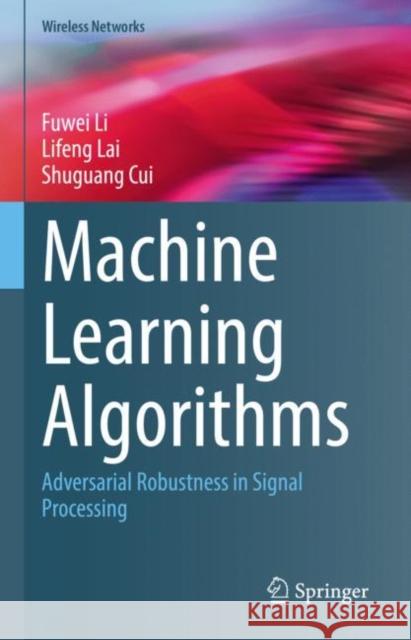
Fuwei Li; Lifeng Lai; Shuguang Cui
Machine Learning Algorithms: Adversarial Robustness in Signal Processing Fuwei Li Lifeng Lai Shuguang Cui 9783031163746 Springer - książkaWidoczna okładka, to zdjęcie poglądowe, a rzeczywista szata graficzna może różnić się od prezentowanej.

Machine Learning Algorithms: Adversarial Robustness in Signal Processing

ISBN-13: 9783031163746 / Angielski / Twarda / 2022 / 104 str.

Fuwei Li; Lifeng Lai; Shuguang Cui
cena 564,88
(netto: 537,98 VAT:  5%)

Najniższa cena z 30 dni: 539,74
Termin realizacji zamówienia:
ok. 22 dni roboczych.

Darmowa dostawa!
inne wydania

This book demonstrates the optimal adversarial attacks against several important signal processing algorithms. Through presenting the optimal attacks in wireless sensor networks, array signal processing, principal component analysis, etc, the authors reveal the robustness of the signal processing algorithms against adversarial attacks. Since data quality is crucial in signal processing, the adversary that can poison the data will be a significant threat to signal processing. Therefore, it is necessary and urgent to investigate the behavior of machine learning algorithms in signal processing under adversarial attacks.The authors in this book mainly examine the adversarial robustness of three commonly used machine learning algorithms in signal processing respectively: linear regression, LASSO-based feature selection, and principal component analysis (PCA). As to linear regression, the authors derive the optimal poisoning data sample and the optimal feature modifications, and also demonstrate the effectiveness of the attack against a wireless distributed learning system. The authors further extend the linear regression to LASSO-based feature selection and study the best strategy to mislead the learning system to select the wrong features. The authors find the optimal attack strategy by solving a bi-level optimization problem and also illustrate how this attack influences array signal processing and weather data analysis. In the end, the authors consider the adversarial robustness of the subspace learning problem. The authors examine the optimal modification strategy under the energy constraints to delude the PCA-based subspace learning algorithm.This book targets researchers working in machine learning, electronic information, and information theory as well as advanced-level students studying these subjects. R&D engineers who are working in machine learning, adversarial machine learning, robust machine learning, and technical consultants working on the security and robustness of machine learning are likely to purchase this book as a reference guide.


This book demonstrates the optimal adversarial attacks against several important signal processing algorithms. Through presenting the optimal attacks in wireless sensor networks, array signal processing, principal component analysis, etc, the authors reveal the robustness of the signal processing algorithms against adversarial attacks. Since data quality is crucial in signal processing, the adversary that can poison the data will be a significant threat to signal processing. Therefore, it is necessary and urgent to investigate the behavior of machine learning algorithms in signal processing under adversarial attacks.

The authors in this book mainly examine the adversarial robustness of three commonly used machine learning algorithms in signal processing respectively: linear regression, LASSO-based feature selection, and principal component analysis (PCA). As to linear regression, the authors derive the optimal poisoning data sample and the optimal feature modifications, and also demonstrate the effectiveness of the attack against a wireless distributed learning system. The authors further extend the linear regression to LASSO-based feature selection and study the best strategy to mislead the learning system to select the wrong features. The authors find the optimal attack strategy by solving a bi-level optimization problem and also illustrate how this attack influences array signal processing and weather data analysis. In the end, the authors consider the adversarial robustness of the subspace learning problem. The authors examine the optimal modification strategy under the energy constraints to delude the PCA-based subspace learning algorithm.

This book targets researchers working in machine learning, electronic information, and information theory as well as advanced-level students studying these subjects. R&D engineers who are working in machine learning, adversarial machine learning, robust machine learning, and technical consultants working on the security and robustness of machine learning are likely to purchase this book as a reference guide.

Kategorie:
Informatyka, Bazy danych
Kategorie BISAC:
Computers > Artificial Intelligence - General
Technology & Engineering > Mobile & Wireless Communications
Mathematics > Prawdopodobieństwo i statystyka
Wydawca:
Springer
Seria wydawnicza:
Wireless Networks
Język:
Angielski
ISBN-13:
9783031163746
Rok wydania:
2022
Dostępne języki:
Numer serii:
000784407
Ilość stron:
104
Waga:
0.34 kg
Wymiary:
23.39 x 15.6 x 0.79
Oprawa:
Twarda
Dodatkowe informacje:
Wydanie ilustrowane

Chapter. 1. Introduction

Chapter. 2. Optimal Feature Manipulation Attacks Against Linear Regression
Chapter. 3. On the Adversarial Robustness of LASSO Based Feature Selection
Chapter. 4. On the Adversarial Robustness of Subspace Learning
Chapter. 5. Summary and Extensions
Chapter. 6. Appendix

​Fuwei Li received his B.S. and M.S. degrees from University of Electronic Science and Technology of China, Sichuan, China, in 2012 and 2015, respectively. During that time, his research focused on sparse signal processing and Bayesian compressed sensing. He received his Ph.D. degree from University of California, Davis, CA, in 2021. During his Ph.D. study, he mainly focused on the adversarial robustness of machine learning algorithms. Now, he is a scientist of AI perception algorithm at Black Sesame Tech. Inc.

Lifeng Lai received the B.E. and M. E. degrees from Zhejiang University, Hangzhou, China in 2001 and 2004 respectively, and the PhD degree from The Ohio State University at Columbus, OH, in 2007. He was a postdoctoral research associate at Princeton University from 2007 to 2009, an assistant professor at University of Arkansas, Little Rock from 2009 to 2012, and an assistant professor at Worcester Polytechnic Institute from 2012 to 2016. He joined the Department of Electrical and Computer Engineering at University of California, Davis as an associate professor in 2016, and was promoted to professor in 2020. His current research interest includes information theory, stochastic signal processing, machine learning and their applications. Dr. Lai was a Distinguished University Fellow of the Ohio State University from 2004 to 2007. He is a co-recipient of the Best Paper Award from IEEE Global Communications Conference (Globecom) in 2008, the Best Paper Award from IEEE Conference on Communications (ICC) in 2011 and the Best Paper Award from IEEE Smart Grid Communications (SmartGridComm) in 2012. He received the National Science Foundation CAREER Award in 2011 and Northrop Young Researcher Award in 2012. He served as a Guest Editor for IEEE Journal on Selected Areas in Communications, Special Issue on Signal Processing Techniques for Wireless Physical Layer Security from 2012 to 2013, an editor for IEEE Transactions on Wireless Communications from 2013 to 2018, and an associate editor for IEEE Transactions on Information Forensics and Security from 2015 to 2020. He is currently serving as an associate editor for IEEE Transactions on Information Theory, IEEE Transactions on Mobile Computing and IEEE Transactions on Signal and Information Processing over Networks.
Shuguang Cui received his Ph.D in Electrical Engineering from Stanford University, California, USA, in 2005. Afterwards, he has been working as assistant, associate, full, Chair Professor in Electrical and Computer Engineering at the Univ. of Arizona, Texas A&M University, UC Davis, and CUHK at Shenzhen respectively. He has also served as the Executive Dean for the School of Science and Engineering at CUHK, Shenzhen, the Director for the Future Network of Intelligence Institute, and the Executive Vice Director at Shenzhen Research Institute of Big Data. His current research interests focus on data driven large-scale system control and resource management, large data set analysis, IoT system design, energy harvesting based communication system design, and cognitive network optimization. He was selected as the Thomson Reuters Highly Cited Researcher and listed in the Worlds’ Most Influential Scientific Minds by ScienceWatch in 2014. He was the recipient of the IEEE Signal Processing Society 2012 Best Paper Award. He has served as the general co-chair and TPC co-chairs for many IEEE conferences. He has also been serving as the area editor for IEEE Signal Processing Magazine, and associate editors for IEEE Transactions on Big Data, IEEE Transactions on Signal Processing, IEEE JSAC Series on Green Communications and Networking, and IEEE Transactions on Wireless Communications. He has been the elected member for IEEE Signal Processing Society SPCOM Technical Committee (2009~2014) and the elected Chair for IEEE ComSoc Wireless Technical Committee (2017~2018). He is a member of the Steering Committee for IEEE Transactions on Big Data and the Chair of the Steering Committee for IEEE Transactions on Cognitive Communications and Networking. He was also a member of the IEEE ComSoc Emerging Technology Committee. He was elected as an IEEE Fellow in 2013, an IEEE ComSoc Distinguished Lecturer in 2014, and IEEE VT Society Distinguished Lecturer in 2019. He has won the IEEE ICC best paper award, ICIP best paper finalist, and the IEEE Globecom best paper award all in 2020.

This book demonstrates the optimal adversarial attacks against several important signal processing algorithms. Through presenting the optimal attacks in wireless sensor networks, array signal processing, principal component analysis, etc, the authors reveal the robustness of the signal processing algorithms against adversarial attacks. Since data quality is crucial in signal processing, the adversary that can poison the data will be a significant threat to signal processing. Therefore, it is necessary and urgent to investigate the behavior of machine learning algorithms in signal processing under adversarial attacks.

The authors in this book mainly examine the adversarial robustness of three commonly used machine learning algorithms in signal processing respectively: linear regression, LASSO-based feature selection, and principal component analysis (PCA). As to linear regression, the authors derive the optimal poisoning data sample and the optimal feature modifications, and also demonstrate the effectiveness of the attack against a wireless distributed learning system. The authors further extend the linear regression to LASSO-based feature selection and study the best strategy to mislead the learning system to select the wrong features. The authors find the optimal attack strategy by solving a bi-level optimization problem and also illustrate how this attack influences array signal processing and weather data analysis. In the end, the authors consider the adversarial robustness of the subspace learning problem. The authors examine the optimal modification strategy under the energy constraints to delude the PCA-based subspace learning algorithm.

This book targets researchers working in machine learning, electronic information, and information theory as well as advanced-level students studying these subjects. R&D engineers who are working in machine learning, adversarial machine learning, robust machine learning, and technical consultants working on the security and robustness of machine learning are likely to purchase this book as a reference guide.




Udostępnij

Facebook - konto krainaksiazek.pl


Opinie o Krainaksiazek.pl na Opineo.pl

Partner Mybenefit

Krainaksiazek.pl w programie rzetelna firma Krainaksiaze.pl - płatności przez paypal

Czytaj nas na:

Facebook - krainaksiazek.pl
  • książki na zamówienie
  • granty
  • książka na prezent
  • kontakt
  • pomoc
  • opinie
  • regulamin
  • polityka prywatności

Zobacz:

  • Księgarnia czeska

  • Wydawnictwo Książkowe Klimaty

1997-2025 DolnySlask.com Agencja Internetowa

© 1997-2022 krainaksiazek.pl
     
KONTAKT | REGULAMIN | POLITYKA PRYWATNOŚCI | USTAWIENIA PRYWATNOŚCI
Zobacz: Księgarnia Czeska | Wydawnictwo Książkowe Klimaty | Mapa strony | Lista autorów
KrainaKsiazek.PL - Księgarnia Internetowa

Polityka prywatnosci - link
Krainaksiazek.pl - płatnośc Przelewy24
Przechowalnia Przechowalnia



