• Wyszukiwanie zaawansowane
  • Kategorie
  • Kategorie BISAC
  • Książki na zamówienie
  • Promocje
  • Granty
  • Książka na prezent
  • Opinie
  • Pomoc
  • Załóż konto
  • Zaloguj się

META-X®-Software for Metapopulation Viability Analysis » książka


zaloguj się | załóż konto
Logo Krainaksiazek.pl

koszyk

konto

szukaj
topmenu
Księgarnia internetowa
Szukaj
Książki na zamówienie
Promocje
Granty
Książka na prezent
Moje konto
Pomoc
 
 
Wyszukiwanie zaawansowane
Pusty koszyk
Bezpłatna dostawa dla zamówień powyżej 20 złBezpłatna dostawa dla zamówień powyżej 20 zł

Kategorie główne

• Nauka
 [2949965]
• Literatura piękna
 [1857847]

  więcej...
• Turystyka
 [70818]
• Informatyka
 [151303]
• Komiksy
 [35733]
• Encyklopedie
 [23180]
• Dziecięca
 [617748]
• Hobby
 [139972]
• AudioBooki
 [1650]
• Literatura faktu
 [228361]
• Muzyka CD
 [398]
• Słowniki
 [2862]
• Inne
 [444732]
• Kalendarze
 [1620]
• Podręczniki
 [167233]
• Poradniki
 [482388]
• Religia
 [509867]
• Czasopisma
 [533]
• Sport
 [61361]
• Sztuka
 [243125]
• CD, DVD, Video
 [3451]
• Technologie
 [219309]
• Zdrowie
 [101347]
• Książkowe Klimaty
 [123]
• Zabawki
 [2362]
• Puzzle, gry
 [3791]
• Literatura w języku ukraińskim
 [253]
• Art. papiernicze i szkolne
 [7933]
Kategorie szczegółowe BISAC

META-X®-Software for Metapopulation Viability Analysis

ISBN-13: 9783642629068 / Angielski / Miękka / 2014 / 195 str.
Karin Frank;Helmut Lorek;Frank Köster
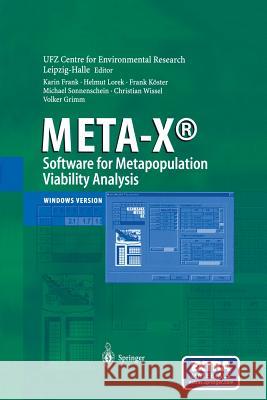
META-X®-Software for Metapopulation Viability Analysis Karin Frank, Helmut Lorek, Frank Köster, Michael Sonnenschein, Christian Wissel, Volker Grimm, UFZ-Centre for Environmen 9783642629068 Springer-Verlag Berlin and Heidelberg GmbH &  - książkaWidoczna okładka, to zdjęcie poglądowe, a rzeczywista szata graficzna może różnić się od prezentowanej.

META-X®-Software for Metapopulation Viability Analysis

ISBN-13: 9783642629068 / Angielski / Miękka / 2014 / 195 str.

Karin Frank;Helmut Lorek;Frank Köster
cena 201,72 zł
(netto: 192,11 VAT:  5%)

Najniższa cena z 30 dni: 192,74 zł
Termin realizacji zamówienia:
ok. 22 dni roboczych
Bez gwarancji dostawy przed świętami

Darmowa dostawa!

Meta-X is a user-friendly computer program that allows students, teachers, and researchers to perform a metapopulation viability analysis i.e. to assess the extinction risk of (meta)populations on discrete, partially isolated patches of habitat, in a comfortable way. The CD comes with an extensive handbook which explains the basic concept of the program and takes you on a guided tour through a model experiment. It further provides the necessary scientific background on both metapopulation dynamics and population viability analysis.
A special feature of Meta-X is that it supports comparative analyses of alternative scenarios. This predestines Meta-X to serve as an aid for decision making in conservation management and landscape planning. Furthermore, handbook and software together provide an invaluable help in research and teaching.


Kategorie:
Informatyka, Bazy danych
Kategorie BISAC:
Science > Life Sciences - Ecology
Computers > Computer Science
Science > Botanika
Wydawca:
Springer-Verlag Berlin and Heidelberg GmbH &
Język:
Angielski
ISBN-13:
9783642629068
Rok wydania:
2014
Dostępne języki:
Angielski
Wydanie:
Softcover Repri
Ilość stron:
195
Waga:
0.33 kg
Wymiary:
23.523.5 x 15.5
Oprawa:
Miękka
Wolumenów:
01

1.1 What Is META-X?.- Metapopulation.- PVA.- Ecological Models.- 1.2 What Is so Special About META-X?.- 1.3 In What Areas Can META-X Be Used?.- In Teaching.- In Empirical Research.- In Biological Conservation and Planning.- 1.4 What Do You Need to Use META-X?.- 1.5 What Cannot Be Done with META-X?.- 1.6 News on META-X.- Installation.- Basic Concepts.- 4.1 The Model.- 4.2 Landscape Structure.- Position of Patches.- Initial Occupancy.- Net of Connections.- 4.3 Patch Characteristics.- Local Extinction Rate.- Number of Emigrants.- Number of Immigrants Needed.- 4.4 Spatial Processes.- Dispersal.- Correlated Extinctions.- 4.5 Simulation.- Control Parameters.- Interactive Simulations.- Automatic Simulations.- 4.6 Evaluation.- 4.7 Organizing Projects.- Scenarios.- Experiments.- Projects.- 4.8 The META-X Steps.- Guided Tour.- 5.1 Your First META-X Experiment.- Defining a New Project.- Creating a New Project by Saving.- Enter Project Documentation.- Creating and Documenting Your First Experiment.- Naming the Species and Delineating the Landscape.- Defining Control Parameters.- Scenario: Documentation and Defining the Landscape.- Patch Characteristics.- Connection Between Patches.- Correlation Length.- Dispersal Range.- Main Model Parameters.- Saving the Project to Your Hard Disk.- 5.2 Interactive Simulation.- Choosing a Scenario.- Interactive Simulation.- Check Parameters.- Pattern of Occupancy.- Modifying the Scenario.- Mean Time to Extinction.- Adding a Second Scenario.- 5.3 Automatic Simulation.- 5.4 Evaluation.- 5.5 Generating a Report.- 5.6 Where Next?.- The Project Tree.- 6.1 The Elements of the Project Tree.- The Root of the Project Tree.- The Experiments Branch.- The Scenarios Branch.- 6.2 Working with the Project Tree.- Working with Experiments.- Working with Scenarios.- Scenarios and Experiments.- 7.1 The Experiment Wizard.- Compile Documentation.- Specify the Species and the Study Area.- Specify Control Parameters.- Specify New Scenario (Based on...).- Modify Existing Scenario.- Complete Definition.- 7.2 The Scenario Wizard.- Documentation of the Scenario.- Number of Patches for a Scenario.- Position of Patches.- Patch Characteristics.- Connection of Patches.- Correlation Length.- Correlation Length (Direct).- Correlation Length (Indirect).- Mean Dispersal Range.- Mean Dispersal Range (Direct).- Mean Dispersal Range (Indirect).- Rates of Colonization.- Main Model Parameters.- Control Parameters for the Whole Experiment.- End of the Scenario Specification.- 7.3 Homogeneous Parameters.- 7.4 User-Defined Scenarios and the Parameter Hierarchy of META-X.- Submodels.- The Standard Submodels of META-X.- User-Defined.- Parameter Hierarchy.- Update Matrix: Warning Message.- Simulation and Evaluation.- 8.1 Interactive Simulation.- Metapopulation Dynamics.- Recorded Data.- Diagrams.- Control Unit.- Further Analysis — FD.- Further Analysis — TM.- Change Scenario.- 8.2 Simulation and Evaluation of Scenarios.- Automatic Simulation.- Evaluation.- 8.3 Simulation and Evaluation of Experiments.- Select Experiments and Scenarios.- Check Control Parameters.- Batch Simulation.- What to Evaluate?.- Evaluation.- The Landscape Editor.- 9.1 Elements of the Landscape Editor.- 9.2 Visualization.- 9.3 Modifying Existing Scenarios.- 9.4 Saving Your Work with the Apply Button.- 9.5 Creating New Scenarios.- Parameter Variation.- 10.1 Variation Experiments.- Creating Variation Experiments (1).- Creating Variation Experiments (2).- Modify Variation Experiments.- Resetting Variation Experiments.- 10.2 Simulation, Evaluation and Reports.- Import, Export and Report.- 11.1 Import of Model Parameters.- Format of Import Files.- 11.2 Export of Simulation Results.- 11.3 Reports.- Report of Scenarios.- Report of Experiments.- Report of Projects.- 11.4 Exporting Graphs to the Clipboard.- Reference.- 12.1 The META-X Menu.- The File Menu.- The Edit Menu.- The View Menu.- The Experiment Menu.- The Scenario Menu.- The Parameter Variation Menu.- The Editor Menu.- The Tools Menu.- The Window Menu.- The Help Menu.- 12.3 Context Menus.- Project Tree.- Landscape Editor.- Evaluation.- 12.4 Warning Messages.- Scenario Wizard Warning Messages.- Landscape Editor Warning Messages.- Interactive Simulation Warning Messages.- Goals, Methods, and Concepts of PVA.- 13.1 Introduction.- 13.2 Goals of PVA.- 13.3 Ecological Models for PVA.- 13.4 A Stochastic Example Model.- 1st Element: Demographic Noise.- 2nd Element: Environmental Noise.- 3rd Density Dependence.- Implementing the Example Model.- Results of the Example Model.- 13.5 Quantifying Persistence and Viability.- Established Phase and Intrinsic Mean Time to Extinction.- Persistence and Viability.- The ln(1-P0) plot.- 13.6 Dealing with Uncertainty.- Relative Risk Assessment.- Sensitivity Analysis.- 13.7 Overview of PVA Models.- 13.8 Potentials and Limitations of PVA.- 13.9 Metapopulation Viability Analysis.- 13.10 Alternatives to Tailored PVA Models.- 13.11 The Conception of META-X.- 13.12 Suggested Reading.- Appendix: Technical Aspects of the ln(1-P0) Plot.- The META-X Model in Detail.- 14.1 Introduction.- 14.2 The Main Model.- Local Extinction.- Correlated Extinction.- Recolonization.- 14.3 The Submodels Provided by META-X.- A Submodel for the Degree of Correlation of Local Extinction.- A Submodel for the Rate of Colonization.- A Submodel for Reachability.- 14.4 Summary and Discussion.- Appendix: the Simulation Algorithm.- Parameterizing META-X.- 15.1 Introduction.- 15.2 General Concepts of Parameterization.- Direct Parameterization of Main Model Parameters.- Indirect Parameterization.- Mechanistic Submodels.- ’soft’ Data, Empirical Knowledge and Hypotheses.- 15.3 Dealing with Uncertainty.- Upper and Lower Boundaries.- Scenarios.- Parameter Variation.- 15.4 Some Specific Guidelines.- Parameterizing the Landscape.- Local Patch Characteristics.- Correlated Extinctions.- Colonization.- 15.5 Summary and Discussion.- Example Applications.- 16.1 Introduction.- 16.2 Examples of Theoretical Problems.- Demonstrating and Analysing the Minimal Dispersal Range.- Increasing the Number of Emigrants from a Certain Patch.- 16.3 Examples of PVA for Specific Metapopulations.- Ecological Uncertainty and the Ranking of Management Options:.- Metapopulation Scenarios of Capercaillie Tetrao urogallus in the Bavarian Alps.- 16.4 Example of Decision Support for Landscape Management.- 16.5 Summary.- References.

Meta-X is a user-friendly computer program that allows students, teachers, and researchers to perform a metapopulation viability analysis i.e. to assess the extinction risk of (meta)populations on discrete, partially isolated patches of habitat, in a comfortable way. The CD comes with an extensive handbook which explains the basic concept of the program and takes you on a guided tour through a model experiment. It further provides the necessary scientific background on both metapopulation dynamics and population viability analysis.
A special feature of Meta-X is that it supports comparative analyses of alternative scenarios. This predestines Meta-X to serve as an aid for decision making in conservation management and landscape planning. Furthermore, handbook and software together provide an invaluable help in research and teaching.

System Requirements:
Windows 95/98, Windows 2000, Windows NT 4.0, or Windows XP, Pentium Processor with a least 133 MHz, 64 MB RAM, 15 MB of free space on hard disk, CD-ROM drive with at least 4x speed, Microsoft Internet Explorer 4.0 or higher.


Udostępnij

Facebook - konto krainaksiazek.pl


Opinie o Krainaksiazek.pl na Opineo.pl

Partner Mybenefit

Krainaksiazek.pl w programie rzetelna firma Krainaksiaze.pl - płatności przez paypal

Czytaj nas na:

Facebook - krainaksiazek.pl
  • książki na zamówienie
  • granty
  • książka na prezent
  • kontakt
  • pomoc
  • opinie
  • regulamin
  • polityka prywatności

Zobacz:

  • Księgarnia czeska

  • Wydawnictwo Książkowe Klimaty

1997-2025 DolnySlask.com Agencja Internetowa

© 1997-2022 krainaksiazek.pl
     
KONTAKT | REGULAMIN | POLITYKA PRYWATNOŚCI | USTAWIENIA PRYWATNOŚCI
Zobacz: Księgarnia Czeska | Wydawnictwo Książkowe Klimaty | Mapa strony | Lista autorów
KrainaKsiazek.PL - Księgarnia Internetowa

Polityka prywatnosci - link
Krainaksiazek.pl - płatnośc Przelewy24
Przechowalnia Przechowalnia




