• Wyszukiwanie zaawansowane
  • Kategorie
  • Kategorie BISAC
  • Książki na zamówienie
  • Promocje
  • Granty
  • Książka na prezent
  • Opinie
  • Pomoc
  • Załóż konto
  • Zaloguj się

Logic for Learning: Learning Comprehensible Theories from Structured Data » książka


zaloguj się | załóż konto
Logo Krainaksiazek.pl

koszyk

konto

szukaj
topmenu
Księgarnia internetowa
Szukaj
Książki na zamówienie
Promocje
Granty
Książka na prezent
Moje konto
Pomoc
 
 
Wyszukiwanie zaawansowane
Pusty koszyk
Bezpłatna dostawa dla zamówień powyżej 20 złBezpłatna dostawa dla zamówień powyżej 20 zł

Kategorie główne

• Nauka
 [2952079]
• Literatura piękna
 [1850969]

  więcej...
• Turystyka
 [71058]
• Informatyka
 [151066]
• Komiksy
 [35579]
• Encyklopedie
 [23181]
• Dziecięca
 [620496]
• Hobby
 [139036]
• AudioBooki
 [1646]
• Literatura faktu
 [228729]
• Muzyka CD
 [379]
• Słowniki
 [2932]
• Inne
 [445708]
• Kalendarze
 [1409]
• Podręczniki
 [164793]
• Poradniki
 [480107]
• Religia
 [510956]
• Czasopisma
 [511]
• Sport
 [61267]
• Sztuka
 [243299]
• CD, DVD, Video
 [3411]
• Technologie
 [219640]
• Zdrowie
 [100984]
• Książkowe Klimaty
 [124]
• Zabawki
 [2281]
• Puzzle, gry
 [3363]
• Literatura w języku ukraińskim
 [258]
• Art. papiernicze i szkolne
 [8020]
Kategorie szczegółowe BISAC

Logic for Learning: Learning Comprehensible Theories from Structured Data

ISBN-13: 9783642075537 / Angielski / Miękka / 2010 / 257 str.
John W. Lloyd
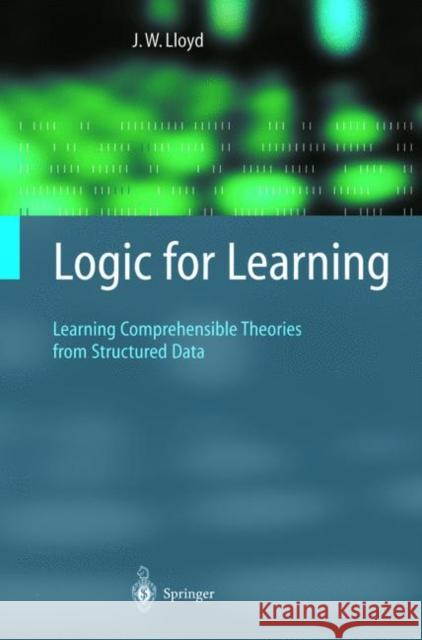
Logic for Learning: Learning Comprehensible Theories from Structured Data John W. Lloyd 9783642075537 Springer-Verlag Berlin and Heidelberg GmbH &  - książkaWidoczna okładka, to zdjęcie poglądowe, a rzeczywista szata graficzna może różnić się od prezentowanej.

Logic for Learning: Learning Comprehensible Theories from Structured Data

ISBN-13: 9783642075537 / Angielski / Miękka / 2010 / 257 str.

John W. Lloyd
cena 201,72
(netto: 192,11 VAT:  5%)

Najniższa cena z 30 dni: 192,74
Termin realizacji zamówienia:
ok. 22 dni roboczych
Dostawa w 2026 r.

Darmowa dostawa!

This book is concerned with the rich and fruitful interplay between the fields of computational logic and machine learning. The intended audience is senior undergraduates, graduate students, and researchers in either of those fields. For those in computational logic, no previous knowledge of machine learning is assumed and, for those in machine learning, no previous knowledge of computational logic is assumed. The logic used throughout the book is a higher-order one. Higher-order logic is already heavily used in some parts of computer science, for example, theoretical computer science, functional programming, and hardware verifica- tion, mainly because of its great expressive power. Similar motivations apply here as well: higher-order functions can have other functions as arguments and this capability can be exploited to provide abstractions for knowledge representation, methods for constructing predicates, and a foundation for logic-based computation. The book should be of interest to researchers in machine learning, espe- cially those who study learning methods for structured data. Machine learn- ing applications are becoming increasingly concerned with applications for which the individuals that are the subject of learning have complex struc- ture. Typical applications include text learning for the World Wide Web and bioinformatics. Traditional methods for such applications usually involve the extraction of features to reduce the problem to one of attribute-value learning.


Kategorie:
Informatyka, Bazy danych
Kategorie BISAC:
Computers > Artificial Intelligence - General
Computers > Computer Science
Computers > Information Theory
Wydawca:
Springer-Verlag Berlin and Heidelberg GmbH &
Seria wydawnicza:
Cognitive Technologies
Język:
Angielski
ISBN-13:
9783642075537
Rok wydania:
2010
Dostępne języki:
Angielski
Numer serii:
000266954
Ilość stron:
257
Waga:
0.45 kg
Wymiary:
23.523.5 x 15.5
Oprawa:
Miękka
Wolumenów:
01
Dodatkowe informacje:
Wydanie ilustrowane

From the reviews of the third edition:

"John has tried his hand at machine learning, and his aim in Logic for Learning is to demonstrate 'the rich and fruitful interplay between the fields of computational logic and machine learning'. ... As such, the book is more geared towards computational logicians who are interested in machine learning ... . The book can also be used as a textbook in a mathematically oriented advanced graduate course. ... it is indeed great stuff, which deserves to be taken serious by any computational logician ... ." (Peter Flach, TLP - Theory and Practice of Logic Programming, Issue 4, 2004)

From the reviews:

"This book provides a systematic approach to knowledge representation, computation, and learning using higher-order logic. It is aimed at researchers, graduate students, and senior undergraduates working in computational logic and/or machine learning." (PHINEWS, Vol. 3, April, 2003)

1. Introduction.- 2. Logic.- 3. Individuals.- 4. Predicates.- 5. Computation.- 6. Learning.- A. Appendix.- A.1 Well-Founded Sets.- References.- Notation.


Udostępnij

Facebook - konto krainaksiazek.pl


Opinie o Krainaksiazek.pl na Opineo.pl

Partner Mybenefit

Krainaksiazek.pl w programie rzetelna firma Krainaksiaze.pl - płatności przez paypal

Czytaj nas na:

Facebook - krainaksiazek.pl
  • książki na zamówienie
  • granty
  • książka na prezent
  • kontakt
  • pomoc
  • opinie
  • regulamin
  • polityka prywatności

Zobacz:

  • Księgarnia czeska

  • Wydawnictwo Książkowe Klimaty

1997-2025 DolnySlask.com Agencja Internetowa

© 1997-2022 krainaksiazek.pl
     
KONTAKT | REGULAMIN | POLITYKA PRYWATNOŚCI | USTAWIENIA PRYWATNOŚCI
Zobacz: Księgarnia Czeska | Wydawnictwo Książkowe Klimaty | Mapa strony | Lista autorów
KrainaKsiazek.PL - Księgarnia Internetowa

Polityka prywatnosci - link
Krainaksiazek.pl - płatnośc Przelewy24
Przechowalnia Przechowalnia






