• Wyszukiwanie zaawansowane
  • Kategorie
  • Kategorie BISAC
  • Książki na zamówienie
  • Promocje
  • Granty
  • Książka na prezent
  • Opinie
  • Pomoc
  • Załóż konto
  • Zaloguj się

Lock-In Thermography: Basics and Use for Evaluating Electronic Devices and Materials » książka

zaloguj się | załóż konto
Logo Krainaksiazek.pl

koszyk

konto

szukaj
topmenu
Księgarnia internetowa
Szukaj
Książki na zamówienie
Promocje
Granty
Książka na prezent
Moje konto
Pomoc
 
 
Wyszukiwanie zaawansowane
Pusty koszyk
Bezpłatna dostawa dla zamówień powyżej 20 złBezpłatna dostawa dla zamówień powyżej 20 zł

Kategorie główne

• Nauka
 [2946600]
• Literatura piękna
 [1856966]

  więcej...
• Turystyka
 [72221]
• Informatyka
 [151456]
• Komiksy
 [35826]
• Encyklopedie
 [23190]
• Dziecięca
 [619653]
• Hobby
 [140543]
• AudioBooki
 [1577]
• Literatura faktu
 [228355]
• Muzyka CD
 [410]
• Słowniki
 [2874]
• Inne
 [445822]
• Kalendarze
 [1744]
• Podręczniki
 [167141]
• Poradniki
 [482898]
• Religia
 [510455]
• Czasopisma
 [526]
• Sport
 [61590]
• Sztuka
 [243598]
• CD, DVD, Video
 [3423]
• Technologie
 [219201]
• Zdrowie
 [101638]
• Książkowe Klimaty
 [124]
• Zabawki
 [2473]
• Puzzle, gry
 [3898]
• Literatura w języku ukraińskim
 [254]
• Art. papiernicze i szkolne
 [8170]
Kategorie szczegółowe BISAC

Lock-In Thermography: Basics and Use for Evaluating Electronic Devices and Materials

ISBN-13: 9783319998244 / Angielski / Twarda / 2019 / 321 str.
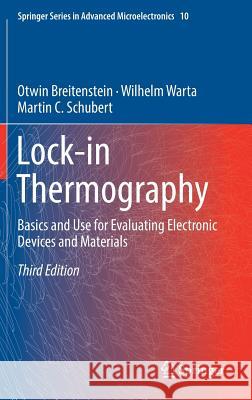
Otwin Breitenstein; Wilhelm Warta; Martin C. Schubert
Lock-In Thermography: Basics and Use for Evaluating Electronic Devices and Materials Breitenstein, Otwin 9783319998244 Springer - książkaWidoczna okładka, to zdjęcie poglądowe, a rzeczywista szata graficzna może różnić się od prezentowanej.

Lock-In Thermography: Basics and Use for Evaluating Electronic Devices and Materials

ISBN-13: 9783319998244 / Angielski / Twarda / 2019 / 321 str.

Otwin Breitenstein; Wilhelm Warta; Martin C. Schubert
cena 645,58 zł
(netto: 614,84 VAT:  5%)

Najniższa cena z 30 dni: 616,85 zł
Termin realizacji zamówienia:
ok. 22 dni roboczych
Bez gwarancji dostawy przed świętami

Darmowa dostawa!

Lock-in Thermography focuses on this sensitive infrared measurement system that offers a more effective analytical capability. Though mainly covering applications in electronic materials and devices, readers will also find treatment of nondestructive evaluation.


Kategorie:
Nauka, Fizyka
Kategorie BISAC:
Technology & Engineering > Lasers & Photonics
Technology & Engineering > Materials Science - General
Technology & Engineering > Microwaves
Wydawca:
Springer
Seria wydawnicza:
Springer Series in Advanced Microelectronics
Język:
Angielski
ISBN-13:
9783319998244
Rok wydania:
2019
Wydanie:
2018
Ilość stron:
321
Waga:
0.65 kg
Wymiary:
23.39 x 15.6 x 2.06
Oprawa:
Twarda
Wolumenów:
01
Dodatkowe informacje:
Wydanie ilustrowane


1. Introduction


2. Physical and Technical Basics

2.1 IR Thermography Basics

2.2 The Lock-in Principle and its Digital Realization

2.3 Lock-in Thermography

2.4 Timing Strategies

2.5 Influence of Non-Harmonic Heating

2.6 Noise Analysis

2.7. Calibration

2.8 Heat Dissipation and Transport Mechanisms in Solar Cells

2.9 Carrier Density Imaging


3. Experimental Technique

3.1 Different (Lock-in) Thermography Realizations

3.2 Commercial Lock-in Thermography Systems

3.3 Illumination Systems

3.4 Solid Immersion Lenses

3.5. Realization of CDI/ILM Systems

3.5.1. Absorption Mode

3.5.2. Emission Mode

3.5.3. Lifetime Calibration


4. Theory

4.1 Influence of the Heat Conduction to the Surrounding

4.2 Temperature Drift Compensation

4.3 Thermal Waves of Point Sources

4.4 Thermal Waves of Extended Sources

4.5 The Quantitative Interpretation of Lock-in Thermograms

4.5.1 The Image Integration / Proportionality Method

4.5.2 Deconvolution of Lock-in Thermograms


5. Measurement Strategies

5.1 Which Signal Should be Displayed?

5.2 Influence of the Lock-in Frequency

5.3 Influence of the IR Emissivity

5.4 Influence of the Peltier Effect


6. Typical Applications

6.1 Integrated Circuits

6.1.1 3D Analysis

6.1.2 IC-Tester Controlled LIT

6.2 Solar Cells

6.2.1 Dark Lock-in Thermography (DLIT)

6.2.1.1 Shunt Imaging

6.2.1.2 High-current DLIT

6.2.1.3 Series Resistance Imaging (RESI)

6.2.1.4 Ideality Factor and Saturation Current Mapping

6.2.1.5 Local I-V curves measured Thermally (LIVT)

6.2.1.6 Reverse-bias DLIT

6.2.1.7 Temperature Coefficient and Slope Imaging

6.2.1.8 DLIT-based Jsc Imaging

6.2.1.9 Local I-V Evaluation

6.2.1.10 LIT and Luminescence Imaging: Comprehensive Loss Analysis

6.2.2 Illuminated Lock-in Thermography (ILIT)

6.2.2.1 Voc-ILIT

6.2.2.2 Jsc-ILIT

6.2.2.3 Rs-ILIT

6.2.2.4 Avalanche Multiplication Factor Imaging (MF-ILIT)

6.2.2.5 ILIT-Based Efficiency Imaging

6.2.2.6 ILIT-Based Jsc Imaging

6.2.2.7 Suns ILIT

6.2.3 Summary of Solar Cell Applications

6.3 Failure Analysis of Solar Modules

6.3.1 Differential ILIT Techniques

6.3.2 Solar Cell Analysis in Modules (SCAM)

6.4 Spin Caloritronics

6.5 CDI/ILM on Solar Materials

6.5.1 Analysis of Material Evaluation During Processing

6.5.1 Temperature-Dependent Measurements

6.5.3 Trap Density Images from CDI/ILM


7. Summary and Outlook


References

Appendix: Thermal and IR Properties of Selected Materials

List of Symbols

Abbreviations

Index 

Dr. Otwin Breitenstein received his Ph.D. in physics from University of Leipzig (Germany) in 1980 with a work on Deep Level Transient Spectroscopy (DLTS). Since 1992 he is with Max Planck Institute of Microstructure Physics, Halle, Germany, where he investigates defects in semiconductors. Since 1999 he has been using lock-in thermography, optical imaging methods, and electron microscopy, for characterizing crystalline solar cells. He is mainly interested in detecting internal shunts and generally evaluating the local efficiency of inhomogeneous silicon solar cells. He is Assistant Professor at University of Halle, Germany, giving lectures on the physics of solar cells and on advanced characterization techniques. He is author of several hundred publications in journals and at conferences and author of a book on "Lock-in Thermography" (Springer 2003, second edition 2010).

Dr. Wilhelm Warta received the Diploma and Ph.D. degrees in physics from the University of Stuttgart, Germany, in 1978 and 1985, respectively. He joined Fraunhofer Institute for Solar Energy Systems, Freiburg, Germany, in 1985, in recent years he acted as Head of the Department Characterization and Simulation/CalLab and the Deputy Director of the Division Silicon Solar Cells—Development and Characterization. He is the author or coauthor of close to 400 papers in reviewed journals and conferences. His research interests include the development of characterization techniques and application to crystalline silicon materials and solar cells, silicon material properties, and the impact on solar cell performance, simulation of solar cells, and cell processing, as well as solar cell calibration with highest precision.

Dr. Martin C. Schubert studied physics at the University of Montpellier, France, and the University of Freiburg, Germany. He was with the Freiburg Materials Research Centre FMF and received the Ph.D. degree in physics in 2008 in collaboration with Fraunhofer ISE from the University of Konstanz, Germany. He has been a Scientist with Fraunhofer ISE since 2008. From 2013 to 2014, he was with Japan Space Exploration Agency and Meiji University, Tokyo, Japan, as a Guest Professor in the frame of a Japan Society for the Promotion of Science research fellowship. He is currently Head of Department “Quality Assurance, Characterization and Simulation” at Fraunhofer ISE. Dr. Schubert received the Ulrich Gösele Young-Scientist-Award in 2013. His main interest is the identification of efficiency limitations of silicon material and solar cells with a focus on spatially resolved analyses based on Luminescence and on Thermography. 

This book discusses lock-in thermography (LIT) as a dynamic variant of the widely known IR thermography. It focuses on applications to electronic devices and materials, but also includes chapters addressing non-destructive evaluation. Periodically modulating heat sources allows a much-improved signal-to-noise ratio (up to 1000x) and a far better lateral resolution compared to steady-state thermography. Reviewing various experimental approaches to LIT, particularly the commercial LIT systems available, this 3rd edition introduces new LIT applications, such as illuminated LIT applied to solar cells, non-thermal LIT lifetime mapping and LIT application to spin caloritronics problems. Numerous LIT investigation case studies are also included.


Udostępnij

Facebook - konto krainaksiazek.pl


Opinie o Krainaksiazek.pl na Opineo.pl

Partner Mybenefit

Krainaksiazek.pl w programie rzetelna firma Krainaksiaze.pl - płatności przez paypal

Czytaj nas na:

Facebook - krainaksiazek.pl
  • książki na zamówienie
  • granty
  • książka na prezent
  • kontakt
  • pomoc
  • opinie
  • regulamin
  • polityka prywatności

Zobacz:

  • Księgarnia czeska

  • Wydawnictwo Książkowe Klimaty

1997-2025 DolnySlask.com Agencja Internetowa

© 1997-2022 krainaksiazek.pl
     
KONTAKT | REGULAMIN | POLITYKA PRYWATNOŚCI | USTAWIENIA PRYWATNOŚCI
Zobacz: Księgarnia Czeska | Wydawnictwo Książkowe Klimaty | Mapa strony | Lista autorów
KrainaKsiazek.PL - Księgarnia Internetowa

Polityka prywatnosci - link
Krainaksiazek.pl - płatnośc Przelewy24
Przechowalnia Przechowalnia







