• Wyszukiwanie zaawansowane
  • Kategorie
  • Kategorie BISAC
  • Książki na zamówienie
  • Promocje
  • Granty
  • Książka na prezent
  • Opinie
  • Pomoc
  • Załóż konto
  • Zaloguj się

Local Quantum Physics: Fields, Particles, Algebras » książka


zaloguj się | załóż konto
Logo Krainaksiazek.pl

koszyk

konto

szukaj
topmenu
Księgarnia internetowa
Szukaj
Książki na zamówienie
Promocje
Granty
Książka na prezent
Moje konto
Pomoc
 
 
Wyszukiwanie zaawansowane
Pusty koszyk
Bezpłatna dostawa dla zamówień powyżej 20 złBezpłatna dostawa dla zamówień powyżej 20 zł

Kategorie główne

• Nauka
 [2946600]
• Literatura piękna
 [1856966]

  więcej...
• Turystyka
 [72221]
• Informatyka
 [151456]
• Komiksy
 [35826]
• Encyklopedie
 [23190]
• Dziecięca
 [619653]
• Hobby
 [140543]
• AudioBooki
 [1577]
• Literatura faktu
 [228355]
• Muzyka CD
 [410]
• Słowniki
 [2874]
• Inne
 [445822]
• Kalendarze
 [1744]
• Podręczniki
 [167141]
• Poradniki
 [482898]
• Religia
 [510455]
• Czasopisma
 [526]
• Sport
 [61590]
• Sztuka
 [243598]
• CD, DVD, Video
 [3423]
• Technologie
 [219201]
• Zdrowie
 [101638]
• Książkowe Klimaty
 [124]
• Zabawki
 [2473]
• Puzzle, gry
 [3898]
• Literatura w języku ukraińskim
 [254]
• Art. papiernicze i szkolne
 [8170]
Kategorie szczegółowe BISAC

Local Quantum Physics: Fields, Particles, Algebras

ISBN-13: 9783540610496 / Angielski / Miękka / 1996 / 390 str.
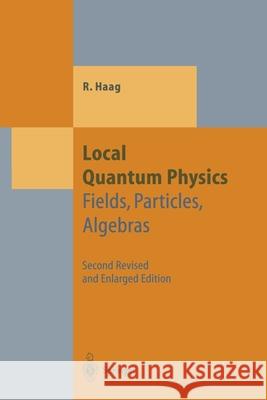
R. Haag; Rudolf Haag
Local Quantum Physics: Fields, Particles, Algebras Haag, Rudolf 9783540610496 Springer - książkaWidoczna okładka, to zdjęcie poglądowe, a rzeczywista szata graficzna może różnić się od prezentowanej.

Local Quantum Physics: Fields, Particles, Algebras

ISBN-13: 9783540610496 / Angielski / Miękka / 1996 / 390 str.

R. Haag; Rudolf Haag
cena 342,95 zł
(netto: 326,62 VAT:  5%)

Najniższa cena z 30 dni: 327,68 zł
Termin realizacji zamówienia:
ok. 22 dni roboczych
Bez gwarancji dostawy przed świętami

Darmowa dostawa!

The new edition provided the opportunity of adding a new chapter entitled "Principles and Lessons of Quantum Physics." It was a tempting challenge to try to sharpen the points at issue in the long lasting debate on the Copenhagen Spirit, to assess the significance of various arguments from our present vantage point, seventy years after the advent of quantum theory, where, after ali, some problems appear in a different light. It includes a section on the assumptions leading to the specific mathematical formalism of quantum theory and a section entitled "The evolutionary picture" describing my personal conclusions. Alto gether the discussion suggests that the conventional language is too narrow and that neither the mathematical nor the conceptual structure are built for eter nity. Future theories will demand radical changes though not in the direction of a return to determinism. Essential lessons taught by Bohr will persist. This chapter is essentially self-contained. Some new material has been added in the last chapter. It concerns the char acterization of specific theories within the general frame and recent progress in quantum field theory on curved space-time manifolds. A few pages on renor malization have been added in Chapter II and some effort has been invested in the search for mistakes and unclear passages in the first edition. The central objective of the book, expressed in the title "Local Quantum Physics," is the synthesis between special relativity and quantum theory to gether with a few other principles of general nature.


Kategorie:
Nauka, Fizyka
Kategorie BISAC:
Science > Fizyka kwantowa
Science > Fizyka matematyczna
Mathematics > Mathematical Analysis
Wydawca:
Springer
Seria wydawnicza:
Texts and Monographs in Physics
Język:
Angielski
ISBN-13:
9783540610496
Rok wydania:
1996
Wydanie:
Revised
Numer serii:
000056444
Ilość stron:
390
Waga:
0.66 kg
Wymiary:
15.6 x 23.5 x 2.2
Oprawa:
Miękka
Wolumenów:
01
Dodatkowe informacje:
Bibliografia

"Indeed, both the expert in the field and the novice will enjoy Haags insightful exposition... This (superb) book is bound to occupy a place on a par with other classics in the mathematical physics literature." Physics Today "...enjoyable reading to anybody interested in the development of fundamental physical theories." Zentralblatt f. Mathematik

I. Background.- 1. Quantum Mechanics.- Basic concepts, mathematical structure, physical interpretation..- 2. The Principle of Locality in Classical Physics and the Relativity Theories.- Faraday’s vision. Fields..- 2.1 Special relativity. Poincaré group. Lorentz group. Spinors. Conformal group..- 2.2 Maxwell theory..- 2.3 General relativity..- 3. Poincaré Invariant Quantum Theory.- 3.1 Geometric symmetries in quantum physics. Projective representations and the covering group..- 3.2 Wigner’s analysis of irreducible, unitary representations of the Poincare group. 3.3 Single particle states. Spin..- 3.4 Many particle states: Bose-Fermi alternative, Fock space, creation operators. Separation of CM-motion..- 4. Action Principle.- Lagrangean. Double rôle of physical quantities. Peierls’ direct definition of Poisson brackets. Relation between local conservation laws and symmetries..- 5. Basic Quantum Field Theory.- 5.1 Canonical quantization..- 5.2 Fields and particles..- 5.3 Free fields..- 5.4 The Maxwell-Dirac system. Gauge invariance..- 5.5 Processes..- II. General Quantum Field Theory.- 1. Mathematical Considerations and General Postulates.- 1.1 The representation problem..- 1.2 Wightman axioms..- 2. Hierarchies of Functions.- 2.1 Wightman functions, reconstruction theorem, analyticity in x-space..- 2.2 Truncated functions, clustering. Generating functionals and linked cluster theorem..- 2.3 Time ordered functions..- 2.4 Covariant perturbation theory, Feynman diagrams. Renormalization..- 2.5 Vertex functions and structure analysis..- 2.6 Retarded functions and analyticity in p-space..- 2.7 Schwinger functions and Osterwalder-Schrader theorem..- 3. Physical Interpretation in Terms of Particles.- 3.1 The particle picture: Asymptotic particle configurations and collision theory..- 3.2 Asymptotic fields. S-matrix..- 3.3 LSZ-formalism..- 4. General Collision Theory.- 4.1 Polynomial algebras of fields. Almost local operators..- 4.2 Construction of asymptotic particle states..- 4.3. Coincidence arrangements of detectors..- 4.4 Generalized LSZ-formalism..- 5. Some Consequences of the Postulates.- 5.1 CPT-operator. Spin-statistics theorem. CPT-theorem..- 5.2 Analyticity of the S-matrix..- 5.3 Reeh-Schlieder theorem..- 5.4 Additivity of the energy-momentum-spectrum..- 5.5 Borchers classes..- III. Algebras of Local Observables and Fields.- 1. Review of the Perspective.- Characterization of the theory by a net of local algebras. Bounded operators. Unobservable fields, superselection rules and the net of abstract algebras of observables. Transcription of the basic postulates..- 2. Von Neumann Algebras. C*-Algebras. W*-Algebras.- 2.1 Algebras of bounded operators. Concrete C*-algebras and von Neumann algebras. Isomorphisms. Reduction. Factors. Classification of factors..- 2.2 Abstract algebras and their representations. Abstract C*-algebras. Relation between the C*-norm and the spectrum. Positive linear forms and states. The GNS-construction. Folia of states. Intertwiners. Primary states and cluster property. Purification. W*-algebras..- 3. The Net of Algebras of Local Observables.- 3.1 Smoothness and integration. Local definiteness and local normality..- 3.2 Symmetries and symmetry breaking. Vacuum states. The spectral ideals..- 3.3 Summary of the structure..- 4. The Vacuum Sector.- 4.1 The orthocomplemented lattice of causally complete regions..- 4.2 The net of von Neumann algebras in the vacuum representation..- IV. Charges, Global Gauge Groups and Exchange Symmetry.- 1. Charge Superselection Sectors.- “Strange statistics”. Charges. Selection criteria for relevant sectors. The program and survey of results..- 2. The DHR-Analysis.- 2.1 Localized morphisms..- 2.2 Intertwiners and exchange symmetry (“Statistics”)..- 2.3 Charge conjugation, statistics parameter..- 2.4 Covariant sectors and energy-momentum spectrum..- 2.5 Fields and collision theory..- 3. The Buchholz-Fredenhagen-Analysis.- 3.1 Localized 1-particle states..- 3.2 BF-topological charges..- 3.3 Composition of sectors and exchange symmetry..- 3.4 Charge conjugation and the absence of “infinite statistics”..- 4. Global Gauge Group and Charge Carrying Fields.- Implementation of endomorphisms. Charges with d = 1. Endomorphisms and non Abelian gauge group. DR categories and the embedding theorem..- 5. Low Dimensional Space-Time and Braid Group Statistics.- Statistics operator and braid group representations. The 2+1-dimensional case with BF-charges. Statistics parameter and Jones index..- V. Thermal States and Modular Automorphisms.- 1. Gibbs Ensembles, Thermodynamic Limit, KMS-Condition.- 1.1 Introduction..- 1.2 Equivalence of KMS-condition to Gibbs ensembles for finite volume..- 1.3 The arguments for Gibbs ensembles..- 1.4 The representation induced by a KMS-state..- 1.5 Phases, symmetry breaking and the decomposition of KMS-states..- 1.6 Variational principles and autocorrelation inequalities..- 2. Modular Automorphisms and Modular Conjugation.- 2.1 The Tomita-Takesaki theorem..- 2.2 Vector representatives of states. Convex cones in H..- 2.3 Relative modular operators and Radon-Nikodym derivatives..- 2.4 Classification of factors..- 3. Direct Characterization of Equilibrium States.- 3.1 Introduction..- 3.2 Stability..- 3.3 Passivity..- 3.4 Chemical potential..- 4. Modular Automorphisms of Local Algebras.- 4.1 The Bisognano-Wichmann theorem..- 4.2 Conformal invariance and the theorem of Hislop and Longo..- 5. Phase Space, Nuclearity, Split Property, Local Equilibrium.- 5.1 Introduction..- 5.2 Nuclearity and split property..- 5.3 Open subsystems..- 5.4 Modular nuclearity..- 6. The Universal Type of Local Algebras.- VI. Particles. Completeness of the Particle Picture.- 1. Detectors, Coincidence Arrangements, Cross Sections.- 1.1 Generalities..- 1.2 Asymptotic particle configurations. Buchholz’s strategy..- 2. The Particle Content.- 2.1 Particles and infraparticles..- 2.2 Single particle weights and their decomposition..- 2.3 Remarks on the particle picture and its completeness..- 3. The Physical State Space of Quantum Electrodynamics.- VII. Principles and Lessons of Quantum Physics. A Review of Interpretations, Mathematical Formalism and Perspectives.- 1. The Copenhagen Spirit. Criticisms, Elaborations.- Niels Bohr’s epistemological considerations. Realism. Physical systems and the division problem. Persistent non-classical correlations. Collective coordinates, decoherence and the classical approximation. Measurements. Correspondence and quantization. Time reflection asymmetry of statistical conclusions..- 2. The Mathematical Formalism.- Operational assumptions. “Quantum Logic”. Convex cones..- 3. The Evolutionary Picture.- Events, causal links and their attributes. Irreversibility. The EPR-effect. Ensembles vs. individuals. Decisions. Comparison with standard procedure..- VIII. Retrospective and Outlook.- 1. Algebraic Approach vs. Euclidean Quantum Field Theory.- 2. Supersymmetry.- 3. The Challenge from General Relativity.- 3.1 Introduction..- 3.2 Quantum field theory in curved space-time..- 3.3 Hawking temperature and Hawking radiation..- 3.4 A few remarks on quantum gravity..- Author Index and References.

This textbook gives a comprehensive account of local quantum physics, understood as the synthesis of quantum theory with the principle of locality. Centered on the algebraic approach it describes the physical concepts, the mathematical structures, and their consequences. These include the emergence of the particle picture, general collision theory covering the cases of massless particles and infraparticles, and the analysis of possible charge structures and exchange symmetries, including braid group statistics. Thermal states of an unbounded medium and local equilibrium are discussed in detail. The author, one of the most original researchers in this field, takes care both to describe the ideas and to give a critical assessment of future perspectives.
The new edition contains numerous improvements and a new chapter concerning formalism and interpretation of quantum theory.
"Under his influence the synthesis of relativity, quantum theory and the theory of operator algebras now called algebraic quantum field theory has proven itself to be extremely flexible and powerful. /.../ This book is by no means the summa of the field of algebraic quantum field theory" Stephen J. Summers, Gainesville, FL, Mathematical Reviews, Issue 94d, USA 1994 "Indeed, both the expert in the field and the novice will enjoy Haag's insightful exposition of the basic physics behind the abstract mathematics, and his unique way of making complicated mathematical theorems plausible without getting bogged down in tedious details. /.../ This book is bound to occupy a place on a par with other classics in the mathematical physics literature." Meinhard E. Mayer, University of California, Irvine, Physics Today, May 1993


Udostępnij

Facebook - konto krainaksiazek.pl


Opinie o Krainaksiazek.pl na Opineo.pl

Partner Mybenefit

Krainaksiazek.pl w programie rzetelna firma Krainaksiaze.pl - płatności przez paypal

Czytaj nas na:

Facebook - krainaksiazek.pl
  • książki na zamówienie
  • granty
  • książka na prezent
  • kontakt
  • pomoc
  • opinie
  • regulamin
  • polityka prywatności

Zobacz:

  • Księgarnia czeska

  • Wydawnictwo Książkowe Klimaty

1997-2025 DolnySlask.com Agencja Internetowa

© 1997-2022 krainaksiazek.pl
     
KONTAKT | REGULAMIN | POLITYKA PRYWATNOŚCI | USTAWIENIA PRYWATNOŚCI
Zobacz: Księgarnia Czeska | Wydawnictwo Książkowe Klimaty | Mapa strony | Lista autorów
KrainaKsiazek.PL - Księgarnia Internetowa

Polityka prywatnosci - link
Krainaksiazek.pl - płatnośc Przelewy24
Przechowalnia Przechowalnia





