• Wyszukiwanie zaawansowane
  • Kategorie
  • Kategorie BISAC
  • Książki na zamówienie
  • Promocje
  • Granty
  • Książka na prezent
  • Opinie
  • Pomoc
  • Załóż konto
  • Zaloguj się

Linking: The Geometry of Argument Structure » książka


zaloguj się | załóż konto
Logo Krainaksiazek.pl

koszyk

konto

szukaj
topmenu
Księgarnia internetowa
Szukaj
Książki na zamówienie
Promocje
Granty
Książka na prezent
Moje konto
Pomoc
 
 
Wyszukiwanie zaawansowane
Pusty koszyk
Bezpłatna dostawa dla zamówień powyżej 20 złBezpłatna dostawa dla zamówień powyżej 20 zł

Kategorie główne

• Nauka
 [2949965]
• Literatura piękna
 [1857847]

  więcej...
• Turystyka
 [70818]
• Informatyka
 [151303]
• Komiksy
 [35733]
• Encyklopedie
 [23180]
• Dziecięca
 [617748]
• Hobby
 [139972]
• AudioBooki
 [1650]
• Literatura faktu
 [228361]
• Muzyka CD
 [398]
• Słowniki
 [2862]
• Inne
 [444732]
• Kalendarze
 [1620]
• Podręczniki
 [167233]
• Poradniki
 [482388]
• Religia
 [509867]
• Czasopisma
 [533]
• Sport
 [61361]
• Sztuka
 [243125]
• CD, DVD, Video
 [3451]
• Technologie
 [219309]
• Zdrowie
 [101347]
• Książkowe Klimaty
 [123]
• Zabawki
 [2362]
• Puzzle, gry
 [3791]
• Literatura w języku ukraińskim
 [253]
• Art. papiernicze i szkolne
 [7933]
Kategorie szczegółowe BISAC

Linking: The Geometry of Argument Structure

ISBN-13: 9789400705326 / Angielski / Miękka / 2010 / 329 str.
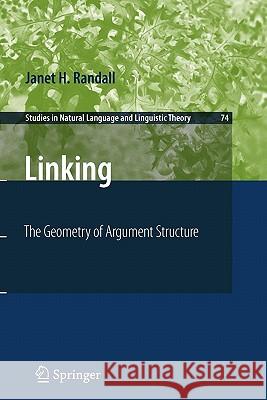
Janet H. Randalll
Linking: The Geometry of Argument Structure Randall, Janet H. 9789400705326 Springer - książkaWidoczna okładka, to zdjęcie poglądowe, a rzeczywista szata graficzna może różnić się od prezentowanej.

Linking: The Geometry of Argument Structure

ISBN-13: 9789400705326 / Angielski / Miękka / 2010 / 329 str.

Janet H. Randalll
cena 605,23 zł
(netto: 576,41 VAT:  5%)

Najniższa cena z 30 dni: 578,30 zł
Termin realizacji zamówienia:
ok. 22 dni roboczych
Bez gwarancji dostawy przed świętami

Darmowa dostawa!
inne wydania

Linking how semantic arguments map to the syntax is one of the challenges for theories of the syntax-semantics interface. In this new approach, Janet Randall explores the hypothesis that the positions of syntactic arguments are strictly determined by lexical argument geometry. Yielding novel if sometimes surprising conclusions, her Isomorphic Linking Hypothesis establishes the linking patterns of a wide range of verbs and, with those results, shows how to reason "backwards" from how a given verb's arguments link to what its lexical representation must be. Along the way, the investigation takes on thorny lexical issues reformulating the Theta Criterion, revisiting the multiple lexical-entry debate, eliminating "indirect" arguments and redefining unaccusativity. It offers new insights into how arguments are represented, assembles a host of argument/adjunct diagnostics, and re-examines the relation between arguments and predicates. The result of this incisive study is a simple and consistent account of linking, integrated with a radical rethinking of the nature of arguments and argument structure. "


Kategorie:
Nauka, Językoznawstwo
Kategorie BISAC:
Language Arts & Disciplines > Linguistics - Semantics
Language Arts & Disciplines > Grammar & Punctuation
Social Science > Socjologia
Wydawca:
Springer
Seria wydawnicza:
Studies in Natural Language and Linguistic Theory
Język:
Angielski
ISBN-13:
9789400705326
Rok wydania:
2010
Wydanie:
2010
Numer serii:
000091356
Ilość stron:
329
Waga:
0.50 kg
Wymiary:
23.3 x 15.7 x 2.0
Oprawa:
Miękka
Wolumenów:
01

From the reviews:

"In the last fifteen years or so the field of lexical argument structure has burgeoned. The latest contribution to this central area of linguistic research, Janet Randall's, Linking: The Geometry of Argument Structure, is an authoritative journey through a minefield of critical problems. Arguing a symmetry between conceptual structure and argument structure, it will richly reward those readers who do themselves the favor of taking the trip." (Samuel Jay Keyser, Professor Emeritus, MIT

"Argument structure is one of the central areas of linguistic inquiry. Under this rubric, modern linguistics investigates word meaning, how word meaning informs syntactic structure and how languages may vary along this dimension. In this book, Janet Randall, building on much recent research, develops her own version of a geometrical theory of the lexicon and explores a restrictive hypothesis on how lexical entries project into syntactic structure, based on structure preservation. The pursuit of this idea takes the form of detailed analyses of a wide range of verb classes and the alternations they display (ranging from causatives, to unaccusatives, resultatives and many more). The outcome illustrates how effectively the search for explanatory models and the unraveling of empirical generalizations can sustain each other. Even those who, like myself, are not so inclined to think of word meaning in geometric terms, will find in this book a striking series of puzzles, challenges, and insights." (Gennaro Chierchia, Haas Foundations Professor of Linguistics Harvard University)

"Janet Randall's book is a model of how to reason across the interface between conceptual structure and syntax. She marshals new and old facts about classic structures of ergatives, causatives, and unaccusatives, and particularly resultatives together with the full array of diagnostics from middles, passives, -able, -er, and nominalizations to develop a theory which shows the interaction of conceptual structure, syntactic projections, and the impact of morphology on argument structure. The role of adjuncts as selected and implicit arguments as allowed or blocked is thrown into sharp relief by her adroit use of morphology. It is a goldmine of razor-sharp observations about argument structure and morphology. Each theoretical step is supported by carefully developed empirical evidence. It will be a lasting accomplishment at both the theoretical and empirical level." (Tom Roeper, University of Massachusetts, Amherst)

"This volume makes a range of original contributions, presenting many new paradigms and introducing a new kind of reasoning for formalizing lexical entries and relating them both to each other and to canonical syntactic realizations. At the center of this innovative account is a novel principle for deriving complex lexical entries from simple ones." (Joseph Emonds, Visiting Professor, Dept. of Basque Studies and Linguistics, University of the Basque Country)

Acknowledgements List of Abbreviations Introduction.- A Phenomenon and a Principle: The Isomorphic Linking Hypothesis – Representations - The Competition - Advantages of this Proposal - Going Forward.- Part I A Geometric Theory of Linking – 1. Conceptual Structure – Motivating Conceptual Structure: A Review of the Problems with Theta Grids – Representing Arguments and Satisfying the Theta Criterion – Building Conceptual Structure Representations – Argument Fusion and Selection – Constraining Fusion: The Prohibition Against Double Fusion – Streamlining the Set of CS Primitives – Argument Structure: The Interface Projection from CS.- 2 Eliminating the Direct/Indirect Internal Argument Distinction – Reasons to Eliminate Indirect Arguments – Apparent Problems and Their Solutions – Syntactic Category – Linear Order – Lexical Rules – Summary .- 3. Explaining Linking Regularities – A New Linking Proposal: The Isomorphic Linking Hypothesis – Causative Verbs – Simple Causative Verbs – Productive “double agent” Causative Verbs – Comparing the ILH to Other Linking Theories – The Thematic Hierarchy Hypothesis (THH) – The Uniformity of Theta Assignment Hypothesis (UTAH) – Why the ILH Is a Better Linking Theory than THH and UTAH – Unaccusative and Unergative Verb Linking and Some Linking Predictions – Unaccusative Verb Linking – Unergative Verb Linking – Some Linking Predictions – Some Problematic Verb Classes – Summary: The Linking Theory So Far.- 4. Syntactically Unexpressed Arguments, Incorporation, and Adjuncts – Implicit Argument Verbs and Implications for Lexical Entries – Implicit Theme Verbs: cook, eat, drink – More Implicit Theme Verbs: rain and snow – Implicit PLACE verbs: deliver (Concrete PLACE) and transform (Abstract PLACE) – Incorporated Argument Verbs – Incorporated Theme Verbs and Adjunct Fusion: butter and bone – MoreIncorporated Theme Verbs: ticket, leaflet, stone, gas – Incorporated Concrete PLACE Verbs: bag, box, bottle, file, shelve – Coindexed Argument Verbs and the Bound Argument Condition on Linking - Delinked CS Arguments: Mismatches Introduced By Word-Formation Rules – Delinked External Arguments: Passive Verbs, Middle Verbs and Deverbal Nominals – Delinked Internal Arguments: Reciprocal Verbs and Reflexive Verbs – Maintaining the Argument/Adjunct Distinction in Light of Selected Adjuncts – Syntactic Arguments – Adjuncts – Tests for the Argument/Adjunct Distinction – Additional Justifications for the Argument/Adjunct Distinction.- 5. The Linking of Resultative Verbs: Clausal Fusion – The Conceptual Structure of Resultative Verbs – The Argument Structure of Resultative Verbs – The Argumenthood of the Result XP – The Argumenthood of the Postverbal NP – The Linking of Resultative Verbs and a Better Linking Theory – The Linking of the Inherited Arguments and a Relativized Isomorphic Linking Hypothesis – A New Kind of AS-CS Mismatch: Nonlinking Themes – Clausal Fusion: Interpreting the Unlinked Theme.- 6. The Prohibition Against Double Fusion – Deriving Resultative Mismatches from the Prohibition Against Double Fusion – Independent Evidence for the Prohibition Against Double Fusion – Passive by-phrases and Agent Subjects – With-Themes and Theme Direct Objects – PP Locations and Locative Direct Objects – The Prohibition Against Double Fusion Versus Jackendoff’s (1990) Constraints on Adjunct Rules – The Prohibition Against Double Fusion and the Theta Criterion – Against an Alternative CS for Resultatives: The Means Analysis (Jackendoff, 1990) – Jackendoff’s First Argument for the Means Analysis and a Refutation: The Actor Test – Jackendoff’s Second Argument for the Means Analysis and a Refutation: “X’s Way” – One Argument in Favor of the Agent Analysis: Unaccusative Verbs – A Second

Linking – how semantic arguments map to the syntax – is one of the challenges for theories of the syntax-semantics interface. In this new approach, Janet Randall explores the hypothesis that the positions of syntactic arguments are strictly determined by lexical argument geometry. Yielding novel – if sometimes surprising – conclusions, her Isomorphic Linking Hypothesis establishes the linking patterns of a wide range of verbs and, with those results, shows how to reason "backwards" from how a given verb's arguments link to what its lexical representation must be. Along the way, the investigation takes on thorny lexical issues – reformulating the Theta Criterion, revisiting the multiple lexical-entry debate, eliminating "indirect" arguments and redefining unaccusativity. It offers new insights into how arguments are represented, assembles a host of argument/adjunct diagnostics, and re-examines the relation between arguments and predicates. The result of this incisive study is a simple and consistent account of linking, integrated with a radical rethinking of the nature of arguments and argument structure.

From the reviews:
"Janet Randall’s Linking: The Geometry of Argument Structure, is an authoritative journey through a minefield of critical problems. Arguing a symmetry between conceptual structure and argument structure, it will richly reward those readers who do themselves the favor of taking the trip." (Samuel Jay Keyser, Professor Emeritus, MIT)

"In this book, Janet Randall, building on much recent research, develops her own version of a geometrical theory of the lexicon and explores a restrictive hypothesis on how lexical entries project into syntactic structure, based on structure preservation. Even those who, like myself, are not so inclined to think of word meaning in geometric terms, will find in this book a striking series of puzzles, challenges, and insights." (Gennaro Chierchia, Haas Foundations Professor of Linguistics, Harvard University)

"Janet Randall's book is a model of how to reason across the interface between conceptual structure and syntax. It is a goldmine of razor sharp observations about argument structure and morphology. Each theoretical step is supported by carefully developed empirical evidence. It will be a lasting accomplishment at both the theoretical and empirical level." (Tom Roeper, University of Massachusetts, Amherst)


Udostępnij

Facebook - konto krainaksiazek.pl


Opinie o Krainaksiazek.pl na Opineo.pl

Partner Mybenefit

Krainaksiazek.pl w programie rzetelna firma Krainaksiaze.pl - płatności przez paypal

Czytaj nas na:

Facebook - krainaksiazek.pl
  • książki na zamówienie
  • granty
  • książka na prezent
  • kontakt
  • pomoc
  • opinie
  • regulamin
  • polityka prywatności

Zobacz:

  • Księgarnia czeska

  • Wydawnictwo Książkowe Klimaty

1997-2025 DolnySlask.com Agencja Internetowa

© 1997-2022 krainaksiazek.pl
     
KONTAKT | REGULAMIN | POLITYKA PRYWATNOŚCI | USTAWIENIA PRYWATNOŚCI
Zobacz: Księgarnia Czeska | Wydawnictwo Książkowe Klimaty | Mapa strony | Lista autorów
KrainaKsiazek.PL - Księgarnia Internetowa

Polityka prywatnosci - link
Krainaksiazek.pl - płatnośc Przelewy24
Przechowalnia Przechowalnia






