• Wyszukiwanie zaawansowane
  • Kategorie
  • Kategorie BISAC
  • Książki na zamówienie
  • Promocje
  • Granty
  • Książka na prezent
  • Opinie
  • Pomoc
  • Załóż konto
  • Zaloguj się

Leonhard Euler and the Foundations of Celestial Mechanics » książka


zaloguj się | załóż konto
Logo Krainaksiazek.pl

koszyk

konto

szukaj
topmenu
Księgarnia internetowa
Szukaj
Książki na zamówienie
Promocje
Granty
Książka na prezent
Moje konto
Pomoc
 
 
Wyszukiwanie zaawansowane
Pusty koszyk
Bezpłatna dostawa dla zamówień powyżej 20 złBezpłatna dostawa dla zamówień powyżej 20 zł

Kategorie główne

• Nauka
 [2946600]
• Literatura piękna
 [1856966]

  więcej...
• Turystyka
 [72221]
• Informatyka
 [151456]
• Komiksy
 [35826]
• Encyklopedie
 [23190]
• Dziecięca
 [619653]
• Hobby
 [140543]
• AudioBooki
 [1577]
• Literatura faktu
 [228355]
• Muzyka CD
 [410]
• Słowniki
 [2874]
• Inne
 [445822]
• Kalendarze
 [1744]
• Podręczniki
 [167141]
• Poradniki
 [482898]
• Religia
 [510455]
• Czasopisma
 [526]
• Sport
 [61590]
• Sztuka
 [243598]
• CD, DVD, Video
 [3423]
• Technologie
 [219201]
• Zdrowie
 [101638]
• Książkowe Klimaty
 [124]
• Zabawki
 [2473]
• Puzzle, gry
 [3898]
• Literatura w języku ukraińskim
 [254]
• Art. papiernicze i szkolne
 [8170]
Kategorie szczegółowe BISAC

Leonhard Euler and the Foundations of Celestial Mechanics

ISBN-13: 9783031123214 / Angielski / Twarda / 2022 / 208 str.
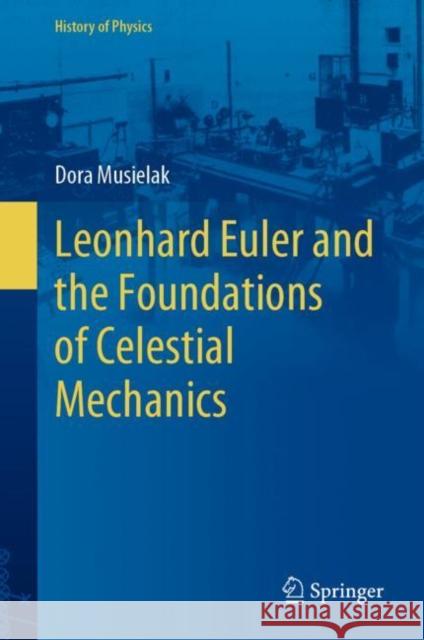
Dora Musielak
Leonhard Euler and the Foundations of Celestial Mechanics Dora Musielak 9783031123214 Springer - książkaWidoczna okładka, to zdjęcie poglądowe, a rzeczywista szata graficzna może różnić się od prezentowanej.

Leonhard Euler and the Foundations of Celestial Mechanics

ISBN-13: 9783031123214 / Angielski / Twarda / 2022 / 208 str.

Dora Musielak
cena 605,23 zł
(netto: 576,41 VAT:  5%)

Najniższa cena z 30 dni: 578,30 zł
Termin realizacji zamówienia:
ok. 22 dni roboczych
Bez gwarancji dostawy przed świętami

Darmowa dostawa!
inne wydania

The intention of this book is to shine a bright light on the intellectual context of Euler’s contributions to physics and mathematical astronomy. Leonhard Euler is one of the most important figures in the history of science, a blind genius who introduced mathematical concepts and many analytical tools to help us understand and describe the universe. Euler also made a monumental contribution to astronomy and orbital mechanics, developing what he called astronomia mechanica. Orbital mechanics of artificial satellites and spacecraft is based on Euler’s analysis of astromechanics. However, previous books have often neglected many of his discoveries in this field. For example, orbital mechanics texts refer to the five equilibrium points in the Sun-Earth-Moon system as Lagrange points, failing to credit Euler who first derived the differential equations for the general n-body problem and who discovered the three collinear points in the three-body problem of celestial mechanics. These equilibrium points are essential today in space exploration; the James Webb Space Telescope (successor to the Hubble), for example, now orbits the Sun near L2, one of the collinear points of the Sun-Earth-Moon system, while future missions to study the universe will place observatories in orbit around Sun-Earth and Earth-Moon equilibrium points that should be properly called Euler-Lagrange points. In this book, the author uses Euler’s memoirs, correspondence, and other scholarly sources to explore how he established the mathematical groundwork for the rigorous study of motion in our Solar System. The reader will learn how he studied comets and eclipses, derived planetary orbits, and pioneered the study of planetary perturbations, and how, old and blind, Euler put forward the most advanced lunar theory of his time.


The intention of this book is to shine a bright light on the intellectual context of Euler’s contributions to physics and mathematical astronomy. Leonhard Euler is one of the most important figures in the history of science, a blind genius who introduced mathematical concepts and many analytical tools to help us understand and describe the universe. Euler also made a monumental contribution to astronomy and orbital mechanics, developing what he called astronomia mechanica. Orbital mechanics of artificial satellites and spacecraft is based on Euler’s analysis of astromechanics. However, previous books have often neglected many of his discoveries in this field. For example, orbital mechanics texts refer to the five equilibrium points in the Sun-Earth-Moon system as Lagrange points, failing to credit Euler who first derived the differential equations for the general n-body problem and who discovered the three collinear points in the three-body problem of celestial mechanics. These equilibrium points are essential today in space exploration; the James Webb Space Telescope (successor to the Hubble), for example, now orbits the Sun near L2, one of the collinear points of the Sun-Earth-Moon system, while future missions to study the universe will place observatories in orbit around Sun-Earth and Earth-Moon equilibrium points that should be properly called Euler-Lagrange points. In this book, the author uses Euler’s memoirs, correspondence, and other scholarly sources to explore how he established the mathematical groundwork for the rigorous study of motion in our Solar System. The reader will learn how he studied comets and eclipses, derived planetary orbits, and pioneered the study of planetary perturbations, and how, old and blind, Euler put forward the most advanced lunar theory of his time.

Kategorie:
Nauka, Fizyka
Kategorie BISAC:
Science > Astronomia, przestrzeń i czas
Science > Fizyka
Science > Mechanics - General
Wydawca:
Springer
Seria wydawnicza:
History of Physics
Język:
Angielski
ISBN-13:
9783031123214
Rok wydania:
2022
Dostępne języki:
Numer serii:
001190040
Ilość stron:
208
Oprawa:
Twarda

"The book is very readable ... . The technical material is patiently explained while assuming little background in the field ... . general readers who are looking for math history popularization will find some enjoyable passages ... . Thankfully, thorough references ensure that the book could serve as a useful entry point to the literature." (Viktor Blåsjö, zbMATH 1509.01004, 2023)

Stella Nova: Euler’s Study of Newtonian and Cartesian Physics.- Euler’s Grand Tour.- Watching the Northern Light: Basic Analysis of Celestial Mechanics.- Rhythms of the Sea: A Theory of Tides.- Beyond the Prussian Sky: Theories of Motion in the Solar System.- Cosmic Wanderers: Motion of Comets and Comet Tail Theory.

Dora Musielak is an aerospace scientist, the recipient of two NASA research fellowships and other honors. She is a Research Professor at the University of Texas in Arlington and teaches mathematical methods to graduate students in physics and engineering.


Dora Musielak is also a historian of mathematics and science. Her research focuses on both the lives of mathematicians and the scientific developments in the eighteenth and nineteenth centuries. A central topic of her scholarly exploration is the mathematical ideas that germinated and grew in Europe, starting with Euler and Lagrange, in order to discover how mathematics led to developments in physics and astronomy. Her research also includes the mathematical formulations for classical (Newtonian) and modern (Einsteinian) quantum mechanics. Dora Musielak is the author of Sophie’s Diary (MAA Press), and her latest book published in Springer Biographies is a scholarly memoir of French mathematician Sophie Germain, describing her contributions to mathematics and her efforts to prove Fermat’s Last Theorem. The present book is Dora Musielak’s tribute to the blind mathematician who saw infinity.

The intention of this book is to shine a bright light on the intellectual context of Euler’s contributions to physics and mathematical astronomy. Leonhard Euler is one of the most important figures in the history of science, a blind genius who introduced mathematical concepts and many analytical tools to help us understand and describe the universe. Euler also made a monumental contribution to astronomy and orbital mechanics, developing what he called astronomia mechanica. Orbital mechanics of artificial satellites and spacecraft is based on Euler’s analysis of astromechanics. However, previous books have often neglected many of his discoveries in this field. For example, orbital mechanics texts refer to the five equilibrium points in the Sun-Earth-Moon system as Lagrange points, failing to credit Euler who first derived the differential equations for the general n-body problem and who discovered the three collinear points in the three-body problem of celestial mechanics. These equilibrium points are essential today in space exploration; the James Webb Space Telescope (successor to the Hubble), for example, now orbits the Sun near L2, one of the collinear points of the Sun-Earth-Moon system, while future missions to study the universe will place observatories in orbit around Sun-Earth and Earth-Moon equilibrium points that should be properly called Euler-Lagrange points. In this book, the author uses Euler’s memoirs, correspondence, and other scholarly sources to explore how he established the mathematical groundwork for the rigorous study of motion in our Solar System. The reader will learn how he studied comets and eclipses, derived planetary orbits, and pioneered the study of planetary perturbations, and how, old and blind, Euler put forward the most advanced lunar theory of his time.




Udostępnij

Facebook - konto krainaksiazek.pl


Opinie o Krainaksiazek.pl na Opineo.pl

Partner Mybenefit

Krainaksiazek.pl w programie rzetelna firma Krainaksiaze.pl - płatności przez paypal

Czytaj nas na:

Facebook - krainaksiazek.pl
  • książki na zamówienie
  • granty
  • książka na prezent
  • kontakt
  • pomoc
  • opinie
  • regulamin
  • polityka prywatności

Zobacz:

  • Księgarnia czeska

  • Wydawnictwo Książkowe Klimaty

1997-2025 DolnySlask.com Agencja Internetowa

© 1997-2022 krainaksiazek.pl
     
KONTAKT | REGULAMIN | POLITYKA PRYWATNOŚCI | USTAWIENIA PRYWATNOŚCI
Zobacz: Księgarnia Czeska | Wydawnictwo Książkowe Klimaty | Mapa strony | Lista autorów
KrainaKsiazek.PL - Księgarnia Internetowa

Polityka prywatnosci - link
Krainaksiazek.pl - płatnośc Przelewy24
Przechowalnia Przechowalnia




