• Wyszukiwanie zaawansowane
  • Kategorie
  • Kategorie BISAC
  • Książki na zamówienie
  • Promocje
  • Granty
  • Książka na prezent
  • Opinie
  • Pomoc
  • Załóż konto
  • Zaloguj się

Learning to Quantify » książka


zaloguj się | załóż konto
Logo Krainaksiazek.pl

koszyk

konto

szukaj
topmenu
Księgarnia internetowa
Szukaj
Książki na zamówienie
Promocje
Granty
Książka na prezent
Moje konto
Pomoc
 
 
Wyszukiwanie zaawansowane
Pusty koszyk
Bezpłatna dostawa dla zamówień powyżej 20 złBezpłatna dostawa dla zamówień powyżej 20 zł

Kategorie główne

• Nauka
 [2949965]
• Literatura piękna
 [1857847]

  więcej...
• Turystyka
 [70818]
• Informatyka
 [151303]
• Komiksy
 [35733]
• Encyklopedie
 [23180]
• Dziecięca
 [617748]
• Hobby
 [139972]
• AudioBooki
 [1650]
• Literatura faktu
 [228361]
• Muzyka CD
 [398]
• Słowniki
 [2862]
• Inne
 [444732]
• Kalendarze
 [1620]
• Podręczniki
 [167233]
• Poradniki
 [482388]
• Religia
 [509867]
• Czasopisma
 [533]
• Sport
 [61361]
• Sztuka
 [243125]
• CD, DVD, Video
 [3451]
• Technologie
 [219309]
• Zdrowie
 [101347]
• Książkowe Klimaty
 [123]
• Zabawki
 [2362]
• Puzzle, gry
 [3791]
• Literatura w języku ukraińskim
 [253]
• Art. papiernicze i szkolne
 [7933]
Kategorie szczegółowe BISAC

Learning to Quantify

ISBN-13: 9783031204661 / Angielski / Twarda / 2023 / 100 str.
Andrea Esuli; Alessandro Fabris; Alejandro Moreo
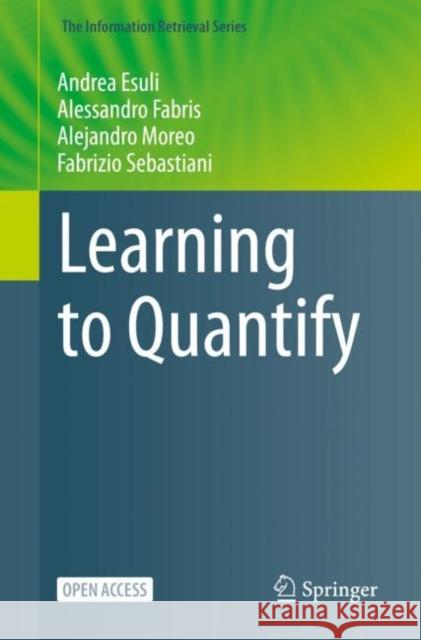
Learning to Quantify Andrea Esuli Alessandro Fabris Alejandro Moreo 9783031204661 Springer - książkaWidoczna okładka, to zdjęcie poglądowe, a rzeczywista szata graficzna może różnić się od prezentowanej.

Learning to Quantify

ISBN-13: 9783031204661 / Angielski / Twarda / 2023 / 100 str.

Andrea Esuli; Alessandro Fabris; Alejandro Moreo
cena 161,36 zł
(netto: 153,68 VAT:  5%)

Najniższa cena z 30 dni: 154,18 zł
Termin realizacji zamówienia:
ok. 22 dni roboczych
Bez gwarancji dostawy przed świętami

Darmowa dostawa!

This open access book provides an introduction and an overview of learning to quantify (a.k.a. “quantification”), i.e. the task of training estimators of class proportions in unlabeled data by means of supervised learning. In data science, learning to quantify is a task of its own related to classification yet different from it, since estimating class proportions by simply classifying all data and counting the labels assigned by the classifier is known to often return inaccurate (“biased”) class proportion estimates.The book introduces learning to quantify by looking at the supervised learning methods that can be used to perform it, at the evaluation measures and evaluation protocols that should be used for evaluating the quality of the returned predictions, at the numerous fields of human activity in which the use of quantification techniques may provide improved results with respect to the naive use of classification techniques, and at advanced topics in quantification research.The book is suitable to researchers, data scientists, or PhD students, who want to come up to speed with the state of the art in learning to quantify, but also to researchers wishing to apply data science technologies to fields of human activity (e.g., the social sciences, political science, epidemiology, market research) which focus on aggregate (“macro”) data rather than on individual (“micro”) data.


This open access book provides an introduction and an overview of learning to quantify (a.k.a. “quantification”), i.e. the task of training estimators of class proportions in unlabeled data by means of supervised learning. In data science, learning to quantify is a task of its own related to classification yet different from it, since estimating class proportions by simply classifying all data and counting the labels assigned by the classifier is known to often return inaccurate (“biased”) class proportion estimates.The book introduces learning to quantify by looking at the supervised learning methods that can be used to perform it, at the evaluation measures and evaluation protocols that should be used for evaluating the quality of the returned predictions, at the numerous fields of human activity in which the use of quantification techniques may provide improved results with respect to the naive use of classification techniques, and at advanced topics in quantification research.The book is suitable to researchers, data scientists, or PhD students, who want to come up to speed with the state of the art in learning to quantify, but also to researchers wishing to apply data science technologies to fields of human activity (e.g., the social sciences, political science, epidemiology, market research) which focus on aggregate (“macro”) data rather than on individual (“micro”) data.

Kategorie:
Informatyka, Bazy danych
Kategorie BISAC:
Computers > System Administration - Storage & Retrieval
Computers > Data Science - Data Analytics
Computers > Artificial Intelligence - General
Wydawca:
Springer
Seria wydawnicza:
Information Retrieval
Język:
Angielski
ISBN-13:
9783031204661
Rok wydania:
2023
Dostępne języki:
Numer serii:
000318554
Ilość stron:
100
Oprawa:
Twarda
Dodatkowe informacje:
Wydanie ilustrowane

- 1. The Case for Quantification. - 2. Applications of Quantification. - 3. Evaluation of Quantification Algorithms. - 4. Methods for Learning to Quantify. - 5. Advanced Topics. - 6. The Quantification Landscape. - 7. The Road Ahead.

Andrea Esuli is a tenured Senior Researcher at the Italian National Council of Research. His research interests include learning to quantify, deep learning for text analysis, cross-modal classification, technology-assisted review, and representation learning.

Alessandro Fabris is a PhD student at the University of Padova. His research interests include learning to quantify, and the fairness and bias of retrieval and classification systems.

Alejandro Moreo is a tenured Researcher at the Italian National Council of Research. His research interests include learning to quantify, deep learning for text analysis, cross-lingual text classification, authorship analysis, and representation learning.

Fabrizio Sebastiani is a tenured Director of Research at the Italian National Council of Research. His research interests include learning to quantify, cross-lingual text classification, technology-assisted review, authorship analysis, and representation learning.


This open access book provides an introduction and an overview of learning to quantify (a.k.a. “quantification”), i.e. the task of training estimators of class proportions in unlabeled data by means of supervised learning. In data science, learning to quantify is a task of its own related to classification yet different from it, since estimating class proportions by simply classifying all data and counting the labels assigned by the classifier is known to often return inaccurate (“biased”) class proportion estimates.

The book introduces learning to quantify by looking at the supervised learning methods that can be used to perform it, at the evaluation measures and evaluation protocols that should be used for evaluating the quality of the returned predictions, at the numerous fields of human activity in which the use of quantification techniques may provide improved results with respect to the naive use of classification techniques, and at advanced topics in quantification research.

The book is suitable to researchers, data scientists, or PhD students, who want to come up to speed with the state of the art in learning to quantify, but also to researchers wishing to apply data science technologies to fields of human activity (e.g., the social sciences, political science, epidemiology, market research) which focus on aggregate (“macro”) data rather than on individual (“micro”) data.




Udostępnij

Facebook - konto krainaksiazek.pl


Opinie o Krainaksiazek.pl na Opineo.pl

Partner Mybenefit

Krainaksiazek.pl w programie rzetelna firma Krainaksiaze.pl - płatności przez paypal

Czytaj nas na:

Facebook - krainaksiazek.pl
  • książki na zamówienie
  • granty
  • książka na prezent
  • kontakt
  • pomoc
  • opinie
  • regulamin
  • polityka prywatności

Zobacz:

  • Księgarnia czeska

  • Wydawnictwo Książkowe Klimaty

1997-2025 DolnySlask.com Agencja Internetowa

© 1997-2022 krainaksiazek.pl
     
KONTAKT | REGULAMIN | POLITYKA PRYWATNOŚCI | USTAWIENIA PRYWATNOŚCI
Zobacz: Księgarnia Czeska | Wydawnictwo Książkowe Klimaty | Mapa strony | Lista autorów
KrainaKsiazek.PL - Księgarnia Internetowa

Polityka prywatnosci - link
Krainaksiazek.pl - płatnośc Przelewy24
Przechowalnia Przechowalnia



