• Wyszukiwanie zaawansowane
  • Kategorie
  • Kategorie BISAC
  • Książki na zamówienie
  • Promocje
  • Granty
  • Książka na prezent
  • Opinie
  • Pomoc
  • Załóż konto
  • Zaloguj się

Learning Landscape Ecology: A Practical Guide to Concepts and Techniques » książka


zaloguj się | załóż konto
Logo Krainaksiazek.pl

koszyk

konto

szukaj
topmenu
Księgarnia internetowa
Szukaj
Książki na zamówienie
Promocje
Granty
Książka na prezent
Moje konto
Pomoc
 
 
Wyszukiwanie zaawansowane
Pusty koszyk
Bezpłatna dostawa dla zamówień powyżej 20 złBezpłatna dostawa dla zamówień powyżej 20 zł

Kategorie główne

• Nauka
 [2950560]
• Literatura piękna
 [1849509]

  więcej...
• Turystyka
 [71097]
• Informatyka
 [151150]
• Komiksy
 [35848]
• Encyklopedie
 [23178]
• Dziecięca
 [617388]
• Hobby
 [139064]
• AudioBooki
 [1657]
• Literatura faktu
 [228597]
• Muzyka CD
 [383]
• Słowniki
 [2855]
• Inne
 [445295]
• Kalendarze
 [1464]
• Podręczniki
 [167547]
• Poradniki
 [480102]
• Religia
 [510749]
• Czasopisma
 [516]
• Sport
 [61293]
• Sztuka
 [243352]
• CD, DVD, Video
 [3414]
• Technologie
 [219456]
• Zdrowie
 [101002]
• Książkowe Klimaty
 [124]
• Zabawki
 [2311]
• Puzzle, gry
 [3459]
• Literatura w języku ukraińskim
 [254]
• Art. papiernicze i szkolne
 [8079]
Kategorie szczegółowe BISAC

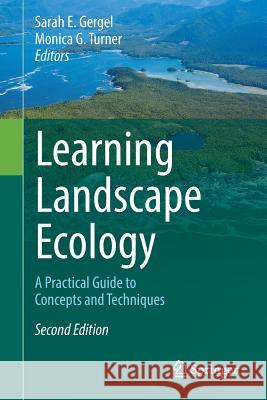
Learning Landscape Ecology: A Practical Guide to Concepts and Techniques

ISBN-13: 9781493963720 / Angielski / Miękka / 2017 / 350 str.
Sarah E. Gergel; Monica G. Turner
Learning Landscape Ecology: A Practical Guide to Concepts and Techniques Gergel, Sarah E. 9781493963720 Springer - książkaWidoczna okładka, to zdjęcie poglądowe, a rzeczywista szata graficzna może różnić się od prezentowanej.

Learning Landscape Ecology: A Practical Guide to Concepts and Techniques

ISBN-13: 9781493963720 / Angielski / Miękka / 2017 / 350 str.

Sarah E. Gergel; Monica G. Turner
cena 342,14
(netto: 325,85 VAT:  5%)

Najniższa cena z 30 dni: 327,68
Termin realizacji zamówienia:
ok. 22 dni roboczych
Dostawa w 2026 r.

Darmowa dostawa!

This title meets a great demand for training in spatial analysis tools accessible to a wide audience. Landscape ecology continues to grow as an exciting discipline with much to offer for solving pressing and emerging problems in environmental science. Much of the strength of landscape ecology lies in its ability to address challenges over large areas, over spatial and temporal scales at which decision-making often occurs. As the world tackles issues related to sustainability and global change, the need for this broad perspective has only increased. Furthermore, spatial data and spatial analysis (core methods in landscape ecology) are critical for analyzing land-cover changes world-wide. While spatial dynamics have long been fundamental to terrestrial conservation strategies, land management and reserve design, mapping and spatial themes are increasingly recognized as important for ecosystem management in aquatic, coastal and marine systems.

This second edition is purposefully more applied and international in its examples, approaches, perspectives and contributors. It includes new advances in quantifying landscape structure and connectivity (such as graph theory), as well as labs that incorporate the latest scientific understanding of ecosystem services, resilience, social-ecological landscapes, and even seascapes. Of course, as before, the exercises emphasize easy-to-use, widely available software.
http: //sarahgergel.net/lel/learning-landscape-ecology/​

Kategorie:
Nauka, Biologia i przyroda
Kategorie BISAC:
Science > Life Sciences - Ecology
Political Science > Public Policy - City Planning & Urban Development
Science > Environmental Science (see also Chemistry - Environmental)
Wydawca:
Springer
Język:
Angielski
ISBN-13:
9781493963720
Rok wydania:
2017
Wydanie:
2017
Ilość stron:
350
Waga:
0.51 kg
Wymiary:
23.39 x 15.6 x 1.93
Oprawa:
Miękka
Wolumenów:
01
Dodatkowe informacje:
Bibliografia
Wydanie ilustrowane

"As with the previous edition, the volume is designed around teaching, including structured exercises and a very helpful guide to designing specific courses of study relating to applied aspects of landscape ecology, from conservation and forestry to sustainable management of landscapes and watersheds. It is also supported by free software and data, now provided online. If you study or teach landscape ecology, you need this book." (Erle C. Ellis, The Quarterly Review of Biology, Vol. 93 (2), June, 2018)

TABLE OF CONTENTS

Preface

Acknowledgements

Advice for Instructors

I.                   WHAT IS A LANDSCAPE? BASIC CONCEPTS AND TOOLS

Chapter 1: Introduction to Remote Sensing

Nicholas C. Coops and T. Rory Tooke

Chapter 2: Historical Aerial Photography for Landscape Analysis

Jessica L. Morgan, Sarah E. Gergel, Collin Ankerson, Stephanie A. Tomscha and Ira Sutherland

Chapter 3: Citizen Science for Assessing Landscape Change

Jeffrey A. Cardille and Michelle M. Jackson

II.                FUNDAMENTALS OF QUANTIFYING LANDSCAPE PATTERN

Chapter 4: Understanding Landscape Metrics

Jeffrey A. Cardille and Monica G. Turner

Chapter 5: Scale Detection with Semivariograms and Autocorrelograms (with R option)

Michael W. Palmer and Daniel J. McGlinn

Chapter 6: Characterizing Categorical Map Patterns Using Neutral Landscape Models (with QRULE and R)

Robert H. Gardner

Chapter 7: What Constitutes a Significant Difference in Landscape Pattern? (using R)

Tarmo K. Remmel and Marie-Josée Fortin

III.             LANDSCAPE CHANGE AND DISTURBANCE

Chapter 8: Modeling Landscape Change with Markov Models (with R option)

Dean L. Urban and David O. Wallin

Chapter 9: Simulating Management Actions and Their Effect on Forest Landscape Pattern (with Harvest Lite)

Eric J. Gustafson

Chapter 10: Regional and Continental-scale Perspectives on Landscape Pattern

Jeffrey A. Cardille and Monica G. Turner

Chapter 11: Using Spatial Statistics and Landscape Metrics to Compare Disturbance Mosaics (with GS+) <

Monica G. Turner and Martin Simard

IV.             APPLICATIONS FOR CONSERVATION AND ASSESSING CONNECTIVITY

Chapter 12: Assessing Multi-scale Landscape Connectivity Using Network Analysis

Todd R. Lookingbill and Emily S. Minor

Chapter 13: Conservation Planning (with Marxan)

Matthew Watts, Hugh P. Possingham, Carissa J. Klein, Tara G. Martin and Josie Carwardine

Chapter 14: Advances in Quantifying Habitat Connectivity Using Graph Theory (with Conefor)

Santiago Saura and Begoña de la Fuente

Chapter 15: Linking Landscapes and Metacommunities (using R)

Joseph R. Bennett and Ben Gilbert

V.                ECOSYSTEM PROCESSES AND FEEDBACKS IN SOCIAL-ECOLOGICAL LANDSCAPES

Chapter 16: Modeling Spatial Dynamics of Ecosystem Processes and Services

Sarah E. Gergel and Tara Reed

Chapter 17: Heterogeneity in Ecosystem Services: Multi-scale Carbon Management in Tropical Forest Landscapes

Kathryn R. Kirby, Jeanine M. Rhemtulla and Sarah E. Gergel


Chapter 18: Regime Shifts and Spatial Resilience in a Coral Reef Seascape

Jennifer C. Selgrath, Garry D. Peterson, Matilda Thyresson, Magnus Nyström and Sarah E. Gergel

Chapter 19: Understanding Land-Use Feedbacks and Ecosystem Service Tradeoffs in Agriculture

Lisa A. Schulte and John C. Tyndall

Chapter 20: Social Networks: Uncovering Social-ecological Mismatches in Heterogeneous Marine Landscapes

Örjan Bodin and Beatrice I. Crona.

Sarah E. Gergel 
Associate Professor of Landscape Ecology & Conservation 
Assistant Dean, Diversity & Inclusion 
Department of Forest & Conservation Sciences 
University of British Columbia 
Vancouver, BC 
Canada

Monica G. Turner 
Eugene P. Odum Professor of Ecology and Vilas Research Professor 
Department of Zoology 
University of Wisconsin-Madison 
Madison, WI 
USA

This title meets a great demand for training in spatial analysis tools accessible to a wide audience. Landscape ecology continues to grow as an exciting discipline with much to offer for solving pressing and emerging problems in environmental science. Much of the strength of landscape ecology lies in its ability to address challenges over large areas, over spatial and temporal scales at which decision-making often occurs. As the world tackles issues related to sustainability and global change, the need for this broad perspective has only increased. Furthermore, spatial data and spatial analysis (core methods in landscape ecology) are critical for analyzing land-cover changes world-wide. While spatial dynamics have long been fundamental to terrestrial conservation strategies, land management and reserve design, mapping and spatial themes are increasingly recognized as important for ecosystem management in aquatic, coastal and marine systems. 

This second edition is purposefully more applied and international in its examples, approaches, perspectives and contributors. It includes new advances in quantifying landscape structure and connectivity (such as graph theory), as well as labs that incorporate the latest scientific understanding of ecosystem services, resilience, social-ecological landscapes, and even seascapes. Of course, as before, the exercises emphasize easy-to-use, widely available software. 

Turner, Monica G. Monica G. Turner is the Eugene P. Odum Professor o... więcej >


Udostępnij

Facebook - konto krainaksiazek.pl


Opinie o Krainaksiazek.pl na Opineo.pl

Partner Mybenefit

Krainaksiazek.pl w programie rzetelna firma Krainaksiaze.pl - płatności przez paypal

Czytaj nas na:

Facebook - krainaksiazek.pl
  • książki na zamówienie
  • granty
  • książka na prezent
  • kontakt
  • pomoc
  • opinie
  • regulamin
  • polityka prywatności

Zobacz:

  • Księgarnia czeska

  • Wydawnictwo Książkowe Klimaty

1997-2025 DolnySlask.com Agencja Internetowa

© 1997-2022 krainaksiazek.pl
     
KONTAKT | REGULAMIN | POLITYKA PRYWATNOŚCI | USTAWIENIA PRYWATNOŚCI
Zobacz: Księgarnia Czeska | Wydawnictwo Książkowe Klimaty | Mapa strony | Lista autorów
KrainaKsiazek.PL - Księgarnia Internetowa

Polityka prywatnosci - link
Krainaksiazek.pl - płatnośc Przelewy24
Przechowalnia Przechowalnia







