• Wyszukiwanie zaawansowane
  • Kategorie
  • Kategorie BISAC
  • Książki na zamówienie
  • Promocje
  • Granty
  • Książka na prezent
  • Opinie
  • Pomoc
  • Załóż konto
  • Zaloguj się

Learning Assessment Techniques: A Handbook for College Faculty » książka

zaloguj się | załóż konto
Logo Krainaksiazek.pl

koszyk

konto

szukaj
topmenu
Księgarnia internetowa
Szukaj
Książki na zamówienie
Promocje
Granty
Książka na prezent
Moje konto
Pomoc
 
 
Wyszukiwanie zaawansowane
Pusty koszyk
Bezpłatna dostawa dla zamówień powyżej 20 złBezpłatna dostawa dla zamówień powyżej 20 zł

Kategorie główne

• Nauka
 [2946600]
• Literatura piękna
 [1856966]

  więcej...
• Turystyka
 [72221]
• Informatyka
 [151456]
• Komiksy
 [35826]
• Encyklopedie
 [23190]
• Dziecięca
 [619653]
• Hobby
 [140543]
• AudioBooki
 [1577]
• Literatura faktu
 [228355]
• Muzyka CD
 [410]
• Słowniki
 [2874]
• Inne
 [445822]
• Kalendarze
 [1744]
• Podręczniki
 [167141]
• Poradniki
 [482898]
• Religia
 [510455]
• Czasopisma
 [526]
• Sport
 [61590]
• Sztuka
 [243598]
• CD, DVD, Video
 [3423]
• Technologie
 [219201]
• Zdrowie
 [101638]
• Książkowe Klimaty
 [124]
• Zabawki
 [2473]
• Puzzle, gry
 [3898]
• Literatura w języku ukraińskim
 [254]
• Art. papiernicze i szkolne
 [8170]
Kategorie szczegółowe BISAC

Learning Assessment Techniques: A Handbook for College Faculty

ISBN-13: 9781119050896 / Angielski / Miękka / 2016 / 480 str.
Barkley, Elizabeth F.; Major, Claire Howell
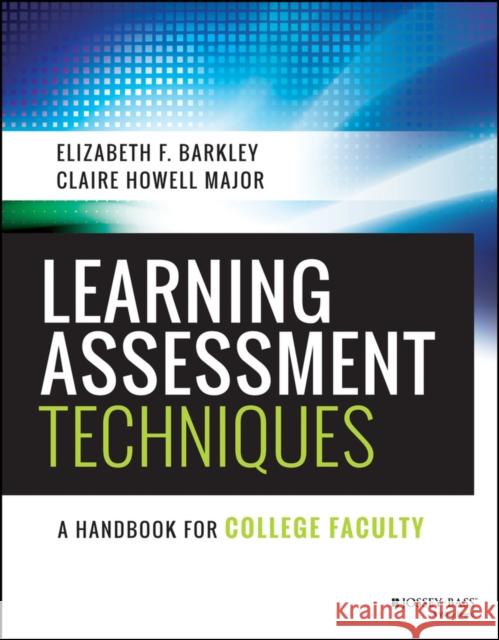
Learning Assessment Techniques: A Handbook for College Faculty Barkley, Elizabeth F.; Major, Claire Howell 9781119050896 John Wiley & Sons - książkaWidoczna okładka, to zdjęcie poglądowe, a rzeczywista szata graficzna może różnić się od prezentowanej.

Learning Assessment Techniques: A Handbook for College Faculty

ISBN-13: 9781119050896 / Angielski / Miękka / 2016 / 480 str.

Barkley, Elizabeth F.; Major, Claire Howell
cena 205,38 zł
(netto: 195,60 VAT:  5%)

Najniższa cena z 30 dni: 203,28 zł
Termin realizacji zamówienia:
ok. 30 dni roboczych
Bez gwarancji dostawy przed świętami

Darmowa dostawa!

50 Techniques for Engaging Students and Assessing Learning in College Courses Do you want to:

  • Know what and how well your students are learning?
  • Promote active learning in ways that readily integrate assessment?
  • Gather information that can help make grading more systematic and streamlined?
  • Efficiently collect solid learning outcomes data for institutional assessment?
  • Provide evidence of your teaching effectiveness for promotion and tenure review?
Learning Assessment Techniques provides 50 easy-to-implement active learning techniques that gauge student learning across academic disciplines and learning environments. Using Fink's Taxonomy of Significant Learning as its organizational framework, it embeds assessment within active learning activities. Each technique features: purpose and use, key learning goals, step-by-step implementation, online adaptation, analysis and reporting, concrete examples in both on-site and online environments, and key references--all in an easy-to-follow format. The book includes an all-new Learning Goals Inventory, as well as more than 35 customizable assessment rubrics, to help teachers determine significant learning goals and appropriate techniques. Readers will also gain access to downloadable supplements, including a worksheet to guide teachers through the six steps of the Learning Assessment Techniques planning and implementation cycle. College teachers today are under increased pressure to teach effectively and provide evidence of what, and how well, students are learning. An invaluable asset for college teachers of any subject, Learning Assessment Techniques provides a practical framework for seamlessly integrating teaching, learning, and assessment.

Kategorie:
Inne
Kategorie BISAC:
Education > Administration - Higher
Education > Teaching - General
Education > Schools - Levels - Higher
Wydawca:
John Wiley & Sons
Język:
Angielski
ISBN-13:
9781119050896
Rok wydania:
2016
Ilość stron:
480
Waga:
1.03 kg
Wymiary:
27.43 x 21.59 x 2.54
Oprawa:
Miękka
Wolumenów:
01
Dodatkowe informacje:
Bibliografia

Preface xi

Acknowledgments xvii

The Authors xix

Introduction: Conceptual Framework 1

How Can We Best Teach to Promote Learning? 1

What Is a Learning Assessment Technique (LAT)? 4

How Do LATs Support the Kind of Teaching that Promotes Significant Learning? 5

Conclusion 10

Part One: The Learning Assessment Techniques Cycle 11

1 Clarifying What You Want Students to Learn 13

Defining Learning 13

Aiming for Significant Learning 14

Using the Learning Goals Inventory (LGI) to Identify Significant Learning Goals 14

Expressing What You Want Students to Learn in Language that Is Helpful for Assessment 14

Identifying Course–Level Learning Goals 14

Considering the Challenges Related to Course Learning Objectives and Outcomes 17

Determining Course–Level Learning Objectives 18

Identifying Course–Level Student Learning Outcomes (SLOs) 20

Differentiating Between Learning Objectives and Learning Outcomes 20

Crafting a Course Learning Outcome Statement 21

Determining Performance Standards for Individuals and the Class as a Whole 21

Is All the Work Required Worth the Effort? 22

2 Determining Your Purpose for Assessing Student Learning 24

Defining Assessment 24

How Learning Assessment Is Different from Grading 25

Types of Learning Assessment 25

Assessing Students to Determine for Ourselves How Well Students Are Learning 26

Assessing to Give Learners Feedback on Their Progress 27

Assessing Learning to Improve Our Profession through the Scholarship of Teaching and Learning (SoTL) 27

Assessing to Provide Information to Institutional and External Stakeholders on How Well Students Are Learning 27

Crafting the Assessment Question 28

3 Selecting a Learning Assessment Technique 30

Using the Learning Goals Inventory (LGI) 30

Considering Instructional Context When Choosing a LAT 30

Key Instructional Elements to Consider 35

Considering Clustering Multiple LATs Together 35

4 Implementing a Learning Assessment Technique 43

Creating Assessment Rubrics 43

Creating Student Self–Evaluation Forms 45

Creating Peer Evaluation Forms 45

Introducing the Activity 46

Providing Students with Information They Need About the Learning Assessment 46

Facilitating the Learning Assessment 47

Concluding the Activity 48

Timing the Phases 49

Collecting the Learning Artifacts 50

Managing the Learning Artifacts 50

5 Analyzing and Reporting What Students Have Learned 52

Identifying Whose Learning You Are Gauging 52

Considering Independent and Collaborative Data Analysis 53

Scoring Individual Learning Artifacts 53

Scoring Group Artifacts 53

Determining the Method of Data Analysis 54

Using Quantitative Data Analysis 54

Using Qualitative Data Analysis 55

Displaying Data and Findings 57

Interpreting Results 64

Writing Up the Results of the Assessment 65

6 Closing the Loop 67

Modifying Your Learning Goals, Objectives, and Outcomes 67

Adjusting Your Purpose for Assessing Learning 68

Selecting a Different LAT 68

Altering an Aspect of Implementation 68

Changing the Way You Analyze or Report Findings 69

Part Two: Learning Assessment Techniques 71

7 Teaching and Assessing for the Foundational Knowledge Domain 73

Clarifying Learning Goals Related to Foundational Knowledge 73

Identifying Learning Outcomes for Foundational Knowledge 74

Aligning Course Level Foundational Knowledge Learning Outcomes with Institutional Learning Goals 75

Assessing Achievement of Foundational Knowledge Learning Outcomes 75

Conclusion 77

Foundational Knowledge Domain LATs 78

1 First Day Final 78

2 Background Knowledge Probe 85

3 Entry and Exit Tickets 91

4 Guided Reading Notes 96

5 Comprehensive Factors List 101

6 Quick Write 105

7 Best Summary 111

8 Snap Shots 116

9 Team Tests 122

10 Team Games Tournament 128

8 Teaching and Assessing for the Application Learning Domain 134

Clarifying Learning Goals Related to Application Learning 134

Skills Goals 134

Identifying Learning Outcomes for Application Learning 136

Aligning Course Level Application Learning Outcomes with Institutional Learning Goals 136

Assessing Achievement of Application Learning Outcomes 136

Conclusion 139

Application Learning Domain LATs 148

11 Prediction Guide 148

12 Fact or Opinion 153

13 Quotation Commentaries 158

14 Insights–Resources–Application (IRA) 164

15 Consider This 169

16 What s the Problem? 174

17 Think–Aloud Problem–Solving Protocols (TAAPs) 180

18 Peer Problem Review 185

19 Triple Jump 191

20 Digital Projects 196

9 Teaching and Assessing for the Integration Domain 202

Clarifying Learning Goals Related to the Integration Domain 202

Identifying Learning Outcomes for Integration Learning 203

Aligning Course Level Integrative Learning Outcomes with Broader Institutional Learning Goals 204

Assessing Achievement of Learning in the Integration Domain 204

Conclusion 204

Integration Domain LATs 208

21 Knowledge Grid 208

22 Sequence Chains 214

23 Concept Maps 218

24 Contemporary Issues Journal 225

25 Dyadic Essay 230

26 Synthesis Paper 237

27 Case Study 243

28 Class Book 248

29 E–Portfolios 255

10 Teaching and Assessing for the Human Dimension Domain 261

Clarifying Learning Goals Related to the Human Dimension Domain 261

Identifying Learning Outcomes for Human Dimension Learning 262

Aligning Course Level Human Dimension Learning Outcomes with

Institutional Learning Goals 262

Assessing Achievement of Learning Regarding the Human Dimension Domain 263

Conclusion 264

Human Dimension Domain LATs 271

30 Free Discussion 271

31 Nominations 277

32 Editorial Review 282

33 Dramatic Dialogues 287

34 Role Play 292

35 Ethical Dilemma 298

36 Digital Story 303

11 Teaching and Assessing for the Caring Domain 312

Clarifying Learning Goals Related to the Caring Domain 313

Identifying Learning Outcomes for the Caring Domain 314

Aligning Learning Outcomes Related to Caring with Institutional Learning Goals 314

Assessing Achievement of Learning Outcomes in the Caring Domain 315

Conclusion 315

Caring Domain LATs 319

37 Stand Where You Stand 319

38 Three–Minute Message 324

39 Issue Awareness Ad 330

40 Proclamations 334

41 Editorial 340

42 Debate 346

43 Briefing Paper 353

12 Teaching and Assessing for the Learning How to Learn Domain 358

Clarifying Learning Goals Related to the Learning How to Learn Domain 358

Identifying Learning Outcomes for the Learning How to Learn Domain 359

Aligning Learning Outcomes Related to Learning How to Learn with Institutional Learning Goals 359

Assessing Achievement of Learning Outcomes in the Learning How to Learn Domain 359

Conclusion 361

Learning How to Learn Domain LATs 364

44 Study Outlines 364

45 Student Generated Rubrics 370

46 Invent the Quiz 376

47 Learning Goal Listing 382

48 What? So What? Now What? Journal 388

49 Multiple–Task Mastery Checklist 393

50 Personal Learning Environment 399

Bibliography 405

Appendices 417

Appendix A About the Learning Goals Inventory (LGI) 419

Appendix B The Learning Goals Inventory with Scoring Sheet 425

Appendix C Key to Classroom Environment and Discipline in LAT Examples 433

Index 439

ELIZABETH F. BARKLEY is professor of music at Foothill College in Los Altos, California. She is a nationally known scholar, educator, and consultant and has been the recipient of several honors, including The Chair Academy′s Outstanding Leadership Award for work with learning outcomes assessment and being named California′s Higher Education Professor of the Year by The Carnegie Foundation for the Advancement of Teaching. She is author of Student Engagement Techniques from Jossey–Bass.

CLAIRE HOWELL MAJOR is professor of higher education at the University of Alabama. Her expertise is in teaching and learning in higher education and in qualitative research methods. With Elizabeth Barkley, she is the author of Collaborative Learning Techniques, Second Edition from Jossey–Bass.

50 TECHNIQUES TO ENGAGE STUDENTS AND ASSESS LEARNING

Learning Assessment Techniques gives faculty 50 easy–to–implement active learning techniques that are designed to gauge student learning across academic disciplines and learning environments. Using Fink′s Taxonomy of Significant Learning as its organizational framework, this important resource embeds assessment within active learning activities. All the techniques presented include illustrative examples as well as information on their purpose and use, key learning goals, and step–by–step implementation instructions. The authors also offer direction for online adaptation and effective analysis and reporting.

With Learning Assessment Techniques as their guide, instructors will know what and how well their students are learning, promote active learning that integrates assessment, and gather information in a systematic and streamlined manner. They will also have the tools to collect solid learning outcomes and data for institutional assessment and provide evidence of their effectiveness that is so vital when seeking promotion and tenure.

"An expertly documented, superbly organized, and convincingly written book centered around 50 techniques that showcase the power of course–based, teacher–driven, integrated assessment."
Maryellen Weimer, professor emerita, Penn State, and editor, The Teaching Professor newsletter and blog

"Learning Assessment Techniques promises to be a landmark contribution to the resources upon which faculty members can draw. If you are looking for fresh ideas for learning activities for those hard–to–teach learning outcomes, you′ve come to the right place!"
Linda Suskie, assessment and accreditation consultant and author of Assessing Student Learning and Five Dimensions of Quality

"Now that higher education recognizes the need to promote more powerful kinds of learning, we need more powerful ideas on how to assess them. This book provides exactly what we need to move forward on that agenda."
Dee Fink, author of Creating Significant Learning Experiences


Udostępnij

Facebook - konto krainaksiazek.pl


Opinie o Krainaksiazek.pl na Opineo.pl

Partner Mybenefit

Krainaksiazek.pl w programie rzetelna firma Krainaksiaze.pl - płatności przez paypal

Czytaj nas na:

Facebook - krainaksiazek.pl
  • książki na zamówienie
  • granty
  • książka na prezent
  • kontakt
  • pomoc
  • opinie
  • regulamin
  • polityka prywatności

Zobacz:

  • Księgarnia czeska

  • Wydawnictwo Książkowe Klimaty

1997-2025 DolnySlask.com Agencja Internetowa

© 1997-2022 krainaksiazek.pl
     
KONTAKT | REGULAMIN | POLITYKA PRYWATNOŚCI | USTAWIENIA PRYWATNOŚCI
Zobacz: Księgarnia Czeska | Wydawnictwo Książkowe Klimaty | Mapa strony | Lista autorów
KrainaKsiazek.PL - Księgarnia Internetowa

Polityka prywatnosci - link
Krainaksiazek.pl - płatnośc Przelewy24
Przechowalnia Przechowalnia







