• Wyszukiwanie zaawansowane
  • Kategorie
  • Kategorie BISAC
  • Książki na zamówienie
  • Promocje
  • Granty
  • Książka na prezent
  • Opinie
  • Pomoc
  • Załóż konto
  • Zaloguj się

Learning Abstract Algebra with Isetl » książka


zaloguj się | załóż konto
Logo Krainaksiazek.pl

koszyk

konto

szukaj
topmenu
Księgarnia internetowa
Szukaj
Książki na zamówienie
Promocje
Granty
Książka na prezent
Moje konto
Pomoc
 
 
Wyszukiwanie zaawansowane
Pusty koszyk
Bezpłatna dostawa dla zamówień powyżej 20 złBezpłatna dostawa dla zamówień powyżej 20 zł

Kategorie główne

• Nauka
 [2946600]
• Literatura piękna
 [1856966]

  więcej...
• Turystyka
 [72221]
• Informatyka
 [151456]
• Komiksy
 [35826]
• Encyklopedie
 [23190]
• Dziecięca
 [619653]
• Hobby
 [140543]
• AudioBooki
 [1577]
• Literatura faktu
 [228355]
• Muzyka CD
 [410]
• Słowniki
 [2874]
• Inne
 [445822]
• Kalendarze
 [1744]
• Podręczniki
 [167141]
• Poradniki
 [482898]
• Religia
 [510455]
• Czasopisma
 [526]
• Sport
 [61590]
• Sztuka
 [243598]
• CD, DVD, Video
 [3423]
• Technologie
 [219201]
• Zdrowie
 [101638]
• Książkowe Klimaty
 [124]
• Zabawki
 [2473]
• Puzzle, gry
 [3898]
• Literatura w języku ukraińskim
 [254]
• Art. papiernicze i szkolne
 [8170]
Kategorie szczegółowe BISAC

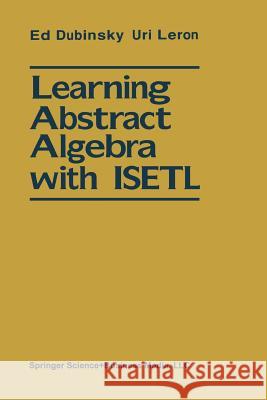
Learning Abstract Algebra with Isetl

ISBN-13: 9781461276104 / Angielski / Miękka / 2014 / 257 str.
Ed Dubinsky; Uri Leron
Learning Abstract Algebra with Isetl Dubinsky, Ed 9781461276104 Springer - książkaWidoczna okładka, to zdjęcie poglądowe, a rzeczywista szata graficzna może różnić się od prezentowanej.

Learning Abstract Algebra with Isetl

ISBN-13: 9781461276104 / Angielski / Miękka / 2014 / 257 str.

Ed Dubinsky; Uri Leron
cena 201,72 zł
(netto: 192,11 VAT:  5%)

Najniższa cena z 30 dni: 192,74 zł
Termin realizacji zamówienia:
ok. 22 dni roboczych
Bez gwarancji dostawy przed świętami

Darmowa dostawa!
inne wydania

This book is based on the belief that, before students can make sense of any presentation of abstract mathematics, they need to be engaged in mental activities that will establish an experiential base for any future verbal explanations and to have the opportunity to reflect on their activities. This approach is based on extensive theoretical and empirical studies, as well as on the substantial experience of the authors in teaching Abstract Algebra. The main source of activities in this course is computer constructions, specifically, small programs written in the math-like programming language ISETL; the main tool for reflection is work in teams of two to four students, where the activities are discussed and debated. Because of the similarity of ISETL expressions to standard written mathematics, there is very little programming overhead: learning to program is inseparable from learning the mathematics. Each topic is first introduced through computer activities, which are then followed by a text section and exercises. The text section is written in an informal, discursive style, closely relating definitions and proofs to the constructions in the activities. Notions such as cosets and quotient groups become much more meaningful to the students than when they are presented in a lecture.


Kategorie:
Nauka, Matematyka
Kategorie BISAC:
Mathematics > Algebra - General
Mathematics > Matematyka stosowana
Mathematics > Algebra - Abstrakcyjna
Wydawca:
Springer
Język:
Angielski
ISBN-13:
9781461276104
Rok wydania:
2014
Wydanie:
Softcover Repri
Ilość stron:
257
Waga:
0.40 kg
Wymiary:
23.39 x 15.6 x 1.52
Oprawa:
Miękka
Wolumenów:
01

1 Mathematical Constructions in ISETL.- 1.1 Using ISETL.- 1.1.1 Activities.- 1.1.2 Getting started.- 1.1.3 Simple objects and operations on them.- 1.1.4 Control statements.- 1.1.5 Exercises.- 1.2 Compound objects and operations on them.- 1.2.1 Activities.- 1.2.2 Tuples.- 1.2.3 Sets.- 1.2.4 Set and tuple formers.- 1.2.5 Set operations.- 1.2.6 Permutations.- 1.2.7 Quantification.- 1.2.8 Miscellaneous ISETL features.- 1.2.9 VISETL.- 1.2.10 Exercises.- 1.3 Functions in ISETL.- 1.3.1 Activities.- 1.3.2 Funcs.- 1.3.3 Alternative syntax for funcs.- 1.3.4 Using funcs to represent situations.- 1.3.5 Funcs for binary operations.- 1.3.6 Funcs to test properties.- 1.3.7 Smaps.- 1.3.8 Procs.- 1.3.9 Exercises.- 2 Groups.- 2.1 Getting acquainted with groups.- 2.1.1 Activities.- 2.1.2 Definition of a group.- 2.1.3 Examples of groups.- Number systems.- Integers mod n.- Symmetric groups.- Symmetries of the square.- Groups of matrices.- 2.1.4 Elementary properties of groups.- 2.1.5 Exercises.- 2.2 The modular groups and the symmetric groups.- 2.2.1 Activities.- 2.2.2 The modular groups Zn.- 2.2.3 The symmetric groups Sn.- Orbits and cycles.- 2.2.4 Exercises.- 2.3 Properties of groups.- 2.3.1 Activities.- 2.3.2 The specific and the general.- 2.3.3 The cancellation law—An illustration of the abstract method.- 2.3.4 How many groups are there?.- Classifying groups of order 4.- 2.3.5 Looking ahead—subgroups.- 2.3.6 Summary of examples and non-examples of groups.- 2.3.7 Exercises.- 3 Subgroups.- 3.1 Definitions and examples.- 3.1.1 Activities.- 3.1.2 Subsets of a group.- Definition of a subgroup.- 3.1.3 Examples of subgroups.- Embedding one group in another.- Conjugates.- Cycle decomposition and conjugates in Sn.- 3.1.4 Exercises.- 3.2 Cyclic groups and their subgroups.- 3.2.1 Activities.- 3.2.2 The subgroup generated by a single element.- 3.2.3 Cyclic groups.- The idea of the proof.- 3.2.4 Generators.- Generators of Sn.- Parity—even and odd permutations.- Determining the parity of a permutation.- 3.2.5 Exercises.- 3.3 Lagrange’s theorem.- 3.3.1 Activities.- 3.3.2 What Lagrange’s theorem is all about.- 3.3.3 Cosets.- 3.3.4 The proof of Lagrange’s theorem.- 3.3.5 Exercises.- 4 The Fundamental Homomorphism Theorem.- 4.1 Quotient groups.- 4.1.1 Activities.- 4.1.2 Normal subgroups.- Multiplying cosets by representatives.- 4.1.3 The quotient group.- 4.1.4 Exercises.- 4.2 Homomorphisms.- 4.2.1 Activities.- 4.2.2 Homomorphisms and kernels.- 4.2.3 Examples.- 4.2.4 Invariants.- 4.2.5 Homomorphisms and normal subgroups.- An interesting example.- 4.2.6 Isomorphisms.- 4.2.7 Identifications.- 4.2.8 Exercises.- 4.3 The homomorphism theorem.- 4.3.1 Activities.- 4.3.2 The canonical homomorphism.- 4.3.3 The fundamental homomorphism theorem.- 4.3.4 Exercises.- 5 Rings.- 5.1 Rings.- 5.1.1 Activities.- 5.1.2 Definition of a ring.- 5.1.3 Examples of rings.- 5.1.4 Rings with additional properties.- Integral domains.- Fields.- 5.1.5 Constructing new rings from old—matrices.- 5.1.6 Constructing new rings from old—polynomials.- 5.1.7 Constructing new rings from old—functions.- 5.1.8 Elementary properties—arithmetic.- 5.1.9 Exercises.- 5.2 Ideals.- 5.2.1 Activities.- 5.2.2 Analogies between groups and rings.- 5.2.3 Subrings.- Definition of subring.- 5.2.4 Examples of subrings.- Subrings of Zn and Z.- Subrings of M(R).- Subrings of polynomial rings.- Subrings of rings of functions.- 5.2.5 Ideals and quotient rings.- Definition of ideal.- Examples of ideals.- 5.2.6 Elementary properties of ideals.- 5.2.7 Elementary properties of quotient rings.- Quotient rings that are integral domains— prime ideals.- Quotient rings that are fields—maximal ideals.- 5.2.8 Exercises.- 5.3 Homomorphisms and isomorphisms.- 5.3.1 Activities.- 5.3.2 Definition of homomorphism and isomorphism.- Group homomorphisms vs. ring homomorphisms.- 5.3.3 Examples of homomorphisms and isomorphisms.- Homomorphisms from Zn to Zk.- Homomorphisms of Z.- Homomorphisms of polynomial rings.- Embeddings—Z, Zn as universal subobjects.- The characteristic of an integral domain and a field.- 5.3.4 Properties of homorphisms.- Preservation.- Ideals and kernels of ring homomorphisms.- 5.3.5 The fundamental homomorphism theorem.- The canonical homomorphism.- The fundamental theorem.- Homomorphic images of Z, Zn.- Identification of quotient rings.- 5.3.6 Exercises.- 6 Factorization in Integral Domains.- 6.1 Divisibility properties of integers and polynomials.- 6.1.1 Activities.- 6.1.2 The integral domains Z, Q[x].- Arithmetic and factoring.- The meaning of unique factorization.- 6.1.3 Arithmetic of polynomials.- Long division of polynomials.- 6.1.4 Division with remainder.- 6.1.5 Greatest Common Divisors and the Euclidean algorithm.- 6.1.6 Exercises.- 6.2 Euclidean domains and unique factorization.- 6.2.1 Activities.- 6.2.2 Gaussian integers.- 6.2.3 Can unique factorization fail?.- 6.2.4 Elementary properties of integral domains.- 6.2.5 Euclidean domains.- Examples of Euclidean domains.- 6.2.6 Unique factorization in Euclidean domains.- 6.2.7 Exercises.- 6.3 The ring of polynomials over a field.- 6.3.1 Unique factorization in F[x].- 6.3.2 Roots of polynomials.- 6.3.3 The evaluation homomorphism.- 6.3.4 Reducible and irreducible polynomials.- Examples.- 6.3.5 Extension fields.- Construction of the complex numbers.- 6.3.6 Splitting fields.- 6.3.7 Exercises.


Udostępnij

Facebook - konto krainaksiazek.pl


Opinie o Krainaksiazek.pl na Opineo.pl

Partner Mybenefit

Krainaksiazek.pl w programie rzetelna firma Krainaksiaze.pl - płatności przez paypal

Czytaj nas na:

Facebook - krainaksiazek.pl
  • książki na zamówienie
  • granty
  • książka na prezent
  • kontakt
  • pomoc
  • opinie
  • regulamin
  • polityka prywatności

Zobacz:

  • Księgarnia czeska

  • Wydawnictwo Książkowe Klimaty

1997-2025 DolnySlask.com Agencja Internetowa

© 1997-2022 krainaksiazek.pl
     
KONTAKT | REGULAMIN | POLITYKA PRYWATNOŚCI | USTAWIENIA PRYWATNOŚCI
Zobacz: Księgarnia Czeska | Wydawnictwo Książkowe Klimaty | Mapa strony | Lista autorów
KrainaKsiazek.PL - Księgarnia Internetowa

Polityka prywatnosci - link
Krainaksiazek.pl - płatnośc Przelewy24
Przechowalnia Przechowalnia





