• Wyszukiwanie zaawansowane
  • Kategorie
  • Kategorie BISAC
  • Książki na zamówienie
  • Promocje
  • Granty
  • Książka na prezent
  • Opinie
  • Pomoc
  • Załóż konto
  • Zaloguj się

Law, Institution and Legal Politics: Fundamental Problems of Legal Theory and Social Philosophy » książka


zaloguj się | załóż konto
Logo Krainaksiazek.pl

koszyk

konto

szukaj
topmenu
Księgarnia internetowa
Szukaj
Książki na zamówienie
Promocje
Granty
Książka na prezent
Moje konto
Pomoc
 
 
Wyszukiwanie zaawansowane
Pusty koszyk
Bezpłatna dostawa dla zamówień powyżej 20 złBezpłatna dostawa dla zamówień powyżej 20 zł

Kategorie główne

• Nauka
 [2948695]
• Literatura piękna
 [1824038]

  więcej...
• Turystyka
 [70868]
• Informatyka
 [151073]
• Komiksy
 [35227]
• Encyklopedie
 [23181]
• Dziecięca
 [621575]
• Hobby
 [138961]
• AudioBooki
 [1642]
• Literatura faktu
 [228651]
• Muzyka CD
 [371]
• Słowniki
 [2933]
• Inne
 [445341]
• Kalendarze
 [1243]
• Podręczniki
 [164416]
• Poradniki
 [479493]
• Religia
 [510449]
• Czasopisma
 [502]
• Sport
 [61384]
• Sztuka
 [243086]
• CD, DVD, Video
 [3417]
• Technologie
 [219673]
• Zdrowie
 [100865]
• Książkowe Klimaty
 [124]
• Zabawki
 [2168]
• Puzzle, gry
 [3372]
• Literatura w języku ukraińskim
 [260]
• Art. papiernicze i szkolne
 [7838]
Kategorie szczegółowe BISAC

Law, Institution and Legal Politics: Fundamental Problems of Legal Theory and Social Philosophy

ISBN-13: 9780792311430 / Angielski / Twarda / 1991 / 276 str.
Ota Weinberger; O. Weinberger
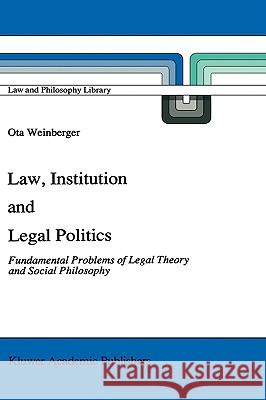
Law, Institution and Legal Politics: Fundamental Problems of Legal Theory and Social Philosophy Weinberger, Ota 9780792311430 Kluwer Academic Publishers - książkaWidoczna okładka, to zdjęcie poglądowe, a rzeczywista szata graficzna może różnić się od prezentowanej.

Law, Institution and Legal Politics: Fundamental Problems of Legal Theory and Social Philosophy

ISBN-13: 9780792311430 / Angielski / Twarda / 1991 / 276 str.

Ota Weinberger; O. Weinberger
cena 605,23
(netto: 576,41 VAT:  5%)

Najniższa cena z 30 dni: 578,30
Termin realizacji zamówienia:
ok. 22 dni roboczych.

Darmowa dostawa!

It gives me great pleasure to offer this foreword to the present work of my admired friend and respected colleague Ota Weinberger. Apart from the essays of his which were published in our joint work An Institutional Theory of Law: New Approaches to Legal Positivism in 1986, relatively little of Wein- berger's work is available in English. This is the more to be regretted, since his is work of particular interest to jurists of the English-speaking world both in view of its origins and in respect of its content As to its origins, Weinberger war reared as a student of the Pure Theory of Law, a theory which in its Kelsenian form has aroused very great interest and has had considerable influence among anglophoone scholars -perhaps even more than in the Germanic countries. Less well known is the fact that the Pure Theory itself divided into two schools, that of Vienna and that of Brno. It was in the Brno school of Frantisek Weyr that Weinberger's legal theory found its early formation, and perhaps from that early influence one can trace his continuing insistence on the dual character of legal norms -both as genuinely normative and yet at the same time having real social existence.


Kategorie:
Nauka, Filozofia
Kategorie BISAC:
Political Science > General
Law > Reference
Philosophy > Reference
Wydawca:
Kluwer Academic Publishers
Seria wydawnicza:
Nijhoff International Philosophy Series
Język:
Angielski
ISBN-13:
9780792311430
Rok wydania:
1991
Wydanie:
1991
Numer serii:
000061101
Ilość stron:
276
Waga:
0.59 kg
Wymiary:
23.39 x 15.6 x 1.75
Oprawa:
Twarda
Wolumenów:
01

A. Theoretical Bases.- I. Elements of Institutional Legal Positivism.- 1. The Ontology of Normative Institutionalism.- 2. The Language of Practical Realms.- 3. The Logic of Practical Thinking.- 4. Why do I Conceive of the Theory of Action as Formalist and why as Finalist?.- 5. Comments on the Definition and the Systematics of Institutions.- 6. Some Legal-Philosophical Implications of Normative Institutionalism.- 7. Why Legal Positivism?.- II. Towards a Formal-Teleological Theory of Action.- 1. Starting Points.- 2. Common-Sense Theory of Action.- 3. Behaviour as Transformation. Description of Actions. Meaningful Actions.- 4. Scope for Action and Freedom.- 5. Action as a Process of Selection based on Information.- 6. Identity and Difference of Actions.- 7. Teleology.- 7.1. The Relation between Teleology and Causality.- 7.2. Some Remarks on the Principle of Causality.- 7.3. Linear Causality and Causal Networks.- 7.4. Some Notes on the Ontology of Ends.- 7.5. Discovery, Optimisation and Choice of Means.- 8. On the Problem of the Dynamics of the System of Ends.- 9. Reducing the Complexity of Teleological Reflection.- 10. Remarks on the Methodology of the Analysis of Action.- III. The Significance of Logic for Modern Legal Theory. Fundamental Problems of Institutionalist Normativism.- 1. Main Areas of Logical Analysis in the Field of Jurisprudence.- 1.1. Logic as the Basis of the Structure Theory of Law.- 1.2. Rational Legal Argumentation.- 2. Logic, Law, and the Problems of the Logic of Norms.- 2.1. The Semantic Basis of the Logic of Norms and Action-related (or Practical) Disciplines.- 2.2. The Existence of Normative Regulations and the Institutionalist Conception of Law.- 2.3. Institutionalist Normativism and the Logic of Norms.- 3. The Idea of a Logic of Norms. Remarks on a Few Fundamental Problems.- 3.1. The Semantics of the Normative Sentences.- 3.2. Normative Sentence and Truth Value.- 3.3. Are there Normological Inferences.- 3.4. Logic of Norms or Deontic Logic.- 3.5. The Meta-postulate of the Non-derivability of ‘Ought’ from ‘Is’ and of ‘Is’ from ‘Ought’.- 3.6. Compound Normative Sentences, particularly the Hypothetical Normative Sentence.- 4. The Institutionalist Structure Theory of Law.- 5. The Plausibility Argumentation and Legal Hermeneutics in the Conception of Logicism.- B. Treatises on Legal Theory and Legal Sociology.- IV. Ontology, Hermeneutics and the Concept of Valid Law.- 1. The Legal Problem of Validity.- 2. ‘Is’ and ‘Ought’.- 3. The Field of Logical Operations.- 4. Institutional Ontology of Norms.- 5. The Juridical Definition of Valid Law.- 6. Legal Validity and Hermeneutics.- 7. Decision-Making Practice and Valid Law.- 8. Law and Purpose: On the Debate between Formalism and Instrumentalism.- V. Constitutional Theory in the Light of the New Institutionalism.- 1. Preliminary Remarks Concerning Terminology.- 2. The Projected Task.- 3. Fundamental Problems of Constitutional Theory.- 4. Theses of Institutional Legal Positivism which are relevant to the Constitutional Theory.- 5. Comments on the Fundamental Problems of the Constitutional Theory.- 5.1. State and Constitution.- 5.2. The Indispensability of the Constitution for the Existence of the State.- 5.3. The Effectiveness of the Constitution.- 5.4. The Institutional Unity of the System of Legal Sources.- 5.5. The Legal Stabilization of the Constitution: The Law establishing the Constitution (the Basic Law, the Constitutional Charter).- 5.6. The Essential Content of the Constitution.- 5.7. The Institutional Conception of Constitutional Knowledge.- 6. Political Power and the Structure of the Constitution.- 7. The Problem of Legitimacy.- 8. The Constitution and the Governing Ideas of Democracy.- VI. The Formal-teleological Theory of Action and Criminal Law.- 1. Some Problems Facing Criminal Law and the Theory of Action and the Goals of my Investigation.- 2. Characteristic Features of the Formal-teleological Theory of Action.- 3. The Concept of ‘Institutional Legal Positivism’.- 4. Fundamental Principles of the Teleological Theory of Action in Relation to Criminal Law.- 5. ‘Action’ and ‘Omission’ in Criminal Law Doctrine.- 6. The Generic Concept of Crime in Criminal Law.- 7. The Concept of Guilt.- 8. Notes on the Metatheory of Subsumption in Criminal Law.- VII. Institutional Theory and Institutional Legal Positivism.- 1. The Program of my Inquiry.- 2. A Characterisation of Institutional Legal Positivism.- 3. My Concept of Action and the Semantic Foundations of Practical Philosophy.- 4. The Concept of the Institution and its Typology.- 5. Institutional Theory in Modern Jurisprudence.- 6. Institutional Theories in Sociology.- 7. Institutional Legal Positivism contrasted with Juristic and Sociological Institutional Theories.- 8. Institutional Normativism and Sociology.- VIII. Sociology and the Normative Institutional Theory. Reflections on Helmut Schelsky’s Institutional Theory from the Point of View of the Normative Institutional Ontology.- 1. Behaviour and Action.- 2. The Language of Practical Philosophy.- 3. Normative Institutional Ontology.- 4. The Role of the Law in Schelsky’s Theory.- 5. Schelsky and Luhmann’s System-theoretical Method.- 6. Theses for a Theoretical Sociology.- C. Treatises on Legal Politics and Theory Of Justice.- IX. Legal-Political Analysis of Institutions.- 1. Legal Policy as a Scientific Problem of our Time.- 2. The Relevance of the Legal-Philosophical Approach to Legal-political Analyses.- 3. Characterization of the Science of Legal Policy.- 4. Rational Thinking and Practical Cognition.- 5. Two Types of Legal Argumentation.- 6. Rationality and the Legal-political Discussion.- 7. Types of Legal-political Argumentation.- 8. The Sources of Practical Dissent and of the Search for Consensus.- 9. Common Haws in Legal-Political Argumentations.- 10. The Conception of Democracy and Legal Policy.- 11. A Functional Analysis of Institutions and Democratic Legal Policy.- 12. Democracy and Power.- 13. Determinants of Political Control.- 14. The Role of the Sciences and of Experts in a Democracy.- 15. Democratic Legal Policy and the Concept of Justice.- X. The Conditio Humana and the Ideal of Justice.- 10.1. The Role of the Theory of Justice.- 10.2. The Anthropological Approach to the Problem of Justice.- 10.3. Ideals of Justice as Determinants of Action.- 10.4. The Analytical and Dialectic Character of Reflections on Justice.- 10.5. Formal Postulates of Justice.- 10.6. Natural Law or Convictions of Justice.- 10.7. Postulates of the Just Application of the Law.- 10.8. Balanced Role-play as a Postulate of Justice.- 10.9. Collective Action.- 10.10. Present-day Aspects of the Problems of Justice.- Original Sources.


Udostępnij

Facebook - konto krainaksiazek.pl


Opinie o Krainaksiazek.pl na Opineo.pl

Partner Mybenefit

Krainaksiazek.pl w programie rzetelna firma Krainaksiaze.pl - płatności przez paypal

Czytaj nas na:

Facebook - krainaksiazek.pl
  • książki na zamówienie
  • granty
  • książka na prezent
  • kontakt
  • pomoc
  • opinie
  • regulamin
  • polityka prywatności

Zobacz:

  • Księgarnia czeska

  • Wydawnictwo Książkowe Klimaty

1997-2026 DolnySlask.com Agencja Internetowa

© 1997-2022 krainaksiazek.pl
     
KONTAKT | REGULAMIN | POLITYKA PRYWATNOŚCI | USTAWIENIA PRYWATNOŚCI
Zobacz: Księgarnia Czeska | Wydawnictwo Książkowe Klimaty | Mapa strony | Lista autorów
KrainaKsiazek.PL - Księgarnia Internetowa

Polityka prywatnosci - link
Krainaksiazek.pl - płatnośc Przelewy24
Przechowalnia Przechowalnia






