• Wyszukiwanie zaawansowane
  • Kategorie
  • Kategorie BISAC
  • Książki na zamówienie
  • Promocje
  • Granty
  • Książka na prezent
  • Opinie
  • Pomoc
  • Załóż konto
  • Zaloguj się

Language, Music and Gesture: Informational Crossroads: Lmgic 2021 » książka


zaloguj się | załóż konto
Logo Krainaksiazek.pl

koszyk

konto

szukaj
topmenu
Księgarnia internetowa
Szukaj
Książki na zamówienie
Promocje
Granty
Książka na prezent
Moje konto
Pomoc
 
 
Wyszukiwanie zaawansowane
Pusty koszyk
Bezpłatna dostawa dla zamówień powyżej 20 złBezpłatna dostawa dla zamówień powyżej 20 zł

Kategorie główne

• Nauka
 [2946600]
• Literatura piękna
 [1856966]

  więcej...
• Turystyka
 [72221]
• Informatyka
 [151456]
• Komiksy
 [35826]
• Encyklopedie
 [23190]
• Dziecięca
 [619653]
• Hobby
 [140543]
• AudioBooki
 [1577]
• Literatura faktu
 [228355]
• Muzyka CD
 [410]
• Słowniki
 [2874]
• Inne
 [445822]
• Kalendarze
 [1744]
• Podręczniki
 [167141]
• Poradniki
 [482898]
• Religia
 [510455]
• Czasopisma
 [526]
• Sport
 [61590]
• Sztuka
 [243598]
• CD, DVD, Video
 [3423]
• Technologie
 [219201]
• Zdrowie
 [101638]
• Książkowe Klimaty
 [124]
• Zabawki
 [2473]
• Puzzle, gry
 [3898]
• Literatura w języku ukraińskim
 [254]
• Art. papiernicze i szkolne
 [8170]
Kategorie szczegółowe BISAC

Language, Music and Gesture: Informational Crossroads: Lmgic 2021

ISBN-13: 9789811637445 / Angielski / Miękka / 2022
Chernigovskaya, Tatiana
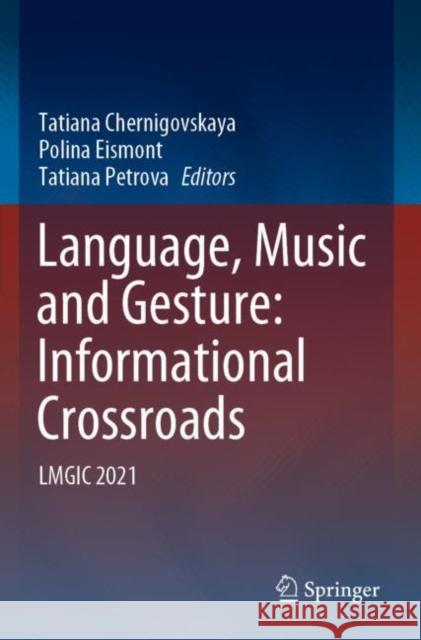
Language, Music and Gesture: Informational Crossroads: Lmgic 2021 Chernigovskaya, Tatiana 9789811637445 Springer Nature Singapore - książkaWidoczna okładka, to zdjęcie poglądowe, a rzeczywista szata graficzna może różnić się od prezentowanej.

Language, Music and Gesture: Informational Crossroads: Lmgic 2021

ISBN-13: 9789811637445 / Angielski / Miękka / 2022

Chernigovskaya, Tatiana
cena 524,53 zł
(netto: 499,55 VAT:  5%)

Najniższa cena z 30 dni: 501,19 zł
Termin realizacji zamówienia:
ok. 22 dni roboczych
Bez gwarancji dostawy przed świętami

Darmowa dostawa!

This book brings together selected revised papers representing a multidisciplinary approach to language, music, and gesture, as well as their interaction. Among the number of multidisciplinary and comparative studies of the structure and organization of language and music, the presented book broadens the scope with the inclusion of gesture problems in the analyzed spectrum. A unique feature of the presented collection is that the papers, compiled in one volume, allow readers to see similarities and differences in gesture as an element of non-verbal communication and gesture as the main element of dance. In addition to enhancing the analysis, the data on the perception and comprehension of speech, music, and dance in regard to both their functioning in a natural situation and their reflection in various forms of performing arts makes this collection extremely useful for those who are interested in human cognitive abilities and performing skills.  
The book begins with a philosophical overview of recent neurophysiological studies reflecting the complexity of higher cognitive functions, which references the idea of the baroque style in art being neither linear nor stable. The following papers are allocated into 5 sections. The papers of the section “Language-Music-Gesture As Semiotic Systems” discuss the issues of symbolic and semiotic aspects of language, music, and gesture, including from the perspective of their notation. This is followed by the issues of "Language-Music-Gesture Onstage" and interaction within the idea of the "World as a Text." The papers of “Teaching Language and Music” present new teaching methods that take into account the interaction of all the cognitive systems examined. The papers of the last two sections focus on issues related primarily to language: The section "Verbalization Of Music And Gesture" considers the problem of describing musical text and non-verbal behavior with language, and papers in the final section "Emotions In Linguistics And Ai-Communication Systems” analyze the ways of expressing emotions in speech and the problems of organizing emotional communication with computer agents.


Kategorie:
Nauka, Językoznawstwo
Kategorie BISAC:
Literary Criticism > Semiotics & Theory
Language Arts & Disciplines > Linguistics - Phonetics & Phonology
Medical > Zaburzenia mowy
Wydawca:
Springer Nature Singapore
Język:
Angielski
ISBN-13:
9789811637445
Rok wydania:
2022
Waga:
0.39 kg
Wymiary:
23.5 x 15.5
Oprawa:
Miękka
Dodatkowe informacje:
Wydanie ilustrowane

Preface

I. LANGUAGE-MUSIC-GESTURE AS SEMIOTIC SYSTEMS
1. Nina Scherbak, Saint Petersburg State University
Theory of sign and cognitive abilities, interaction of musical and literary languages
2. Konstantin V. Zenkin, Tchaikovsky Moscow State Conservatory
Music sense and gesture
3. Alexandra Krylova, Rachmaninov Rostov State Conservatory
Acousmatic objects in the space of multimedia installations
4. Giula Baijan Shamilli, The State Institute for Art Studies
Language and Music in Aspect of a Subject-Predicate Construction: Hierarchical and Non-hierarchical Structures
5. Tuğral Oğuzhan, Independent researcher, Turkey
On The Syntax Of A Compound Maqam In Turkish Art Music: Yet, Another Look At Maximal Projections In Generative Grammar Studies In Music
6. Anastasia Gundorina, Gnesins Russian Academy Of Music
Metaphor as a structural principle of modern musical notation

II. LANGUAGE-MUSIC-GESTURE ONSTAGE 
1. Olga Manulkina, Saint Petersburg State University
Reading Opera: Verbal vs Nonverbal in Opera Theatre at the Late 20th and Early 21st Centuries
2. Sophie Benn, Case Western Reserve University
By Any Other Name: Historiography and Phraseology in Dance and Music, 1820-1860
3. Elena Pogorelova, Saint Petersburg State University
A gesture and a word in a dance performance («The Wedding» by Bronislava Nizhynskaya and «Orpheus and Eurydice» by Pina Bausch)
4. Ekaterina Levina, Vaganova Ballet Academy
K.King's "Metapoiesis" as a form of intertext
5. Ilia Kronchev, Saint Petersburg State University
Language of Body in Rebecca Horn's performances: the pattern of the gesture and its semiotics

III. VERBALIZATION OF MUSIC AND GESTURE
1. Polina Eismont, Saint Petersburg State University
The role of gestures in storytelling: static vs. dynamic
2. Leonid V. Pakhomov, Elena V. Erofeeva, Tatyana E. Petrova, Perm State National Research University, Saint Petersburg State University
Metaphorical Space of Discourse: Modeling of a Vocal Metaphor Target-Domain
3. Elena Chistova, Siberian Federal University
Non-verbal semiotics in dance narrative and simultaneous interpreting: a cognitive intersection
4. Annamaria Minafra, Independent researcher, UK
Exploring gestures and body language in professional musicians during the self-reflection process on technical movement

IV. THE BEAT OF LANGUAGE
1. Sofiya Ros, Utrecht University
When language has a beat: Senegalese drum language and linguistic theory
2. Vera V. Evdokimova, Saint Petersburg State University
A comparative analysis of the long-term speech spectra in dialogues
3. Tatiana Kachkovskaia, Saint Petersburg iState University
Intensity patterns of final and non-final IPs: a corpus-based study
4. Ekaterina Zavodova, Vera Karpinskaya, Saint Petersburg State University
Cross-modal interaction in visual tasks with rhythmical stimuli
5. João Veloso, University of Porto, Portugal
Metric and musical prominence in Portuguese folk verse
6. T.V. Skulacheva, N.A. Slioussar, A.E. Kostyuk, A.A. Lipina, E.I. Latypov, V.M. Koroleva, V.V. Vinogradov Russian Language Institute of the Russian Academy of Sciences, Saint Petersburg State University, Higher School of Economics, Moscow
Information processing in verse and prose: experimental study

V. EMOTIONS IN LINGUISTICS AND  AI-COMMUNICATION SYSTEMS
1. Artemiy Kotov, Nikita Arinkin, Alexander Filatov, Liudmila Zaidelman, Anna Zinina, National Research Center «Kurchatov Institute», Russian State University for the Humanities
Model of Emotional Expressions for F-2 Companion Robot
2. Eleonora Beier, University of California, Davis
Prosodic focus in speech directed toward human vs. voice-AI interlocutors
3. Beatrice Szczepek Reed, King's College London
The musical elements of speech as a co-ordinating resource for conversation: the role of prosodic mirroring
4. Valeriia Dolgaya, Elena Riekhakaynen, Evelina Kuznetsova, Varvara Nikolaeva, Saint Petersburg State University
Can adolescents recognize emotional state of their age-mates by speech?
5. Pavel Skrelin, Uliana Kochetkova, Vera Evdokimova, Tatiana Chukaeva, Daria Novoselova, Saint Petersburg State University
Creating corpus of speech for the analysis of the acoustic cues of irony
6. Anastassia Kolmogorova, Alexandre Kalinin, Anna Malikova, Siberian Federal University
The part and the whole in emotional perception of text: two pathways for assessment of emotional dataset

​Tatiana Chernigovskaya is Professor of St Petersburg University, Head of the Department of the Problems of Convergence in Natural Sciences and Humanities, Director of Institute for Cognitive research, Doctor of Science in Human Physiology (1993), Member of Russian Academy of Education, Member of the Norwegian Academy of Science and Letters, Honorary member of the Semiotic Society of Finland. Invited lecturer in many European and North American Universities. The author of more than 350 publications. Gold medal of Russian Academy of Sciences for propagation of scientific knowledge winner (2017).


Polina Eismont is an Associate Professor at the Department of General Linguistics, St. Petersburg State University. Her research interests include Language Acquisition and Psycholinguistics, Text Linguistics, Cognitive Linguistics, Event Structure, Music Semantics, Syntax of Nulls. She obtained her Ph.D. from St. Petersburg State University in 2008. She is the author of more than 40 papers in domestic and international journals and the co-editor of two CCIS volumes “Language, Music, and Computing” (Springer Verlag, 2015, 2019).  

Tatiana Petrova is an Associate Professor at the Department of Theory and Methodology for Teaching Arts and Humanities, and the leading researcher of the Institute for Cognitive Studies, St. Petersburg State University. Her research interests include Psycholinguistics and Neurolinguistics, Text Processing, Second Language Acquisition, Context Predictability, Reading and Visual Recognition. She obtained her Ph.D.from St. Petersburg State University in 2000. She is the author of more than 80 papers in domestic and international journals and the co-author of two online courses on Coursera. In the past 10 years, she has been coordinating the work of the St. Petersburg Seminar on cognitive Research. She also organizes St. Petersburg Winter Workshops on Experimental Studies of Speech and Language (2011, 2014, 2015, 2018, 2019), serving as a member of Program Committee.

This book brings together selected revised papers representing a multidisciplinary approach to language, music, and gesture, as well as their interaction. Among the number of multidisciplinary and comparative studies of the structure and organization of language and music, the presented book broadens the scope with the inclusion of gesture problems in the analyzed spectrum. A unique feature of the presented collection is that the papers, compiled in one volume, allow readers to see similarities and differences in gesture as an element of non-verbal communication and gesture as the main element of dance. In addition to enhancing the analysis, the data on the perception and comprehension of speech, music, and dance in regard to both their functioning in a natural situation and their reflection in various forms of performing arts makes this collection extremely useful for those who are interested in human cognitive abilities and performing skills.  

The book begins with a philosophical overview of recent neurophysiological studies reflecting the complexity of higher cognitive functions, which references the idea of the baroque style in art being neither linear nor stable. The following papers are allocated into 5 sections. The papers of the section “Language-Music-Gesture As Semiotic Systems” discuss the issues of symbolic and semiotic aspects of language, music, and gesture, including from the perspective of their notation. This is followed by the issues of "Language-Music-Gesture Onstage" and interaction within the idea of the "World as a Text." The papers of “Teaching Language and Music” present new teaching methods that take into account the interaction of all the cognitive systems examined. The papers of the last two sections focus on issues related primarily to language: The section "Verbalization Of Music And Gesture" considers the problem of describing musical text and non-verbal behavior with language, and papers in the final section "Emotions In Linguistics And Ai-Communication Systems” analyze the ways of expressing emotions in speech and the problems of organizing emotional communication with computer agents.




Udostępnij

Facebook - konto krainaksiazek.pl


Opinie o Krainaksiazek.pl na Opineo.pl

Partner Mybenefit

Krainaksiazek.pl w programie rzetelna firma Krainaksiaze.pl - płatności przez paypal

Czytaj nas na:

Facebook - krainaksiazek.pl
  • książki na zamówienie
  • granty
  • książka na prezent
  • kontakt
  • pomoc
  • opinie
  • regulamin
  • polityka prywatności

Zobacz:

  • Księgarnia czeska

  • Wydawnictwo Książkowe Klimaty

1997-2025 DolnySlask.com Agencja Internetowa

© 1997-2022 krainaksiazek.pl
     
KONTAKT | REGULAMIN | POLITYKA PRYWATNOŚCI | USTAWIENIA PRYWATNOŚCI
Zobacz: Księgarnia Czeska | Wydawnictwo Książkowe Klimaty | Mapa strony | Lista autorów
KrainaKsiazek.PL - Księgarnia Internetowa

Polityka prywatnosci - link
Krainaksiazek.pl - płatnośc Przelewy24
Przechowalnia Przechowalnia




