Land and Agrarian Reform in Zimbabwe. Beyond White-Settler Capitalism » książka





Land and Agrarian Reform in Zimbabwe. Beyond White-Settler Capitalism
ISBN-13: 9782869785533 / Angielski / Miękka / 2013 / 372 str.
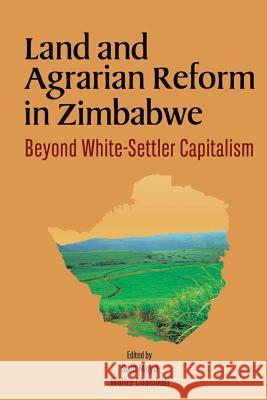
The Fast Track Land Reform Programme implemented during the 2000s in Zimbabwe represents the only instance of radical redistributive land reforms since the end of the Cold War. It reversed the racially-skewed agrarian structure and discriminatory land tenures inherited from colonial rule. The land reform also radicalised the state towards a nationalist, introverted accumulation strategy, against a broad array of unilateral Western sanctions. Indeed, Zimbabwe's land reform, in its social and political dynamics, must be compared to the leading land reforms of the twentieth century, which include those of Mexico, Russia, China, Japan, South Korea, Taiwan, Cuba and Mozambique. The fact that the Zimbabwe case has not been recognised as vanguard nationalism has much to do with the 'intellectual structural adjustment' which has accompanied neoliberalism and a hostile media campaign. This has entailed dubious theories of eneopatrimonialismi, which reduce African politics and the state to endemic ecorruptioni, epatronagei, and etribalismi while overstating the virtues of neoliberal good governance. Under this racist repertoire, it has been impossible to see class politics, mass mobilisation and resistance, let alone believe that something progressive can occur in Africa. This book comes to a conclusion that the Zimbabwe land reform represents a new form of resistance with distinct and innovative characteristics when compared to other cases of radicalisation, reform and resistance. The process of reform and resistance has entailed the deliberate creation of a tri-modal agrarian structure to accommodate and balance the interests of various domestic classes, the progressive restructuring of labour relations and agrarian markets, the continuing pressures for radical reforms (through the indigenisation of mining and other sectors), and the rise of extensive, albeit relatively weak, producer cooperative structures. The book also highlights some of the resonances between the Zimbabwean land struggles and those on the continent, as well as in the South in general, arguing that there are some convergences and divergences worthy of intellectual attention. The book thus calls for greater endogenous empirical research which overcomes the pre-occupation with failed interpretations of the nature of the state and agency in Africa.
The Fast Track Land Reform Programme implemented during the 2000s in Zimbabwe represents the only instance of radical redistributive land reforms since the end of the Cold War. It reversed the racially-skewed agrarian structure and discriminatory land tenures inherited from colonial rule. The land reform also radicalised the state towards a nationalist, introverted accumulation strategy, against a broad array of unilateral Western sanctions. Indeed, Zimbabwes land reform, in its social and political dynamics, must be compared to the leading land reforms of the twentieth century, which include those of Mexico, Russia, China, Japan, South Korea, Taiwan, Cuba and Mozambique. The fact that the Zimbabwe case has not been recognised as vanguard nationalism has much to do with the intellectual structural adjustment which has accompanied neoliberalism and a hostile media campaign. This has entailed dubious theories of ëneopatrimonialismí, which reduce African politics and the state to endemic ëcorruptioní, ëpatronageí, and ëtribalismí while overstating the virtues of neoliberal good governance. Under this racist repertoire, it has been impossible to see class politics, mass mobilisation and resistance, let alone believe that something progressive can occur in Africa. This book comes to a conclusion that the Zimbabwe land reform represents a new form of resistance with distinct and innovative characteristics when compared to other cases of radicalisation, reform and resistance. The process of reform and resistance has entailed the deliberate creation of a tri-modal agrarian structure to accommodate and balance the interests of various domestic classes, the progressive restructuring of labour relations and agrarian markets, the continuing pressures for radical reforms (through the indigenisation of mining and other sectors), and the rise of extensive, albeit relatively weak, producer cooperative structures. The book also highlights some of the resonances between the Zimbabwean land struggles and those on the continent, as well as in the South in general, arguing that there are some convergences and divergences worthy of intellectual attention. The book thus calls for greater endogenous empirical research which overcomes the pre-occupation with failed interpretations of the nature of the state and agency in Africa.




Czytaj nas na:
KrainaKsiazek.PL - Księgarnia Internetowa


