Land Cover Classification of Remotely Sensed Images: A Textural Approach » książka





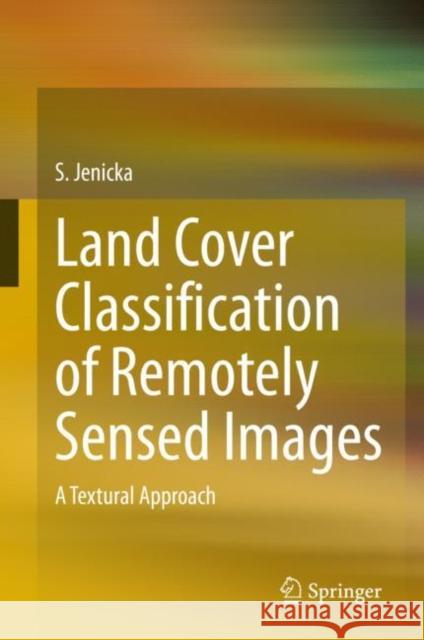
Land Cover Classification of Remotely Sensed Images: A Textural Approach
ISBN-13: 9783030665944 / Angielski / Twarda / 2021 / 176 str.
Land Cover Classification of Remotely Sensed Images: A Textural Approach
ISBN-13: 9783030665944 / Angielski / Twarda / 2021 / 176 str.
(netto: 498,38 VAT: 5%)
Najniższa cena z 30 dni: 501,19
ok. 16-18 dni roboczych.
Darmowa dostawa!
ABSTRACT
i
ACKNOWLEDGEMENTS
iii
DEDICATION
v
TABLE OF CONTENTS
vi
LIST OF FIGURES
xi
LIST OF TABLES
xiv
LIST OF SYMBOLS AND ABBREVIATIONS
xvi
1
INTRODUCTION TO REMOTE SENSING
1
1.1
Basics of Remote Sensing
1
1.2
Resolution Characteristics of remotely sensed imagery data
7
1.3
Reflectance Characteristics of Remotely Sensed Imagery9
1.4
Remote sensing applications
12
1.5
Types of remotely sensed images
2
INTRODUCTION TO TEXTURE
14
2.1
Basics of texture14
2.2
Texture analysis
3
LITERATURE SURVEY
19
3.1
Introduction19
3.2
Survey Papers on Texture Models
19
3.3
Texture Models used for Characterization of Images
26
3.3.1
Structural Texture Models
27
3.3.2
Statistical Texture Models
27
3.3.3
Spectral Models
30
3.3.4
Model based Texture Models
30
3.3.5
Fuzzy based Models
31
3.3.6
Combined (texture and colour) approach Models
3.4
Classifiers applied in texture based study
42
3.5
Distance measures in texture based study45
4
A FEW EXISTING BASIC AND MULTIVARIATE TEXTURE MODELS
49
4.1
Multivariate Local Binary Pattern
49
4.2
Multivariate Local Texture Pattern50
4.3
Gray Level Co-occurrence Matrix
51
4.4
Texture Spectrum
54
4.5
Discrete Local Texture Pattern
4.6
Local Derivative Pattern
4.7
MATLAB codes of basic texture models
5
TEXTURE BASED SEGMENTATION USING BASIC TEXTURE MODELS
77
5.1
Texture based classification77
5.2
Texture based segmentation
78
5.3
k-Nearest Neighbour (k-NN) Classifier
5.4
Experimental data
5.5
Matlab codes for texture based segmentation
5.5.1
GLCM and minimum distance classifier
5.5.2
LBP and minimum distance classifier
6
TEXTURE BASED SEGMENTATION USING LBP WITH SUPERVISED AND UNSUPERVISED CLASSIFIERS
6.1
Texture Segmentation using LBP with Supervised Classifiers
78
6.1.1
LBP with fuzzy k-NN
6.1.2
LBP with SVM
6.1.3
LBP with ANFIS
6.1.4
LBP with ELM
6.1.5
LBP with HMM
6.2
Texture Segmentation using LBP with Unsupervised Classifiers
6.2.1
LBP with SOM
6.2.2
LBP with FCM
7
TEXTURE BASED CLASSIFICATION OF REMOTELY SENSED IMAGES
7.1
Issues and challenges in texture based classification of remotely sensed images
7.2
The proposed texture model
7.3
Matlab code : Classification Procedure for texture based classification of remotely sensed images using the proposed texture model
7.4
The proposed approach using HMM
8
PERFORMANCE METRICS
135
REFERENCES
LIST OF PUBLICATIONS BY AUTHOR
AUTHOR’S BIOGRAPHY
Dr. S. Jenicka completed her under graduation in Computer Science and Engineering at Thiagarajar College of Engineering, Madurai, Tamil Nadu in 1994. Later she finished her post-graduation in the same discipline in 2009 from Manonmaniam Sundaranar University, Tirunelveli, Tamil Nadu. She completed a doctorate in Computer Science and Engineering in 2014. Her research work was on ‘Texture based classification of remotely sensed images’. Her interests include Satellite image processing and texture segmentation.
The book introduces two domains namely Remote Sensing and Digital Image Processing. It discusses remote sensing, texture, classifiers, and procedures for performing the texture-based segmentation and land cover classification.
The first chapter discusses the important terminologies in remote sensing, basics of land cover classification, types of remotely sensed images and their characteristics. The second chapter introduces the texture and a detailed literature survey citing papers related to texture analysis and image processing. The third chapter describes basic texture models for gray level images and multivariate texture models for color or remotely sensed images with relevant Matlab source codes. The fourth chapter focuses on texture-based classification and texture-based segmentation. The Matlab source codes for performing supervised texture based segmentation using basic texture models and minimum distance classifier are listed. The fifth chapter describes supervised and unsupervised classifiers. The experimental results obtained using a basic texture model (Uniform Local Binary Pattern) with the classifiers described earlier are discussed through the relevant Matlab source codes. The sixth chapter describes land cover classification procedure using multivariate (statistical and spectral) texture models and minimum distance classifier with Matlab source codes. A few performance metrics are also explained. The seventh chapter explains how texture based segmentation and land cover classification are performed using the hidden Markov model with relevant Matlab source codes. The eighth chapter gives an overview of spatial data analysis and other existing land cover classification methods. The ninth chapter addresses the research issues and challenges associated with land cover classification using textural approaches.
This book is useful for undergraduates in Computer Science and Civil Engineering and postgraduates who plan to do research or project work in digital image processing. The book can serve as a guide to those who narrow down their research to processing remotely sensed images. It addresses a wide range of texture models and classifiers. The book not only guides but aids the reader in implementing the concepts through the Matlab source codes listed. In short, the book will be a valuable resource for growing academicians to gain expertise in their area of specialization and students who aim at gaining in-depth knowledge through practical implementations. The exercises given under texture based segmentation (excluding land cover classification exercises) can serve as lab exercises for the undergraduate students who learn texture based image processing.




Czytaj nas na:
1997-2026 DolnySlask.com Agencja Internetowa
KrainaKsiazek.PL - Księgarnia Internetowa


