Knowledge-Based Bioinformatics » książka





Knowledge-Based Bioinformatics
ISBN-13: 9780470748312 / Angielski / Twarda / 2010 / 400 str.
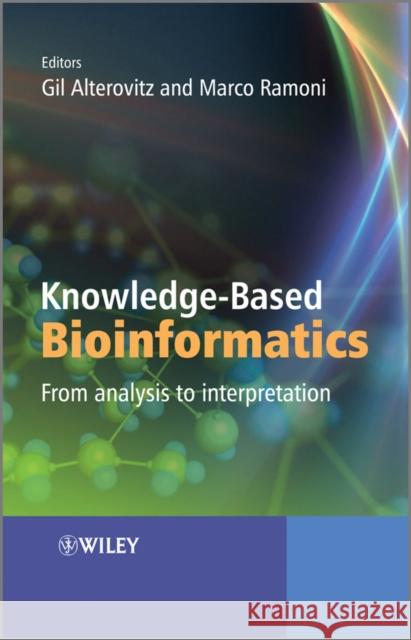
Knowledge-Based Bioinformatics
ISBN-13: 9780470748312 / Angielski / Twarda / 2010 / 400 str.
(netto: 318,47 VAT: 5%)
Najniższa cena z 30 dni: 325,67
ok. 30 dni roboczych.
Darmowa dostawa!
In order to deal with issues that arise from the increase of biological data in genomic and proteomic research, broader coverage of recent developments in the field of knowledge-based systems and their applications is required. This book provides comprehensive coverage of knowledge-driven approaches to bioinformatics.
Wydanie ilustrowane
Preface.
List of Contributors.
PART I FUNDAMENTALS.
Section 1 Knowledge–Driven Approaches.
1 Knowledge–based bioinformatics (Eric Karl Neumann).
1.1 Introduction.
1.2 Formal reasoning for bioinformatics.
1.3 Knowledge representations.
1.4 Collecting explicit knowledge.
1.5 Representing common knowledge.
1.6 Capturing novel knowledge.
1.7 Knowledge discovery applications.
1.8 Semantic harmonization: the power and limitation of ontologies.
1.9 Text mining and extraction.
1.10 Gene expression.
1.11 Pathways and mechanistic knowledge.
1.12 Genotypes and phenotypes.
1.13 The Web′s role in knowledge mining.
1.14 New frontiers.
1.15 References.
2 Knowledge–driven approaches to genome–scale analysis (Hannah Tipney and Lawrence Hunter).
2.1 Fundamentals.
2.2 Challenges in knowledge–driven approaches.
2.3 Current knowledge–based bioinformatics tools.
2.4 3R systems: reading, reasoning and reporting the way towards biomedical discovery.
2.5 The Hanalyzer: a proof of 3R concept.
2.6 Acknowledgements.
2.7 References.
3 Technologies and best practices for building bio–ontologies (Mikel Egaña Aranguren, Robert Stevens, Erick Antezana, Jesualdo Tomás Fernández–Breis, Martin Kuiper, and Vladimir Mironov).
3.1 Introduction.
3.2 Knowledge representation languages and tools for building bio–ontologies.
3.3 Best practices for building bio–ontologies.
3.4 Conclusion.
3.5 Acknowledgements.
3.6 References.
4 Design, implementation and updating of knowledge bases (Sarah Hunter, Rolf Apweiler, and Maria Jesus Martin).
4.1 Introduction.
4.2 Sources of data in bioinformatics knowledge bases.
4.3 Design of knowledge bases.
4.4 Implementation of knowledge bases.
4.5 Updating of knowledge bases.
4.6 Conclusions.
4.7 References.
Section 2 Data–Analysis Approaches.
5 Classical statistical learning in bioinformatics (Mark Reimers).
5.1 Introduction.
5.2 Significance testing.
5.3 Exploratory analysis.
5.4 Classification and prediction.
5.5 References.
6 Bayesian methods in genomics and proteomics studies (Ning Sun and Hongyu Zhao).
6.1 Introduction.
6.2 Bayes theorem and some simple applications.
6.3 Inference of population structure from genetic marker data.
6.4 Inference of protein binding motifs from sequence data.
6.5 Inference of transcriptional regulatory networks from joint analysis of protein DNA binding data and gene expression data.
6.6 Inference of protein and domain interactions from yeast two–hybrid data.
6.7 Conclusions.
6.8 Acknowledgements.
6.9 References.
7 Automatic text analysis for bioinformatics knowledge discovery (Dietrich Rebholz–Schuhmann and Jung–jae Kim).
7.1 Introduction.
7.2 Information needs for biomedical text mining.
7.3 Principles of text mining.
7.4 Development issues.
7.5 Success stories.
7.6 Conclusion.
7.7 References.
PART II APPLICATIONS.
Section 3 Gene and Protein Information.
8 Fundamentals of gene ontology functional annotation (Varsha K. Khodiyar, Emily C. Dimmer, Rachael P. Huntley, and Ruth C. Lovering).
8.1 Introduction.
8.2 Gene Ontology (GO).
8.3 Comparative genomics and electronic protein annotation.
8.4 Community annotation.
8.5 Limitations.
8.6 Accessing GO annotations.
8.7 Conclusions.
8.8 References.
9 Methods for improving genome annotation (Jonathan Mudge and Jennifer Harrow).
9.1 The basis of gene annotation.
9.2 The impact of next generation sequencing on genome annotation.
9.3 References.
10 Sequences from prokaryotic, eukaryotic, and viral genomes available clustered according to phylotype on a Self–Organizing Map (Takashi Abe, Shigehiko Kanaya, and Toshimichi Ikemura).
10.1 Introduction.
10.2 Batch–learning SOM (BLSOM) adapted for genome informatics.
10.3 Genome sequence analyses using BLSOM.
10.4 Conclusions and discussion.
10.5 References.
Section 4 Biomolecular Relationships and Meta–Relationships.
11 Molecular network analysis and applications (Minlu Zhang, Jingyuan Deng, Chunsheng V. Fang, Xiao Zhang, and Long Jason Lu).
11.1 Introduction.
11.2 Topology analysis and applications.
11.3 Network motif analysis.
11.4 Network modular analysis and applications.
11.5 Network comparison.
11.6 Network analysis software and tools.
11.7 Summary.
11.8 Acknowledgement.
11.9 References.
12 Biological pathway analysis: an overview of Reactome and other integrative pathway knowledge bases (Robin A. Haw, Marc E. Gillespie, and Michael A. Caudy).
12.1 Biological pathway analysis and pathway knowledge bases.
12.2 Overview of high–throughput data capture technologies and data repositories.
12.3 Brief review of selected pathway knowledge bases.
12.4 How does information get into pathway knowledge bases?
12.5 Introduction to data exchange languages.
12.6 Visualization tools.
12.7 Use case: pathway analysis in Reactome using statistical analysis of high–throughput data sets.
12.8 Discussion: challenges and future directions of pathway knowledge bases.
12.9 References.
13 Methods and challenges of identifying biomolecular relationships and networks associated with complex diseases/phenotypes, and their application to drug treatments (Mie Rizig).
13.1 Complex traits: clinical phenomenology and molecular background.
13.2 Why it is challenging to infer relationships between genes and phenotypes in complex traits? 317
13.3 Bottom–up or top–down: which approach is more useful in delineating complex traits key drivers?
13.4 High–throughput technologies and their applications in complex traits genetics.
13.5 Integrative systems biology: a comprehensive approach to mining high–throughput data.
13.6 Methods applying systems biology approach in the identification of functional relationships from gene expression data.
13.7 Advantages of networks exploration in molecular biology and drug discovery.
13.8 Practical examples of applying systems biology approaches and network exploration in the identification of functional modules and disease–causing genes in complex phenotypes/diseases.
13.9 Challenges and future directions.
13.10 References.
Trends and conclusion.
Index.
There is an increasing need throughout the biomedical sciences for a greater understanding of knowledge–based systems and their application to genomic and proteomic research. This book discusses knowledge–based and statistical approaches, along with applications in bioinformatics and systems biology. The text emphasizes the integration of different methods for analysing and interpreting biomedical data. This, in turn, can lead to breakthrough biomolecular discoveries, with applications in personalized medicine.
Key Features:
- Explores the fundamentals and applications of knowledge–based and statistical approaches in bioinformatics and systems biology.
- Helps readers to interpret genomic, proteomic, and metabolomic data in understanding complex biological molecules and their interactions.
- Provides useful guidance on dealing with large datasets in knowledge bases, a common issue in bioinformatics.
- Written by leading international experts in this field.
Students, researchers, and industry professionals with a background in biomedical sciences, mathematics, statistics, or computer science will benefit from this book. It will also be useful for readers worldwide who want to master the application of bioinformatics to real–world situations and understand biological problems that motivate algorithms.




Czytaj nas na:
1997-2026 DolnySlask.com Agencja Internetowa
KrainaKsiazek.PL - Księgarnia Internetowa


