• Wyszukiwanie zaawansowane
  • Kategorie
  • Kategorie BISAC
  • Książki na zamówienie
  • Promocje
  • Granty
  • Książka na prezent
  • Opinie
  • Pomoc
  • Załóż konto
  • Zaloguj się

Judgment in Predictive Analytics » książka


zaloguj się | załóż konto
Logo Krainaksiazek.pl

koszyk

konto

szukaj
topmenu
Księgarnia internetowa
Szukaj
Książki na zamówienie
Promocje
Granty
Książka na prezent
Moje konto
Pomoc
 
 
Wyszukiwanie zaawansowane
Pusty koszyk
Bezpłatna dostawa dla zamówień powyżej 20 złBezpłatna dostawa dla zamówień powyżej 20 zł

Kategorie główne

• Nauka
 [2946600]
• Literatura piękna
 [1856966]

  więcej...
• Turystyka
 [72221]
• Informatyka
 [151456]
• Komiksy
 [35826]
• Encyklopedie
 [23190]
• Dziecięca
 [619653]
• Hobby
 [140543]
• AudioBooki
 [1577]
• Literatura faktu
 [228355]
• Muzyka CD
 [410]
• Słowniki
 [2874]
• Inne
 [445822]
• Kalendarze
 [1744]
• Podręczniki
 [167141]
• Poradniki
 [482898]
• Religia
 [510455]
• Czasopisma
 [526]
• Sport
 [61590]
• Sztuka
 [243598]
• CD, DVD, Video
 [3423]
• Technologie
 [219201]
• Zdrowie
 [101638]
• Książkowe Klimaty
 [124]
• Zabawki
 [2473]
• Puzzle, gry
 [3898]
• Literatura w języku ukraińskim
 [254]
• Art. papiernicze i szkolne
 [8170]
Kategorie szczegółowe BISAC

Judgment in Predictive Analytics

ISBN-13: 9783031300844 / Angielski
Matthias Seifert
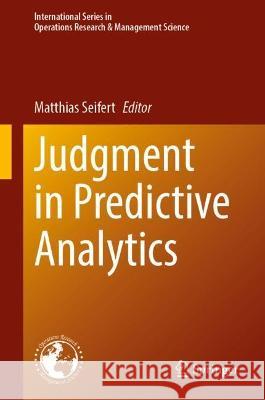
Judgment in Predictive Analytics Matthias Seifert 9783031300844 Springer - książkaWidoczna okładka, to zdjęcie poglądowe, a rzeczywista szata graficzna może różnić się od prezentowanej.

Judgment in Predictive Analytics

ISBN-13: 9783031300844 / Angielski

Matthias Seifert
cena 685,93 zł
(netto: 653,27 VAT:  5%)

Najniższa cena z 30 dni: 616,85 zł
Termin realizacji zamówienia:
ok. 22 dni roboczych
Bez gwarancji dostawy przed świętami

Darmowa dostawa!
inne wydania

This book highlights research on the behavioral biases affecting judgmental accuracy in judgmental forecasting and showcases the state-of-the-art in judgment-based predictive analytics. In recent years, technological advancements have made it possible to use predictive analytics to exploit highly complex (big) data resources. Consequently, modern forecasting methodologies are based on sophisticated algorithms from the domain of machine learning and deep learning. However, research shows that in the majority of industry contexts, human judgment remains an indispensable component of the managerial forecasting process. This book discusses ways in which decision-makers can address human behavioral issues in judgmental forecasting.The book begins by introducing readers to the notion of human-machine interactions. This includes a look at the necessity of managerial judgment in situations where organizations commonly have algorithmic decision support models at their disposal. The remainder of the book is divided into three parts, with Part I focusing on the role of individual-level judgment in the design and utilization of algorithmic models. The respective chapters cover individual-level biases such as algorithm aversion, model selection criteria, model-judgment aggregation issues and implications for behavioral change. In turn, Part II addresses the role of collective judgments in predictive analytics. The chapters focus on issues related to talent spotting, performance-weighted aggregation, and the wisdom of timely crowds. Part III concludes the book by shedding light on the importance of contextual factors as critical determinants of forecasting performance. Its chapters discuss the usefulness of scenario analysis, the role of external factors in time series forecasting and introduce the idea of mindful organizing as an approach to creating more sustainable forecasting practices in organizations.


This book highlights research on the behavioral biases affecting judgmental accuracy in judgmental forecasting and showcases the state-of-the-art in judgment-based predictive analytics. In recent years, technological advancements have made it possible to use predictive analytics to exploit highly complex (big) data resources. Consequently, modern forecasting methodologies are based on sophisticated algorithms from the domain of machine learning and deep learning. However, research shows that in the majority of industry contexts, human judgment remains an indispensable component of the managerial forecasting process. This book discusses ways in which decision-makers can address human behavioral issues in judgmental forecasting. The book begins by introducing readers to the notion of human-machine interactions. This includes a look at the necessity of managerial judgment in situations where organizations commonly have algorithmic decision support models at their disposal. The remainder of the book is divided into three parts, with Part I focusing on the role of individual-level judgment in the design and utilization of algorithmic models. The respective chapters cover individual-level biases such as algorithm aversion, model selection criteria, model-judgment aggregation issues and implications for behavioral change. In turn, Part II addresses the role of collective judgments in predictive analytics. The chapters focus on issues related to talent spotting, performance-weighted aggregation, and the wisdom of timely crowds. Part III concludes the book by shedding light on the importance of contextual factors as critical determinants of forecasting performance. Its chapters discuss the usefulness of scenario analysis, the role of external factors in time series forecasting and introduce the idea of mindful organizing as an approach to creating more sustainable forecasting practices in organizations.




Kategorie:
Nauka, Ekonomia i biznes
Kategorie BISAC:
Business & Economics > Operations Research
Social Science > Statistics
Business & Economics > Ekonometria
Wydawca:
Springer
Seria wydawnicza:
International Operations Research & Management Science
Język:
Angielski
ISBN-13:
9783031300844


Matthias Seifert is an Associate Professor of Decision Sciences in the Operations and Technology area at IE University. Prior to joining IE, he was affiliated with the London Business School, Cambridge University, and the London School of Economics and Political Science. Dr. Seifert’s research focuses on decision making under risk and uncertainty and managerial forecasting. His work has been published in top academic journals including Management Science, Organizational Behavior and Human Decision Processes, Journal of Operations Management, Nature Human Behavior, Personality and Social Psychology Bulletin (and others) as well as in practitioner outlets such as Harvard Business Review and MIT Sloan Management Review. Dr. Seifert is an Associate Editor at the International Journal of Forecasting and serves on the editorial board of outlets including Organizational Behavior and Human Decision Processes and Decision Analysis. His research has been featured by public media including Forbes India, Ideas for Leaders, CBS News, the Financial Times International (“Professor of the Week”), Psychology Today and others. In 2016, he has been named as one of “The Best 40 Under 40 Business School Professors” by Poets & Quants.

This book highlights research on the behavioral biases affecting judgmental accuracy in judgmental forecasting and showcases the state-of-the-art in judgment-based predictive analytics. In recent years, technological advancements have made it possible to use predictive analytics to exploit highly complex (big) data resources. Consequently, modern forecasting methodologies are based on sophisticated algorithms from the domain of machine learning and deep learning. However, research shows that in the majority of industry contexts, human judgment remains an indispensable component of the managerial forecasting process. This book discusses ways in which decision-makers can address human behavioral issues in judgmental forecasting. 

The book begins by introducing readers to the notion of human-machine interactions. This includes a look at the necessity of managerial judgment in situations where organizations commonly have algorithmic decision support models at their disposal. The remainder of the book is divided into three parts, with Part I focusing on the role of individual-level judgment in the design and utilization of algorithmic models. The respective chapters cover individual-level biases such as algorithm aversion, model selection criteria, model-judgment aggregation issues and implications for behavioral change. In turn, Part II addresses the role of collective judgments in predictive analytics. The chapters focus on issues related to talent spotting, performance-weighted aggregation, and the wisdom of timely crowds. Part III concludes the book by shedding light on the importance of contextual factors as critical determinants of forecasting performance. Its chapters discuss the usefulness of scenario analysis, the role of external factors in time series forecasting and introduce the idea of mindful organizing as an approach to creating more sustainable forecasting practices in organizations.


Udostępnij

Facebook - konto krainaksiazek.pl


Opinie o Krainaksiazek.pl na Opineo.pl

Partner Mybenefit

Krainaksiazek.pl w programie rzetelna firma Krainaksiaze.pl - płatności przez paypal

Czytaj nas na:

Facebook - krainaksiazek.pl
  • książki na zamówienie
  • granty
  • książka na prezent
  • kontakt
  • pomoc
  • opinie
  • regulamin
  • polityka prywatności

Zobacz:

  • Księgarnia czeska

  • Wydawnictwo Książkowe Klimaty

1997-2025 DolnySlask.com Agencja Internetowa

© 1997-2022 krainaksiazek.pl
     
KONTAKT | REGULAMIN | POLITYKA PRYWATNOŚCI | USTAWIENIA PRYWATNOŚCI
Zobacz: Księgarnia Czeska | Wydawnictwo Książkowe Klimaty | Mapa strony | Lista autorów
KrainaKsiazek.PL - Księgarnia Internetowa

Polityka prywatnosci - link
Krainaksiazek.pl - płatnośc Przelewy24
Przechowalnia Przechowalnia



