• Wyszukiwanie zaawansowane
  • Kategorie
  • Kategorie BISAC
  • Książki na zamówienie
  • Promocje
  • Granty
  • Książka na prezent
  • Opinie
  • Pomoc
  • Załóż konto
  • Zaloguj się

Joseph Liouville 1809-1882: Master of Pure and Applied Mathematics » książka


zaloguj się | załóż konto
Logo Krainaksiazek.pl

koszyk

konto

szukaj
topmenu
Księgarnia internetowa
Szukaj
Książki na zamówienie
Promocje
Granty
Książka na prezent
Moje konto
Pomoc
 
 
Wyszukiwanie zaawansowane
Pusty koszyk
Bezpłatna dostawa dla zamówień powyżej 20 złBezpłatna dostawa dla zamówień powyżej 20 zł

Kategorie główne

• Nauka
 [2946600]
• Literatura piękna
 [1856966]

  więcej...
• Turystyka
 [72221]
• Informatyka
 [151456]
• Komiksy
 [35826]
• Encyklopedie
 [23190]
• Dziecięca
 [619653]
• Hobby
 [140543]
• AudioBooki
 [1577]
• Literatura faktu
 [228355]
• Muzyka CD
 [410]
• Słowniki
 [2874]
• Inne
 [445822]
• Kalendarze
 [1744]
• Podręczniki
 [167141]
• Poradniki
 [482898]
• Religia
 [510455]
• Czasopisma
 [526]
• Sport
 [61590]
• Sztuka
 [243598]
• CD, DVD, Video
 [3423]
• Technologie
 [219201]
• Zdrowie
 [101638]
• Książkowe Klimaty
 [124]
• Zabawki
 [2473]
• Puzzle, gry
 [3898]
• Literatura w języku ukraińskim
 [254]
• Art. papiernicze i szkolne
 [8170]
Kategorie szczegółowe BISAC

Joseph Liouville 1809-1882: Master of Pure and Applied Mathematics

ISBN-13: 9781461269731 / Angielski / Miękka / 2013 / 885 str.
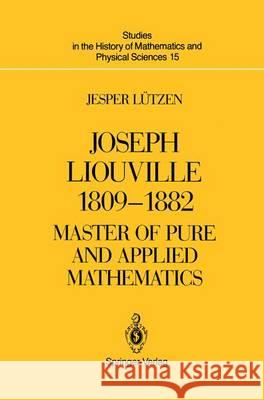
Jesper Lutzen
Joseph Liouville 1809-1882: Master of Pure and Applied Mathematics Lützen, Jesper 9781461269731 Springer - książkaWidoczna okładka, to zdjęcie poglądowe, a rzeczywista szata graficzna może różnić się od prezentowanej.

Joseph Liouville 1809-1882: Master of Pure and Applied Mathematics

ISBN-13: 9781461269731 / Angielski / Miękka / 2013 / 885 str.

Jesper Lutzen
cena 564,88 zł
(netto: 537,98 VAT:  5%)

Najniższa cena z 30 dni: 539,74 zł
Termin realizacji zamówienia:
ok. 22 dni roboczych
Bez gwarancji dostawy przed świętami

Darmowa dostawa!

Joseph Liouville was the most important French mathematician in the gen- eration between Galois and Hermite. This is reflected in the fact that even today all mathematicians know at least one of the more than six theorems named after him and regularly study Liouville's Journal, as the Journal de Mathematiques pures et appliquees is usually nicknamed after its creator. However, few mathematicians are aware of the astonishing variety of Liou- ville's contributions to almost all areas of pure and applied mathematics. The reason is that these contributions have not been studied in their histor- ical context. In the Dictionary of Scientific Biography 1973, Taton 1973] gave a rather sad but also true picture of the Liouville studies carried out up to that date: The few articles devoted to Liouville contain little biographical data. Thus the principal stages of his life must be reconstructed on the ba- sis of original documentation. There is no exhausti ve list of Liou ville's works, which are dispersed in some 400 publications ...His work as a whole has been treated in only two original studies of limited scope those of G. Chrystal and G. Loria.Since this was written, the situation has improved somewhat through the publications of Peiffer, Edwards, Neuenschwander, and myself. Moreover, C. Houzel and I have planned on publishing Liouville's collected works.


Kategorie:
Nauka, Matematyka
Kategorie BISAC:
Biography & Autobiography > General
Gardening > General
Mathematics > Filozofia i historia matematyki
Wydawca:
Springer
Seria wydawnicza:
Studies in the History of Mathematics and Physical Sciences
Język:
Angielski
ISBN-13:
9781461269731
Rok wydania:
2013
Wydanie:
Softcover Repri
Numer serii:
000127158
Ilość stron:
885
Oprawa:
Miękka
Wolumenów:
01

I. The Career of a Mathematician.- I. Youth (1809–1830).- Early Interests in Mathematics.- Student at the École Polytechnique.- The Ponts et Chausées.- The Independent Researcher.- II. Climbing the Academic Ladder (1830–1840).- The Public School System.- The École Centrale; Colladon and Sturm.- Scientific Societies; the Société Philomatique.- The Creation of New Fields.- The Creation of Liouville’s Journal.- Defeats at the Académie and at the École Polytechnique.- Magnanimity toward Sturm.- Success at the Collège de France and at the École Polytechnique.- A Vacancy in the Astronomy Section of the Académie.- Opposition from Libri.- Liouville and Dirichlet against Libri.- Election to the Bureau des Longitudes.- III. Professor, Academician, and Editor (1840–1848).- Setting the Stage.- The École Polytechnique.- Administrative Duties.- Liouville’s “Cours d’Analyse et de Mécanique”.- Rigor.- Notes in Navier’s Résumé.- Other Related Works; Transcendental Numbers.- Influence.- Collège de France.- Inspiring Courses.- A Scandalous Election; Liouville, Cauchy, and Libri.- Académie des Sciences.- The Active Examiner.- Fermat’s Last Theorem.- International Contacts.- Prize Competitions.- The Bureau des Longitudes.- Cauchy’s Membership?.- Presentation of New Ideas.- Journal Editor.- Guiding Young Talents.- Le Verrier (Catalan and Delaunay).- From Irresolution to Authority.- Quarrel with Pontécoulant.- The Name Neptune.- Hermite, Bertrand, and Serret.- Two Reports.- Last Clash with Libri.- Hermite and Doubly Periodic Functions.- J. A. Serret; “Elliptic Curves”.- Galois Theory.- Foreign Visitors.- Steiner, The Dublin School, Geometry.- William Thomson—Lord Kelvin.- A Coherent Mathematical Universe.- IV. The Second Republic (1848–1852).- Banquets Rèformistes (1840).- Political Opposition (1840-1848).- The 1848 Revolution.- Candidate for the Constituting Assembly.- Member of the Constituting Assembly.- The Bitter Defeat (1849).- Reduced Mathematical Activity.- The Second Election at the College de France; Retirement from the École Polytechnique.- Lectures at the Collège de France.- The Disappointing Outcome of the Second Republic.- V. The Last Flash of Genius (1852–1862).- Imperial Politics; Its Influence on Liouville’s Family.- Ernest Liouville, Statistics, Bienaymè (1852-1853).- Liouville Opposing Le Verrier (1852–1854).- Friendship with Dirichlet.- Mathematical Production (1852–1857).- Sturm’s Death.- Chasles’s Substitute?.- Competition with J. A. Serret.- Professor of Mechanics at the Facultè des Sciences.- Courses at the Collège de France.- Chebyshev.- Scandinavian Students.- Great Teaching Load—No Research.- Bad Health.- Liouville’s Final Opinion of Cauchy.- Liouville Commerating Dirichlet.- “I myself, who only like my hole”.- The Quarrels with Le Verrier Continued.- Declining Influence in the Académie; Bour.- Official Honors.- VI. Old Age (1862–1882).- Mathematical Work.- Lecturer and Promoter.- Public Life.- The Franco-Prussian War and the Commune.- Foreign Member of the Berlin Academy.- The Last Courses.- Domestic Life.- The Stay in Toul, Summer and Autumn 1876.- Longing for Death.- Posthumous Reputation.- II. Mathematical Work.- VII. Juvenile Work.- Electrodynamics.- Ampère’s Electrodynamics.- Liouville’s Contributions.- Theory of Heat.- Laplace, Fourier, and Poisson on the Heat Equation.- Liouville’s Contribution.- Differential Equations.- VIII. Differentiation of Arbitrary Order.- Applications, the Source of Interest.- Foundations.- Fractional Differential Equations.- Rigor.- Concluding Remarks.- IX. Integration in Finite Terms.- Historical Background.- Abel’s Contributions.- Integration in Algebraic Terms.- Integration in Finite Terms.- Solution of Differential Equations in Finite Terms.- Further Developments.- Conclusion.- X. Sturm-Liouville Theory.- The Roots of Sturm-Liouville Theory.- The physical origins.- D’Alembert’s Contribution.- Fourier’s Contribution.- Poisson’s Contribution.- Sturm’s First Memoir.- Origins.- Sturm’s Second Memoir.- Liouville’s Youthful Work on Heat Conduction.- Liouville’s Mature Papers on Second-Order Differential Equations. Expansion in Fourier Series.- Convergence of Fourier Series.- Determination of the Sum of the Fourier Series.- Minor Results.- Liouville’s Generalization of Sturm-Liouville Theory to Higher-Order Equations.- Third Degree; Constant Coefficients.- Higher Degree; Variable Coefficients.- Further Generalizations.- Concluding Remarks.- XI. Figures of Equilibrium of a Rotating Mass of Fluid.- Prehistory; Maclaurin Ellipsoids.- Jacobi Ellipsoids.- Stability of Equilibrium Figures.- Sources.- Results on Stability.- Successors.- Methods and Proofs.- Formulas for the Force Vive.- Liquid on an Almost Spherical Kernel.- Lame Functions.- Stability of Fluid Ellipsoids.- A Corrected and an Uncorrected Error.- Concluding Remarks.- XII. Transcendental Numbers.- Historical Background.- Liouville on the Transcendence of e (1840).- Construction of Transcendental Numbers (1844).- The Impact of Liouville’s Discovery.- XIII. Doubly Periodic Functions.- General Introduction; Diffusion of Liouville’s Ideas.- Division of the Lemniscate.- The Discovery of Liouville’s Theorem.- The Gradual Development of the General Theory.- The Final Form of Liouville’s Theory.- Conclusion.- XIV. Galois Theory.- The “Avertissement”.- Galois’s Friends?.- Galois Theory According to Galois.- Liouville’s Commentaries.- Proposition II.- Proposition VI-VIII.- Liouville’s Publication of the Works of Galois.- Liouville’s Understanding of Galois Theory.- Liouville’s Impact.- XV. Potential Theory.- The Genesis of Potential Theory.- Liouville’s Published Contributions.- Liouville on Potentials of Ellipsoids.- Liouville’s Unpublished Notes on Spectral Theory of Integral Operators in Potential Theory.- Interpretation of the Major Result.- A Posteriori Motivation.- Reconstruction of the A Priori Proof.- The Paper on the General Spectral Theory of Symmetric Integral Operators.- Unsolved Problems, Alternative Methods.- Anticipation of Weierstrass’s Criticism of the Dirichlet Principle.- Are Liouville’s Results Correct?.- Poincaré’s Fundamental Functions.- Later Developments.- XVI. Mechanics.- The Theory of Perturbation by Variation of the Arbitrary Constants.- Celestial Mechanics.- Two Publications by Liouville on Planetary Perturbations.- The Chronological Development of Liouville’s Ideas.- Atmospherical Refraction.- Conclusion.- Liouville’s Theorem “on the Volume in Phase Space”.- Rational Mechanics.- The Hamilton-Jacobi Formalism.- Liouville’s Theorem and a Precursor.- Poisson on Liouville’s Theorem.- The Publication of Jacobi’s Ideas.- Jacobi on Liouville’s Theorem.- Parisian Developments Prompting Liouville’s Publication of His Theorem.- Liouville’s Lecture on Mechanics.- The Geometrization of the Principle of Least Action.- Liouville’s Unpublished Notes; Generalized Poisson Brackets.- The “Liouvillian” Integrable Systems.- Concluding Remarks.- XVII. Geometry.- Analytic versus Synthetic Geometry; Chasles’s Influence.- Relations with Mechanics and Elliptic and Abelian Functions; Jacobi’s Influence.- Inversion in Spheres; William Thomson’s Influence.- Contributions to Gaussian Differential Geometry.- Appendix I. Liouville on Ampère’s Force Law.- Appendix II. Liouville’s Notes on Galois Theory.- Notes.- Unpublished Manuscripts and Other Archival Material.- List of J. Liouville’s Published Works.- Other References.

Lutzen, Jesper Jesper Lutzen is a Lecturer in the Department of M... więcej >


Udostępnij

Facebook - konto krainaksiazek.pl


Opinie o Krainaksiazek.pl na Opineo.pl

Partner Mybenefit

Krainaksiazek.pl w programie rzetelna firma Krainaksiaze.pl - płatności przez paypal

Czytaj nas na:

Facebook - krainaksiazek.pl
  • książki na zamówienie
  • granty
  • książka na prezent
  • kontakt
  • pomoc
  • opinie
  • regulamin
  • polityka prywatności

Zobacz:

  • Księgarnia czeska

  • Wydawnictwo Książkowe Klimaty

1997-2025 DolnySlask.com Agencja Internetowa

© 1997-2022 krainaksiazek.pl
     
KONTAKT | REGULAMIN | POLITYKA PRYWATNOŚCI | USTAWIENIA PRYWATNOŚCI
Zobacz: Księgarnia Czeska | Wydawnictwo Książkowe Klimaty | Mapa strony | Lista autorów
KrainaKsiazek.PL - Księgarnia Internetowa

Polityka prywatnosci - link
Krainaksiazek.pl - płatnośc Przelewy24
Przechowalnia Przechowalnia






