• Wyszukiwanie zaawansowane
  • Kategorie
  • Kategorie BISAC
  • Książki na zamówienie
  • Promocje
  • Granty
  • Książka na prezent
  • Opinie
  • Pomoc
  • Załóż konto
  • Zaloguj się

Joe Pawsey and the Founding of Australian Radio Astronomy: Early Discoveries, from the Sun to the Cosmos » książka


zaloguj się | załóż konto
Logo Krainaksiazek.pl

koszyk

konto

szukaj
topmenu
Księgarnia internetowa
Szukaj
Książki na zamówienie
Promocje
Granty
Książka na prezent
Moje konto
Pomoc
 
 
Wyszukiwanie zaawansowane
Pusty koszyk
Bezpłatna dostawa dla zamówień powyżej 20 złBezpłatna dostawa dla zamówień powyżej 20 zł

Kategorie główne

• Nauka
 [2946600]
• Literatura piękna
 [1856966]

  więcej...
• Turystyka
 [72221]
• Informatyka
 [151456]
• Komiksy
 [35826]
• Encyklopedie
 [23190]
• Dziecięca
 [619653]
• Hobby
 [140543]
• AudioBooki
 [1577]
• Literatura faktu
 [228355]
• Muzyka CD
 [410]
• Słowniki
 [2874]
• Inne
 [445822]
• Kalendarze
 [1744]
• Podręczniki
 [167141]
• Poradniki
 [482898]
• Religia
 [510455]
• Czasopisma
 [526]
• Sport
 [61590]
• Sztuka
 [243598]
• CD, DVD, Video
 [3423]
• Technologie
 [219201]
• Zdrowie
 [101638]
• Książkowe Klimaty
 [124]
• Zabawki
 [2473]
• Puzzle, gry
 [3898]
• Literatura w języku ukraińskim
 [254]
• Art. papiernicze i szkolne
 [8170]
Kategorie szczegółowe BISAC

Joe Pawsey and the Founding of Australian Radio Astronomy: Early Discoveries, from the Sun to the Cosmos

ISBN-13: 9783031079153 / Angielski / Twarda / 2023 / 812 str.
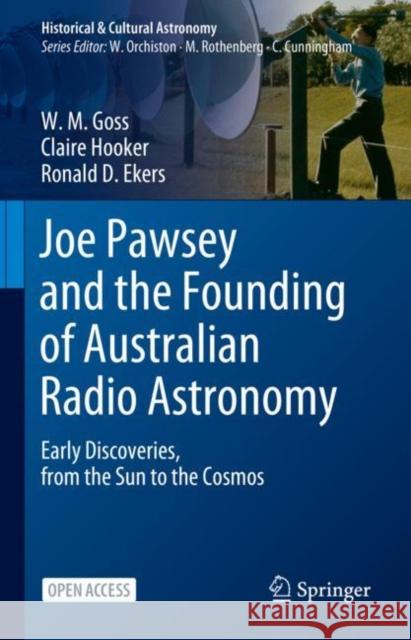
W. M. Goss; Claire Hooker; Ronald D. Ekers
Joe Pawsey and the Founding of Australian Radio Astronomy: Early Discoveries, from the Sun to the Cosmos W. M. Goss Claire Hooker Ronald D. Ekers 9783031079153 Springer - książkaWidoczna okładka, to zdjęcie poglądowe, a rzeczywista szata graficzna może różnić się od prezentowanej.

Joe Pawsey and the Founding of Australian Radio Astronomy: Early Discoveries, from the Sun to the Cosmos

ISBN-13: 9783031079153 / Angielski / Twarda / 2023 / 812 str.

W. M. Goss; Claire Hooker; Ronald D. Ekers
cena 201,72 zł
(netto: 192,11 VAT:  5%)

Najniższa cena z 30 dni: 192,74 zł
Termin realizacji zamówienia:
ok. 22 dni roboczych
Bez gwarancji dostawy przed świętami

Darmowa dostawa!
inne wydania

This open access book is a biography of Joseph L. Pawsey. It examines not only his life but the birth and growth of the field of radio astronomy and the state of science itself in twentieth century Australia. The book explains how an isolated continent with limited resources grew to be one of the leaders in the study of radio astronomy and the design of instruments to do so.Pawsey made a name for himself in the international astronomy community within a decade after WWII and coined the term radio astronomy. His most valuable talent was his ability to recruit and support bright young scientists who became the technical and methodological innovators of the era, building new telescopes from the Mills Cross and Chris (Christiansen) Cross to the Parkes radio telescope.The development of aperture synthesis and the controversy surrounding the cosmological interpretation of the first major survey which resulted in the Sydney research group's disagreements with Nobel laureate Martin Ryle play major roles in this story. This book also shows the connections among prominent astronomers like Oort, Minkowski, Baade, Struve, famous scientists in the UK such as J.A. Ratcliffe, Edward Appleton and Henry Tizard, and the engineers and physicists in Australia who helped develop the field of radio astronomy. Pawsey was appointed the second Director of the National Radio Astronomy Observatory (Green Bank, West Virginia) in October 1961; he died in Sydney at the age of 54 in late November 1962.Upper level students, scientists and historians of astronomy and technology will find the information, much of it from primary sources, relevant to any study of Joseph L. Pawsey or radio astronomy. This open access book includes a Foreword by Woodruff T. Sullivan II.


This open access book is a biography of Joseph L. Pawsey. It examines not only his life but the birth and growth of the field of radio astronomy and the state of science itself in twentieth century Australia. The book explains how an isolated continent with limited resources grew to be one of the leaders in the study of radio astronomy and the design of instruments to do so. Pawsey made a name for himself in the international astronomy community within a decade after WWII and coined the term radio astronomy. His most valuable talent was his ability to recruit and support bright young scientists who became the technical and methodological innovators of the era, building new telescopes from the Mills Cross and Chris (Christiansen) Cross to the Parkes radio telescope. The development of aperture synthesis and the controversy surrounding the cosmological interpretation of the first major survey which resulted in the Sydney research group's disagreements with Nobel laureate Martin Ryle play major roles in this story. This book also shows the connections among prominent astronomers like Oort, Minkowski, Baade, Struve, famous scientists in the UK such as J.A. Ratcliffe, Edward Appleton and Henry Tizard, and the engineers and physicists in Australia who helped develop the field of radio astronomy. Pawsey was appointed the second Director of the National Radio Astronomy Observatory (Green Bank, West Virginia) in October 1961; he died in Sydney at the age of 54 in late November 1962. Upper level students, scientists and historians of astronomy and technology will find the information, much of it from primary sources, relevant to any study of Joseph L. Pawsey or radio astronomy. This open access book includes a Foreword by Woodruff T. Sullivan II.

Kategorie:
Nauka, Fizyka
Kategorie BISAC:
Science > Astronomia, przestrzeń i czas
Science > Fizyka
Technology & Engineering > Electronics - Circuits - General
Wydawca:
Springer
Seria wydawnicza:
Historical & Cultural Astronomy
Język:
Angielski
ISBN-13:
9783031079153
Rok wydania:
2023
Dostępne języki:
Numer serii:
000796607
Ilość stron:
812
Oprawa:
Twarda

Frontispiece and cover

Dedication

Foreword

Preface

Acknowledgements

Table of Contents

Part 1: Childhood

1 An Inheritance of Intangibles, 1890s

2 Just a Boy from the Bush, 1908-1925

3 Becoming a Physicist, 1926-1929

Part 2: Becoming a scientist

4 New Opportunities in Australian science, 1929

5 Ionospheric Research, 1895-1935

6 To the Cavendish Laboratory of the University of Cambridge 1931

7 Research for PhD Thesis at Cambridge 1931-1934

8 After the PhD: Electric and Musical Industries (EMI) and Marriage to Lenore Nicoll 1934-

1939

Part 3: WWII 1939-1945

9 J.L. Pawsey’s Role in Australian Radar Research in World War II

10 Transition to Peace, 1945-1946

Part 4: Hot Corona

11 Beginnings of Solar Radio Astronomy, 1944-1945

12 Serendipity: Sunspots at Collaroy, 1945-1946

13 Sea-cliff Interferometry: Dover Heights, 1946

14 The Million Degree Solar Corona, 1945-1946

Part 5: Connections

15 Horizons 1944-1947

16 A New Field of Science

17 Pursuing “Radio Astronomy”: Pawsey’s travels to North America, the UK and Europe,

1947-1948

18 Scintillating Relationship with Cambridge, 1948-1951

Part 6: Quiet Leadership

19 Consolidation: Leadership at RPL, 1950-1951

20 Finite Resources: Pawsey & the HI line

21 No More Radio Stars! 1952

22 1953: "Radio" is Part of Astronomy

23 The Galactic Centre, 1951-1954

24 The Royal Society: Europe and North America, 1954

25 The Sun and the Ionosphere

26 Overseas again: Jodrell Bank and IAU, August 1955

Part 7: Towards a Bigger Science

27 Pawsey and the Giant Radio Telescope, 1951-1956

28 Brain Drain - Trip to US and Canada 1957-1959

29 Driving the GRT, 1957-1959

30 Schism at Radiophysics (1960)

31 John Bolton Returns, 1960-1961

32 Reflections on Science at/from the GRT

Part 8: The Development of Understanding

33 Pawsey and Philosophy of Science

34 The Development of a Theory for Radio Emission

35 Radio Source Survey: disputes, 1948-1957

36 Radio Source Survey: reconciliation, 1958-1962

37 The Evolution of Aperture Synthesis Imaging

Part 9: Death and Legacy

38 To the US National Radio Astronomy Observatory, 1961

39 Visions for NRAO, 1962

40 The Final Year – 1962

41 Legacy

42 Conclusion: J.L. Pawsey (1908-1962) and the Development of Radio Astronomy

Appendix A: Abbreviations

Appendix B: Dramatis Personae

Appendix C: Timeline

Appendix D: Electronic Supplemental Material (ESM)

Appendix E: NRAO ONLINE Supplementary Resources

References


W. M. Goss has published over 500 papers in refereed journals and was the Director of the Very Large Array and the Very Long Baseline Array of the National Radio Astronomy Observatory in New Mexico. He has written three books on the history of radio astronomy: Under the Radar, The First Woman in Radio Astronomy, Ruby Payne-Scott, (by Goss and McGee, Springer, 2009, in the series Astrophysics and Space Science Library), followed by Making Waves, The Story of Ruby Payne-Scott, Australian Pioneer Radio Astronomer (Goss, Springer, 2013, for a more popular audience in The Astronomers University Series). In 2017, a new book in this later series was published (book launch was 9 February 2018 at Sydney University) by Frater, Goss and Wendt, Four Pillars of Radio Astronomy: Mills, Christiansen, Wild, Bracewell. Goss has worked throughout his career on the physics of the interstellar medium, the radio continuum of the galactic centre and pulsar astrometry. Goss was the recipient of the Australian Academy of Science Pawsey Medal in 1976.

Claire Hooker holds a PhD in the history of science and medicine, work that underpins her teaching and research in the variegated field of the Health and Medical Humanities. She has taken an historical-oriented approach to studies of how different stakeholders respond to health risks, particularly in response to infectious disease.  She has published 3 books and over 50 peer-reviewed journal articles and book chapters on topics as diverse as non-representational theories of empathy and of infection control, the importance of taking a multi-cultural approach to the medical humanities, and the use of video-reflexive ethnography to improve hospital practice. Claire Hooker has sustained interest in the history of radio astronomy since completing her PhD courtesy of a continued connection with W.M. Goss.

Ronald D. Ekers is one of the more prominent astronomers in Australia. He was the first Director of the completed US Very Large Array, then the Foundation Director of CSIRO’s Australia Telescope National Facility. He is a past President of the International Astronomical Union (2003-2006), a Fellow of the Australian Academy of Science, the Royal Dutch Academy of Science, the Royal Society of London (FRS) and the US National Academy of Science. Ekers is the author of over 280 refereed publications and editor of SETI 2020. Ekers research interests in astronomy are broad; including extragalactic astronomy and cosmology, galactic nuclei (the centres of galaxies), ultra-high energy particle physics and innovative applications of radio astronomical techniques.


This open access book is a biography of Joseph L. Pawsey. It examines not only his life but the birth and growth of the field of radio astronomy and the state of science itself in twentieth century Australia. The book explains how an isolated continent with limited resources grew to be one of the leaders in the study of radio astronomy and the design of instruments to do so.

Pawsey made a name for himself in the international astronomy community within a decade after WWII and coined the term radio astronomy. His most valuable talent was his ability to recruit and support bright young scientists who became the technical and methodological innovators of the era, building new telescopes from the Mills Cross and Chris (Christiansen) Cross to the Parkes radio telescope.

The development of aperture synthesis and the controversy surrounding the cosmological interpretation of the first major survey which resulted in the Sydney research group's disagreements with Nobel laureate Martin Ryle play major roles in this story. This book also shows the connections among prominent astronomers like Oort, Minkowski, Baade, Struve, famous scientists in the UK such as J.A. Ratcliffe, Edward Appleton and Henry Tizard, and the engineers and physicists in Australia who helped develop the field of radio astronomy. Pawsey was appointed the second Director of the National Radio Astronomy Observatory (Green Bank, West Virginia) in October 1961; he died in Sydney at the age of 54 in late November 1962.

Upper level students, scientists and historians will find the information, much of it from primary sources, relevant to any study of Joseph L. Pawsey or radio astronomy.

This is an open access book.


Udostępnij

Facebook - konto krainaksiazek.pl


Opinie o Krainaksiazek.pl na Opineo.pl

Partner Mybenefit

Krainaksiazek.pl w programie rzetelna firma Krainaksiaze.pl - płatności przez paypal

Czytaj nas na:

Facebook - krainaksiazek.pl
  • książki na zamówienie
  • granty
  • książka na prezent
  • kontakt
  • pomoc
  • opinie
  • regulamin
  • polityka prywatności

Zobacz:

  • Księgarnia czeska

  • Wydawnictwo Książkowe Klimaty

1997-2025 DolnySlask.com Agencja Internetowa

© 1997-2022 krainaksiazek.pl
     
KONTAKT | REGULAMIN | POLITYKA PRYWATNOŚCI | USTAWIENIA PRYWATNOŚCI
Zobacz: Księgarnia Czeska | Wydawnictwo Książkowe Klimaty | Mapa strony | Lista autorów
KrainaKsiazek.PL - Księgarnia Internetowa

Polityka prywatnosci - link
Krainaksiazek.pl - płatnośc Przelewy24
Przechowalnia Przechowalnia





