Jesus after Modernity » książka





Jesus after Modernity
ISBN-13: 9781498257022 / Angielski / Twarda / 2011 / 158 str.
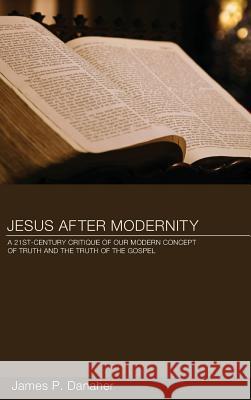
Jesus after Modernity
ISBN-13: 9781498257022 / Angielski / Twarda / 2011 / 158 str.
(netto: 174,99 VAT: 5%)
Najniższa cena z 30 dni: 176,33
ok. 16-18 dni roboczych.
Darmowa dostawa!
During the seventeenth and eighteenth centuries, modern thinkers came to believe that our notion of truth should be objective, certain, and precise. Mathematics became the model for how truth should be conceptualized, and we sought to eliminate ideas that were vague, ambiguous, or contradictory. This inevitably led to our belief that the truth of the Gospel must be conceptualized in the same way, and much of modern theology saw the defense of the Gospel in these terms as its task. The teachings of Jesus, however, are often vague, ambiguous, and even contradictory. Fortunately, a twenty-first century understanding of the human condition has debunked the modern notion of truth, showing it to be truncated at best. Truth, at least as we have access to it, is very different from what our early modern ancestors imagined. This is especially good news since the truth of the Gospel was never compatible with modernity's notion of truth as objective, certain, and precise. Consequently, we are now free to rethink our notion of truth in a way that is compatible with the things that Jesus said and did, and equally compatible with what we now know to be our access to truth given the limits of our human condition. This volume sets out to explore these issues in depth and examine what it might mean for us to speak of the truth of the Gospel in a twenty-first century context. --We in religion concentrate so much on what we know for certain, but there has always been too little self critique about 'How do we know what we think we know?' This clear and well-written book is both very honest and very helpful on the subject. No one will lose their faith here--perhaps many will find it for the first time I am happy someone has written this much-needed book, and I hope it is used in classrooms, by many seekers, and in the churches.-- --Richard Rohr, OFM Center for Action and Contemplation --Jim Danaher, as an author and a friend, is a man who has challenged my long-held assumptions, inspiring me to wrestle with new, fresh perspectives. He has motivated me to pray: 'I want to know Jesus better.' And through his example he has roused me to love God and love others with greater passion. Jim is a brilliant philosopher-theologian for the twenty-first century. While his writing may provoke you in places, I believe reading this text will lead you to think deeply, pray passionately, and love God and His people with greater zeal.-- --Ronald Walborn Dean of Alliance Theological Seminary Nyack College --James P. Danaher is a rare philosopher who has an unusual skill for saying things with incredible clarity. For this reason Jesus after Modernity is a splendid little book. It bridges the academic worlds of philosophy and theology and takes the reader right into the experience of God's love in Jesus Christ. I happily encourage you to read it, even several times if you want to grasp how important his message is for our time.-- --John H. Armstrong Author of Your Church Is Too Small: Why Unity in Christ's Mission Is Vital to the Future of the Church James P. Danaher is Professor of Philosophy and Head of the Philosophy Department at Nyack College. He is the author of Eyes that See, Ears that Hear: Perceiving Jesus in a Postmodern Context (2006), and Postmodern Christianity and the Reconstruction of the Christian Mind (2001).
During the seventeenth and eighteenth centuries, modern thinkers came to believe that our notion of truth should be objective, certain, and precise. Mathematics became the model for how truth should be conceptualized, and we sought to eliminate ideas that were vague, ambiguous, or contradictory. This inevitably led to our belief that the truth of the Gospel must be conceptualized in the same way, and much of modern theology saw the defense of the Gospel in these terms as its task. The teachings of Jesus, however, are often vague, ambiguous, and even contradictory. Fortunately, a twenty-first century understanding of the human condition has debunked the modern notion of truth, showing it to be truncated at best. Truth, at least as we have access to it, is very different from what our early modern ancestors imagined. This is especially good news since the truth of the Gospel was never compatible with modernitys notion of truth as objective, certain, and precise. Consequently, we are now free to rethink our notion of truth in a way that is compatible with the things that Jesus said and did, and equally compatible with what we now know to be our access to truth given the limits of our human condition. This volume sets out to explore these issues in depth and examine what it might mean for us to speak of the truth of the Gospel in a twenty-first century context.""We in religion concentrate so much on what we know for certain, but there has always been too little self critique about How do we know what we think we know? This clear and well-written book is both very honest and very helpful on the subject. No one will lose their faith here--perhaps many will find it for the first time! I am happy someone has written this much-needed book, and I hope it is used in classrooms, by many seekers, and in the churches."" --Richard Rohr, OFM Center for Action and Contemplation ""Jim Danaher, as an author and a friend, is a man who has challenged my long-held assumptions, inspiring me to wrestle with new, fresh perspectives. He has motivated me to pray: I want to know Jesus better. And through his example he has roused me to love God and love others with greater passion. Jim is a brilliant philosopher-theologian for the twenty-first century. While his writing may provoke you in places, I believe reading this text will lead you to think deeply, pray passionately, and love God and His people with greater zeal.""--Ronald WalbornDean of Alliance Theological SeminaryNyack College""James P. Danaher is a rare philosopher who has an unusual skill for saying things with incredible clarity. For this reason Jesus after Modernity is a splendid little book. It bridges the academic worlds of philosophy and theology and takes the reader right into the experience of Gods love in Jesus Christ. I happily encourage you to read it, even several times if you want to grasp how important his message is for our time.""--John H. ArmstrongAuthor of Your Church Is Too Small: Why Unity in Christs Mission Is Vital to the Future of the Church James P. Danaher is Professor of Philosophy and Head of the Philosophy Department at Nyack College. He is the author of Eyes that See, Ears that Hear: Perceiving Jesus in a Postmodern Context (2006), and Postmodern Christianity and the Reconstruction of the Christian Mind (2001).




Czytaj nas na:
KrainaKsiazek.PL - Księgarnia Internetowa


