• Wyszukiwanie zaawansowane
  • Kategorie
  • Kategorie BISAC
  • Książki na zamówienie
  • Promocje
  • Granty
  • Książka na prezent
  • Opinie
  • Pomoc
  • Załóż konto
  • Zaloguj się

Japan's Rush to the Pacific War: The Institutional Roots of Overbalancing » książka


zaloguj się | załóż konto
Logo Krainaksiazek.pl

koszyk

konto

szukaj
topmenu
Księgarnia internetowa
Szukaj
Książki na zamówienie
Promocje
Granty
Książka na prezent
Moje konto
Pomoc
 
 
Wyszukiwanie zaawansowane
Pusty koszyk
Bezpłatna dostawa dla zamówień powyżej 20 złBezpłatna dostawa dla zamówień powyżej 20 zł

Kategorie główne

• Nauka
 [2948695]
• Literatura piękna
 [1824038]

  więcej...
• Turystyka
 [70868]
• Informatyka
 [151073]
• Komiksy
 [35227]
• Encyklopedie
 [23181]
• Dziecięca
 [621575]
• Hobby
 [138961]
• AudioBooki
 [1642]
• Literatura faktu
 [228651]
• Muzyka CD
 [371]
• Słowniki
 [2933]
• Inne
 [445341]
• Kalendarze
 [1243]
• Podręczniki
 [164416]
• Poradniki
 [479493]
• Religia
 [510449]
• Czasopisma
 [502]
• Sport
 [61384]
• Sztuka
 [243086]
• CD, DVD, Video
 [3417]
• Technologie
 [219673]
• Zdrowie
 [100865]
• Książkowe Klimaty
 [124]
• Zabawki
 [2168]
• Puzzle, gry
 [3372]
• Literatura w języku ukraińskim
 [260]
• Art. papiernicze i szkolne
 [7838]
Kategorie szczegółowe BISAC

Japan's Rush to the Pacific War: The Institutional Roots of Overbalancing

ISBN-13: 9783031220524 / Angielski / Twarda / 2023 / 190 str.
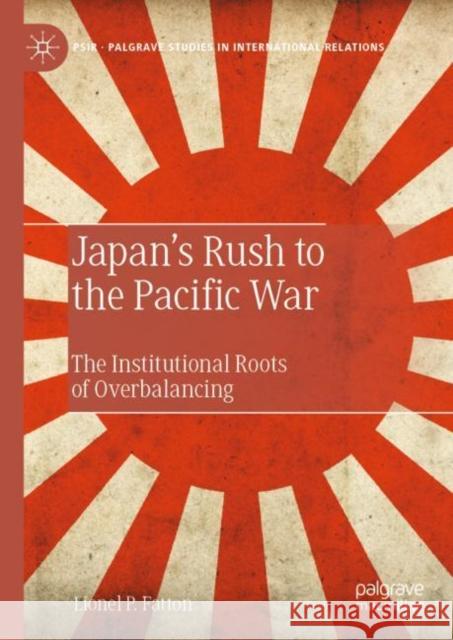
Lionel Fatton
Japan's Rush to the Pacific War: The Institutional Roots of Overbalancing Fatton, Lionel 9783031220524 Palgrave MacMillan - książkaWidoczna okładka, to zdjęcie poglądowe, a rzeczywista szata graficzna może różnić się od prezentowanej.

Japan's Rush to the Pacific War: The Institutional Roots of Overbalancing

ISBN-13: 9783031220524 / Angielski / Twarda / 2023 / 190 str.

Lionel Fatton
cena 523,30
(netto: 498,38 VAT:  5%)

Najniższa cena z 30 dni: 462,63
Termin realizacji zamówienia:
ok. 22 dni roboczych.

Darmowa dostawa!
inne wydania

This book investigates the phenomenon of overbalancing through an analysis of Japan’s foreign policy during the interbellum. In the mid-1930s, Japan withdrew from a naval arms control framework that had restrained military buildup on both sides of the Pacific Ocean since the early 1920s. By doing so, Japan not only triggered a naval arms race with the United States that exhausted its economy, it also destroyed the last institutionalized structure regulating the relationship between the two Pacific powers. Japan and the United States became caught in a spiral of tensions that culminated with the attack on Pearl Harbor in December 1941. Puzzling is the fact that the international environment in the Asia-Pacific was relatively stable in the mid-1930s, while Washington was pursuing a policy of accommodation toward Tokyo. By rejecting arms control and engaging in unfettered naval expansion, Japan overbalanced against the United States and began its rush to the Pacific War.The book explains Japan’s overbalancing with a neoclassical realist model that combines the literatures on threat perception and civil-military relations. Amid the Manchurian crisis of 1931-1933, as the Japanese government collaborated with the military institution to address the situation in China, military influence on the formulation of foreign policy surged. The perceptual and policy biases of the military, which include the tendency to distrust other countries’ intentions, to adopt worst-case analyses of international dynamics and to strive to maximize military power, gradually penetrated the decision-making process. Dysfunctions in the preexisting structure of Japanese civil-military relations, engendered by an over-depoliticization of the military institution, allowed the navy to convince policymakers that the United States was inherently hostile to Japan, hence the necessity to prepare for war. The government wasbrainstormed, adopting the biased military perspective on international affairs. Japan overbalanced in a myopic but conscious way.


This book investigates the phenomenon of overbalancing through an analysis of Japan’s foreign policy during the interbellum. In the mid-1930s, Japan withdrew from a naval arms control framework that had restrained military buildup on both sides of the Pacific Ocean since the early 1920s. By doing so, Japan not only triggered a naval arms race with the United States that exhausted its economy, it also destroyed the last institutionalized structure regulating the relationship between the two Pacific powers. Japan and the United States became caught in a spiral of tensions that culminated with the attack on Pearl Harbor in December 1941. Puzzling is the fact that the international environment in the Asia-Pacific was relatively stable in the mid-1930s, while Washington was pursuing a policy of accommodation toward Tokyo. By rejecting arms control and engaging in unfettered naval expansion, Japan overbalanced against the United States and began its rush to the Pacific War.The book explains Japan’s overbalancing with a neoclassical realist model that combines the literatures on threat perception and civil-military relations. Amid the Manchurian crisis of 1931-1933, as the Japanese government collaborated with the military institution to address the situation in China, military influence on the formulation of foreign policy surged. The perceptual and policy biases of the military, which include the tendency to distrust other countries’ intentions, to adopt worst-case analyses of international dynamics and to strive to maximize military power, gradually penetrated the decision-making process. Dysfunctions in the preexisting structure of Japanese civil-military relations, engendered by an over-depoliticization of the military institution, allowed the navy to convince policymakers that the United States was inherently hostile to Japan, hence the necessity to prepare for war. The government was brainstormed, adopting the biased military perspective on international affairs. Japan overbalanced in a myopic but conscious way.

Kategorie:
Nauka, Polityka
Kategorie BISAC:
Political Science > International Relations - General
Political Science > Security (National & International)
Wydawca:
Palgrave MacMillan
Seria wydawnicza:
Palgrave Studies in International Relations
Język:
Angielski
ISBN-13:
9783031220524
Rok wydania:
2023
Dostępne języki:
Numer serii:
000534411
Ilość stron:
190
Oprawa:
Twarda
Dodatkowe informacje:
Wydanie ilustrowane

1. Overbalancing as a Systemic Pathology.- 2. Explaining Japan’s Rush to the Pacific War.- 3. Appropriate Balancing in the Naval Arms Control Era, 1920-1931.- 4. The Manchurian Crisis as an Exogenous Shock, 1931-1933.- 5. Overbalancing and Japan’s Rush to the Pacific War, 1933-1941.- 6. Beyond Japan and the Pacific War.


Lionel P. Fatton is Assistant Professor of International Relations at Webster University Geneva, Switzerland, and Research Collaborator at the Research Institute for the History of Global Arms Transfer, Meiji University, Japan.

This book investigates the phenomenon of overbalancing through an analysis of Japan’s foreign policy during the interbellum. In the mid-1930s, Japan withdrew from a naval arms control framework that had restrained military buildup on both sides of the Pacific Ocean since the early 1920s. By doing so, Japan not only triggered a naval arms race with the United States that exhausted its economy, it also destroyed the last institutionalized structure regulating the relationship between the two Pacific powers. Japan and the United States became caught in a spiral of tensions that culminated with the attack on Pearl Harbor in December 1941. Puzzling is the fact that the international environment in the Asia-Pacific was relatively stable in the mid-1930s, while Washington was pursuing a policy of accommodation toward Tokyo. By rejecting arms control and engaging in unfettered naval expansion, Japan overbalanced against the United States and began its rush to the Pacific War.

The book explains Japan’s overbalancing with a neoclassical realist model that combines the literatures on threat perception and civil-military relations. Amid the Manchurian crisis of 1931-1933, as the Japanese government collaborated with the military institution to address the situation in China, military influence on the formulation of foreign policy surged. The perceptual and policy biases of the military, which include the tendency to distrust other countries’ intentions, to adopt worst-case analyses of international dynamics and to strive to maximize military power, gradually penetrated the decision-making process. Dysfunctions in the preexisting structure of Japanese civil-military relations, engendered by an over-depoliticization of the military institution, allowed the navy to convince policymakers that the United States was inherently hostile to Japan, hence the necessity to prepare for war. The government was brainstormed, adopting the biased military perspective on international affairs. Japan overbalanced in a myopic but conscious way.

Lionel P. Fatton is Assistant Professor of International Relations at Webster University Geneva, Switzerland, and Research Collaborator at the Research Institute for the History of Global Arms Transfer, Meiji University, Japan.


Udostępnij

Facebook - konto krainaksiazek.pl


Opinie o Krainaksiazek.pl na Opineo.pl

Partner Mybenefit

Krainaksiazek.pl w programie rzetelna firma Krainaksiaze.pl - płatności przez paypal

Czytaj nas na:

Facebook - krainaksiazek.pl
  • książki na zamówienie
  • granty
  • książka na prezent
  • kontakt
  • pomoc
  • opinie
  • regulamin
  • polityka prywatności

Zobacz:

  • Księgarnia czeska

  • Wydawnictwo Książkowe Klimaty

1997-2026 DolnySlask.com Agencja Internetowa

© 1997-2022 krainaksiazek.pl
     
KONTAKT | REGULAMIN | POLITYKA PRYWATNOŚCI | USTAWIENIA PRYWATNOŚCI
Zobacz: Księgarnia Czeska | Wydawnictwo Książkowe Klimaty | Mapa strony | Lista autorów
KrainaKsiazek.PL - Księgarnia Internetowa

Polityka prywatnosci - link
Krainaksiazek.pl - płatnośc Przelewy24
Przechowalnia Przechowalnia



