• Wyszukiwanie zaawansowane
  • Kategorie
  • Kategorie BISAC
  • Książki na zamówienie
  • Promocje
  • Granty
  • Książka na prezent
  • Opinie
  • Pomoc
  • Załóż konto
  • Zaloguj się

Japan's Industrious Revolution: Economic and Social Transformations in the Early Modern Period » książka


zaloguj się | załóż konto
Logo Krainaksiazek.pl

koszyk

konto

szukaj
topmenu
Księgarnia internetowa
Szukaj
Książki na zamówienie
Promocje
Granty
Książka na prezent
Moje konto
Pomoc
 
 
Wyszukiwanie zaawansowane
Pusty koszyk
Bezpłatna dostawa dla zamówień powyżej 20 złBezpłatna dostawa dla zamówień powyżej 20 zł

Kategorie główne

• Nauka
 [2949965]
• Literatura piękna
 [1857847]

  więcej...
• Turystyka
 [70818]
• Informatyka
 [151303]
• Komiksy
 [35733]
• Encyklopedie
 [23180]
• Dziecięca
 [617748]
• Hobby
 [139972]
• AudioBooki
 [1650]
• Literatura faktu
 [228361]
• Muzyka CD
 [398]
• Słowniki
 [2862]
• Inne
 [444732]
• Kalendarze
 [1620]
• Podręczniki
 [167233]
• Poradniki
 [482388]
• Religia
 [509867]
• Czasopisma
 [533]
• Sport
 [61361]
• Sztuka
 [243125]
• CD, DVD, Video
 [3451]
• Technologie
 [219309]
• Zdrowie
 [101347]
• Książkowe Klimaty
 [123]
• Zabawki
 [2362]
• Puzzle, gry
 [3791]
• Literatura w języku ukraińskim
 [253]
• Art. papiernicze i szkolne
 [7933]
Kategorie szczegółowe BISAC

Japan's Industrious Revolution: Economic and Social Transformations in the Early Modern Period

ISBN-13: 9784431551416 / Angielski / Twarda / 2015 / 130 str.
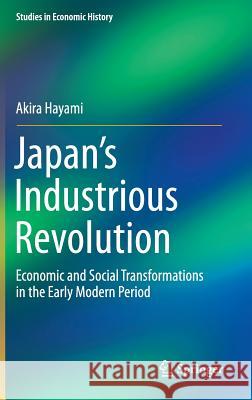
Akira Hayami
Japan's Industrious Revolution: Economic and Social Transformations in the Early Modern Period Hayami, Akira 9784431551416 Springer - książkaWidoczna okładka, to zdjęcie poglądowe, a rzeczywista szata graficzna może różnić się od prezentowanej.

Japan's Industrious Revolution: Economic and Social Transformations in the Early Modern Period

ISBN-13: 9784431551416 / Angielski / Twarda / 2015 / 130 str.

Akira Hayami
cena 201,72
(netto: 192,11 VAT:  5%)

Najniższa cena z 30 dni: 192,74
Termin realizacji zamówienia:
ok. 22 dni roboczych
Bez gwarancji dostawy przed świętami

Darmowa dostawa!

This book explains in fascinating detail how economic and social transformations in pre-1600 Japan led to an industrious revolution in the early modern period and how the fruits of the Industrious Revolution are what have supported Japan since the eighteenth century, improving living standards and leading to the formation of the work ethic of modern Japan. The arrival of the Sengoku Period in the sixteenth century saw the emergence and domination of government by the warrior class. It was Tokugawa Ieyasu who unified the realm. Yet this unity did not give rise to an autocratic state, as the shogun was recognized merely as a main pillar of the warrior class.Economically, however, from the fourteenth century, currency payments for sh en nengu (taxes paid to the proprietor) became standard, and currency circulation began, primarily in the central region. Under Tokugawa rule, organized domestic coinage of currency began, opening the way to establishing a national economic society. Also, agricultural land was surveyed through cadastral surveys known as kenchi. Land values were converted in terms of rice, so the expected rice yields for each village were assessed, and the lords used this as a benchmark for imposing taxes. In the sixteenth and seventeenth centuries, Japan experienced a great transition, and conditions for peasants, agriculture, and farming villages underwent great changes. Inefficient traditional agriculture using peasants in a state of servitude was transformed into highly efficient small-sized farming operations which relied on family labor. As production yields increased due to labor-intensive agriculture, the profits obtained by the peasants improved their living standards. The stem-family system became the norm through which work ethics and even literacy were transmitted. This very change was the result of the industrious revolution in Japan. The book thus presents the framework of the facts of pre-industrial Japanese history and depicts pre-modern Japan from a macroscopic point of view, showing how the industrious revolution came about. It is certain to be of great interest to economists and historians alike. "


Kategorie:
Nauka, Historia
Kategorie BISAC:
History > Asia - Japan
Business & Economics > Development - Economic Development
Social Science > Ludność i demografia
Wydawca:
Springer
Seria wydawnicza:
Studies in Economic History
Język:
Angielski
ISBN-13:
9784431551416
Rok wydania:
2015
Wydanie:
2015
Ilość stron:
130
Waga:
3.55 kg
Wymiary:
23.5 x 15.5
Oprawa:
Twarda
Wolumenów:
01
Dodatkowe informacje:
Wydanie ilustrowane

Part I Socio-Economic Development in Modern Japan.- 1. Analyzing Japanese Economic History.- 2. Before the Formulation of a Socio-Economic History.- 3. The Formulation of a Economic Society.- 4. Economy and Society in the Edo Era.- 5. The Industrialization of Modern Japan.- Part II Characteristics of the Economic Society in the Edo Era.- Part III Economic Development in Modern Japan.- 6. Economic Development in Modern Japan.- 7. Industrious Revolution and Economic Development.- 8. Industrious Revolution v.s. Industrial Revolution.

Akira Hayami is a member of the Japan Academy and a correspondent member of the Academy of the Moral and Political Sciences, France. He is professor emeritus of Keio University (Tokyo), the International Research Center for Japanese Studies (Kyoto), and Reitaku University (Kashiwa). Hayami is also the former vice president of the International Association of Economic History, honorary president of the International Committee of Historical Demography and former president of the Socio-economic History Society in Japan. He was awarded the Order of Cultural Merit (Japan) in 2009.

Major publications include The Historical Demography of Pre-Modern Japan (University of Tokyo Press, 2001), Population, Family and Society in Pre-Modern Japan (Global Oriental, 2009), and Population and Family in Early-Modern Central Japan (International Research Center for Japanese Studies, 2010). He also co-edited with Ad Van Der Woude the volume Urbanization in History: A Process of Dynamic Interactions (Oxford University Press, 1990) and co-edited with Osamu Saito the book Emergence of Economic Society in Japan, 1600–1859 (Oxford University Press, 2004).

Hayami’s major contributions include the application of historical demography methods to early-modern Japanese data, the finding of fresh facts made possible by the methodological breakthrough, which in turn emancipated early-modern Japanese historiography from a “dark age” imagery, and the coining of the term “Industrious Revolution.”

This book explains in fascinating detail how economic and social transformations in pre-1600 Japan led to an industrious revolution in the early modern period, and how the fruits of the Industrious Revolution are what have supported Japan since the eighteenth century, improving living standards and leading to the formation of the work ethic of modern Japan.

The arrival of the Sengoku Period in the sixteenth century saw the emergence and domination of government by the warrior class. It was Tokugawa Ieyasu who unified the realm. Yet this unity did not give rise to an autocratic state, as the shogun was recognized merely as a main pillar of the warrior class.

Economically, however, from the fourteenth century, currency payments for shōen nengu (taxes paid to the proprietor) became standard, and currency circulation began, primarily in the central region. Under Tokugawa rule, organized domestic coinage of currency began, opening the way to establishing a national economic society. Also, agricultural land was surveyed through cadastral surveys known as kenchi. Land values were converted in terms of rice, so the expected rice yields for each village were assessed, and the lords used this as a benchmark for imposing taxes.

In the sixteenth and seventeenth centuries, Japan experienced a “great transition,” and conditions for peasants, agriculture, and farming villages underwent great changes. Inefficient traditional agriculture using peasants in a state of servitude was transformed into highly efficient small-sized farming operations which relied on family labor. As production yields increased due to labor-intensive agriculture, the profits obtained by the peasants improved their living standards. The stem-family system became the norm through which work ethics and even literacy were transmitted. This very change was the result of the “industrious revolution” in Japan.          

The book thus presents the framework of the facts of pre-industrial Japanese history and depicts pre-modern Japan from a macroscopic point of view, showing how the industrious revolution came about. It is certain to be of great interest to economists and historians alike.

Hayami, Akira Akira Hayami, who has conducted research on histor... więcej >


Udostępnij

Facebook - konto krainaksiazek.pl


Opinie o Krainaksiazek.pl na Opineo.pl

Partner Mybenefit

Krainaksiazek.pl w programie rzetelna firma Krainaksiaze.pl - płatności przez paypal

Czytaj nas na:

Facebook - krainaksiazek.pl
  • książki na zamówienie
  • granty
  • książka na prezent
  • kontakt
  • pomoc
  • opinie
  • regulamin
  • polityka prywatności

Zobacz:

  • Księgarnia czeska

  • Wydawnictwo Książkowe Klimaty

1997-2025 DolnySlask.com Agencja Internetowa

© 1997-2022 krainaksiazek.pl
     
KONTAKT | REGULAMIN | POLITYKA PRYWATNOŚCI | USTAWIENIA PRYWATNOŚCI
Zobacz: Księgarnia Czeska | Wydawnictwo Książkowe Klimaty | Mapa strony | Lista autorów
KrainaKsiazek.PL - Księgarnia Internetowa

Polityka prywatnosci - link
Krainaksiazek.pl - płatnośc Przelewy24
Przechowalnia Przechowalnia





