Inverse Heat Conduction: Ill-Posed Problems » książka





Inverse Heat Conduction: Ill-Posed Problems
ISBN-13: 9781119840190 / Angielski / Twarda / 2023 / 384 str.
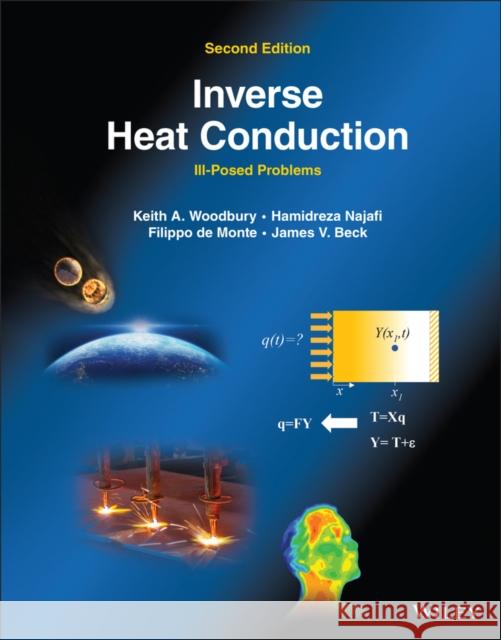
Inverse Heat Conduction: Ill-Posed Problems
ISBN-13: 9781119840190 / Angielski / Twarda / 2023 / 384 str.
(netto: 609,00 VAT: 5%)
Najniższa cena z 30 dni: 560,18
ok. 16-18 dni roboczych.
Darmowa dostawa!
Preface First EditionPreface Second EditionNomenclature1 Inverse Heat Conduction Problems: An Overview 1-11.1 Introduction 1-11.2 Basic Mathematical Description 1-31.3 Classification of Methods 1-51.4 Function Estimation Versus Parameter Estimation 1-71.5 Other Inverse Function Estimation Problems 1-71.6 Early Works on IHCPs 1-91.7 Applications of IHCPS: A Modern Look 1-101.8 Measurements 1-201.9 Criteria for Evaluation of IHCP Methods 1-231.10 Scope of Book 1-241.11 Chapter Summary 1-241.12 References 1-251.13 List of Figures 1-331.14 List of Tables 1-342 Analytical Solutions of Direct Heat Conduction Problems 2.12.1 Introduction 2.12.2 Numbering System 2.22.3 One-Dimensional Temperature Solutions 2.32.4 Two-Dimensional Temperature Solutions 2.272.5 Chapter Summary 2.482.6 References 2.502.7 Problems 2.522.8 List of Figures 2.552.9 List of Tables 2.563 Approximate Methods for Direct Heat Conduction Problems 3-13.1 Introduction 3-13.2 Superposition Principles 3-23.3 One-Dimensional Problem with Time-Dependent Surface Temperature 3-43.4 One-Dimensional Problem with Time-Dependent Surface Heat Flux 3-213.5 Two-Dimensional Problem with Space-Dependent and Constant Surface Heat Flux 3-343.6 Two-Dimensional Problem with Space- and Time-Dependent Surface Heat Flux 3-413.7 Chapter Summary 3-523.8 References 3-533.9 Problems 3-533.10 List of Figures 3-593.11 List of Tables 3-604 Inverse Heat Conduction Estimation Procedures 4.14.1 Introduction 4.14.2 Why is the IHCP Difficult? 4.24.3 Ill-Posed Problems 4.44.4 IHCP Solution Methodology 4.84.5 Sensitivity Coefficients 4.94.6 Stolz Method: Single Future Time Step Method 4.194.7 Function Specification Method 4.234.8 Tikhonov Regularization Method 4.354.9 Gradient Methods 4.444.10 Truncated Singular Value Decomposition Method 4.554.11 Kalman Filter 4.584.12 Chapter Summary 4.664.13 References 4.674.14 Problems 4.714.15 List of Figures 4.744.16 List of Tables 4.755 Filter Form of IHCP Solution 5-15.1 Introduction 5-15.2 Temperature Perturbation Approach 5-15.3 Filter Matrix Perspective 5-35.4 Sequential Filter Form 5-155.5 Using Second Temperature Sensor as Boundary Condition 5-185.6 Filter Coefficients for Multi-Layer Domain 5-265.7 Filter Coefficients for Non-Linear IHCP: Application for Heat Flux Measurement Using Directional Flame Thermometer 5-335.8 Chapter Summary 5-465.9 Problems 5-465.10 References 5-475.11 List of Figures 5-495.12 List of Tables 5-516 Optimal Regularization 6.16.1 Preliminaries 6.16.2 Two Conflicting Objectives 6.26.3 Mean Squared Error 6.46.4 Minimize Mean Squared Error in Heat Flux 6.56.5 Minimize Mean Squared Error in Temperature 6.136.6 The L-curve 6.176.7 Generalized Cross Validation 6.206.8 Chapter Summary 6.246.9 References 6.266.10 Problems 6.276.11 List of Figures 6.286.12 List of Tables 6.297 Evaluation of IHCP Solution Procedures 7.17.1 Introduction 7.17.2 Test Cases 7.37.3 Function Specification Method 7.137.4 Tikhonov Regularization 7.227.5 Conjugate Gradient Method 7.297.6 Truncated Singular Value Decomposition 7.377.7 Kalman Filter 7.447.8 Chapter Summary 7.517.9 References 7.557.10 Problems 7.557.11 List of Figures 7.577.12 List of Tables 7.618 Multiple Heat Flux Estimation 8-18.1 Introduction 8-18.2 The forward and the inverse problems 8-18.3 Examples 8-78.4 Chapter Summary 8-158.5 References 8-168.6 Problems 8-168.7 List of Figures 8-178.8 List of Tables 8-199 Heat Transfer Coefficient Estimation 9-19.1 Introduction 9-19.2 Sensitivity Coefficients 9-49.3 Lumped Body Analyses 9-89.4 Bodies with Internal Temperature Gradients 9-159.5 Chapter Summary 9-189.6 References 9-189.7 Problems 9-209.8 Figures 9-219.9 Tables 9-2210 Temperature Measurement 10.110.1 Introduction 10.110.2 Correction Kernel Concept 10.310.3 Unsteady surface element method 10.1610.4 Chapter Summary 10.2210.5 References 10.2310.6 Problems 10.2510.7 Figures 10.2710.8 Tables 10.27AppendicesA Numbering System A.1A.1 Dimensionality, coordinate system, and types of boundary condition A.1A.2 Boundary condition information A.2A.3 Initial temperature distribution A.5A.4 REFERENCES A.6B Exact Solution X22B(y1pt1)0Y22B00T0 B.1B.1 Exact analytical solution. Short-time form B.1B.2 Exact analytical solution. Large-time form B.4B.3 References B.8C Green's functions Solution Equation C-1C.1 Introduction C-1C.2 One-Dimensional Problem with Time-Dependent Surface Temperature C-1C.3 One-Dimensional Problem with Time-Dependent Surface Heat Flux C-9C.4 Two-Dimensional Problem With Space- And Time-Dependent Surface Heat Flux C-14C.5 References C-16C.6 List of Figures C-16
Keith A. Woodbury is Professor Emeritus of Mechanical Engineering at the University of Alabama, where his research in inverse heat conduction supported investigations into quenching and metal casting. Dr. Woodbury is a life-long member of ASME and has organized numerous technical sessions on inverse problems through the Heat Transfer Division's K-20 Committee. He is the editor of the Inverse Engineering Handbook (2003).Hamidreza Najafi is Associate Professor of Mechanical Engineering and Director of the Heat Transfer Lab at Florida Institute of Technology. He has authored and co-authored numerous articles in the areas of inverse heat conduction problems, computational heat transfer, and design and optimization of energy/thermal systems. Dr. Najafi is an active member of ASME and ASHRAE and has served in various leadership roles in multiple technical committees.Filippo de Monte is Professor of Mechanical Engineering at the University L'Aquila, Italy. He served as a full-time Visiting Ph.D. student at the Department of Engineering, University of Cambridge, UK, in 1992, and a seasonal Visiting Associate Professor at the Department of Mechanical Engineering, Michigan State University, USA, from 2007 to 2014. He is a Member of the American Society of Mechanical Engineers (ASME) and holds editorial positions at the Journal of Verification, Validation and Uncertainty Quantification (ASME) and Heat Transfer Engineering. He was the Chairman of the 10th International Conference on Inverse Problems in Engineering (ICIPE 22), May 15-19, 2022, Francavilla al Mare (Chieti), Italy, and is co-editor of the book Modeling of Mass Transport Processes in Biological Media (July 2022).James V. Beck (1930-2022) was Professor Emeritus of Mechanical Engineering at Michigan State University (MSU), a Fellow of ASME, and one of the pioneers of the fields of inverse problems and parameter estimation. Dr. Beck was honored with the MSU Distinguished Faculty Award (1987) and the ASME Heat Transfer Memorial Award (1998). He was the originator of the Inverse Problems Symposium and was the inventor, with Professor Litkouhi, of the numbering system for heat conduction solutions. Professor Beck made outstanding pioneering contributions to the field of heat transfer with numerous refereed journal articles and books.




Czytaj nas na:
1997-2026 DolnySlask.com Agencja Internetowa
KrainaKsiazek.PL - Księgarnia Internetowa


