


ISBN-13: 9783540437963 / Angielski / Twarda / 2002 / 223 str.
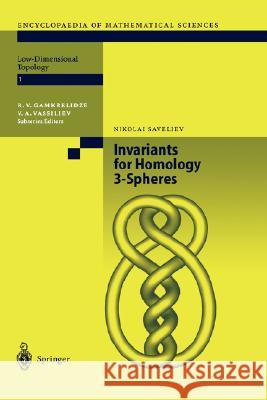
The book gives a systematic exposition of the diverse ideas and methods in the area, from algebraic topology of manifolds to invariants arising from quantum field theories. The main topics covered include: constructions and classification of homology 3-spheres, Rokhlin invariant, Casson invariant and its extensions, and Floer homology and gauge-theoretical invariants of homology cobordism. Many of the topics covered in the book appear in monograph form for the first time. The book gives a rather broad overview of ideas and methods and provides a comprehensive bibliography. The text will be a valuable source for both the graduate student and researcher in mathematics and theoretical physics.
From the reviews:
"The book can be considered as a fundamental monograph on invariants of homology 3-spheres. Let us mention that while the topic may seem rather specialised, these investigations have proved to be extremely useful in the manifold topology... [...] Obviously, the book is designed for specialists in the field who will find there a practically complete survey of results and methods. On the other hand, it is written in such a clear style that I would like to recommend it strongly to postgraduate students starting to make themselves familiar with the field. The book will help them to learn basic notions and will gradually introduce them into contemporary research. [...]"
European Mathematical Society Newsletter, Dec. 2004, p. 44
"This book is an excellent survey on invariants of homology 3-spheres. [...] This book is both a valuable resource for experts and a good introduction for newcomers. The author has exercised judicious restraint in his selection of topics, and the result is a well-organized and well-written book that will appeal to anyone with an interest in low-dimensional topology. [...]"
Hans U. Boden, Mathematical Reviews Clippings from Issue 2004c
"The book can be considered as a fundamental monograph on invariants of homology 3- spheres. ... the book is designed for specialists in the field who will find there a practically complete survey of results and methods. On the other hand, it is written in such a clear style that I would like to recommend it strongly to postgraduate students starting to make themselves familiar with the field." (EMS, December, 2004)
"This book is an excellent survey on invariants of homology 3-spheres. ... This book is both a valuable resource for experts and a good introduction for newcomers. The author has exercised judicious restraint in his selection of topics, and the result is a well-organized and well-written book that will appeal to anyone with an interest in low-dimensional topology." (Hans U. Boden, Mathematical Reviews, 2004 c)
"As suggested by the title of the book, its main subject are invariants of integer and rational homology 3-spheres ... . The book is written in a style in the middle between the text book and a report or encyclopaedia. ... on little more than 200 pages the book presents a wealth of material which will make it useful for graduate students and researchers in mathematics and theoretical physics looking for information and orientation in a field of considerable interest in the last decades." (Bruno Zimmermann, Zentralblatt MATH, Vol. 998 (23), 2002)
1 Homology 3-Spheres 1.1 Integral homology 3-spheres 1.1.1 Homotopy 3-spheres 1.1.2 Poincare homology sphere 1.1.3 Brieskorn homology spheres 1.1.4 Seifert fibered homology spheres 1.1.5 Dehn surgery on knots 1.1.6 Surgery on links 1.1.7 Connected sums and splicing 1.1.8 Splice decomposition 1.1.9 Plumbing 1.1.10 Links of singularities 1.1.11 Mutations 1.1.12 Branched covers 1.1.13 Heegaard splittings of homology spheres 1.2 Rational homology spheres 1.2.1 Spherical space forms 1.2.2 Dehn surgery 1.2.3 Seifert fibered manifolds 1.2.4 Links of singularities 1.2.5 Branched covers 2 Rokhlin Invariant 2.1 The Rokhlin theorem 2.2 Definition of the Rokhlin invariant 2.3 Properties of the Rokhlin invariant 2.3.1 Surgery formula for the Rokhlin invariant 2.3.2 Surgery on algebraically split links 2.3.3 Splicing and mutation 2.3.4 Rokhlin invariant of branched coverings 2.3.5 Birman-Craggs homomorphisms 2.3.6 Homology cobordism invariance 2.4 Seifert fibered and graph homology spheres 2.4.1 The algorithm 2.4.2 The formula 3 Casson Invariant 3.1 Definition of the Casson invariant 3.2 Construction of the Casson invariant 3.2.1 SU(2)-representation spaces 3.2.2 The intersection theory 3.2.3 Orientations 3.2.4 Independence of Heegaard splitting 3.2.5 Casson invariant for knots and property (1) 3.2.6 The difference cycle 3.2.7 Casson invariant for boundary links and property (2) 3.2.8 Casson invariant of a trefoil and property (0) 3.3 Comments and ramifications 3.3.1 Pillowcase 3.3.2 Perturbations 3.3.3 The connected sum formula 3.3.4 The integrality of Casson invariant 3.3.5 Casson invariant of algebraically split links 3.4 Properties of the Casson invariant 3.4.1 Splicing additivity 3.4.2 Mutation invariance 3.4.3 Casson invariant of branched coverings 3.4.4 Casson invariant of fibered knots 3.4.5 Finite type invariants 3.4.6 Further properties of the Casson invariant 3.5 Seifert fibered and graph homology spheres 3.5.1 Casson invariant of Brieskorn homology spheres 3.5.2 Casson invariant of Seifert fibered homology spheres 3.5.3 The Neumann-Wahl conjecture 3.6 Applications of the Casson invariant 3.6.1 Triangulating topological 4-manifolds 3.6.2 Amphicheiral homology spheres 3.6.3 Property P for knots 4 Invariants of Walker and Lescop 4.1 Definition of the Walker invariant 4.2 Construction of the Walker invariant 4.2.1 SU(2)-representation varieties 4.2.2 The intersection theory 4.2.3 The surgery formula 4.2.4 Combinatorial definition of the Walker invariant 4.3 The Lescop invariant 4.4 Properties of the Walker and Lescop invariants 4.4.1 The gluing formula 4.4.2 Branched covers 4.4.3 Seifert fibered manifolds 4.5 Casson type invariants from other Lie groups 5 Casson Invariant and Gauge Theory 5.1 Gauge theory in dimension 3 5.2 Chern-Simons function 5.3 The Casson invariant from gauge theory 5.3.1 Morse theory and Euler characteristic 5.3.2 Critical points of cs and spectral flow 5.3.3 Non-degenerate case 5.3.4 Perturbations 5.3.5 Morse type perturbations 5.3.6 Casson invariant and Seiberg-Witten equations 5.4 Casson-type invariants of knots 5.4.1 Representation varieties of knot groups 5.4.2 The invariants 5.5 Equivariant Casson invariant 5.5.1 Equivariant gauge theory 5.5.2 Definition of the invariants 5.5.3 Equivariant Casson and knot signatures 5.5.4 Applications 5.6 The SU(3)-Casson invariant 5.6.1 Some SU(3)-gauge theory 5.6.2 Definition of the invariant 5.6.3 Properties and computations 6 Instanton Floer Homology 6.1 Gauge theory in dimension 4 6.1.1 Gauge theory on closed 4-manifolds 6.1.2 Gauge theory on open 4-manifolds 6.1.3 Linear analysis 6.1.4 Non-linear analysis 6.2 Definition of the Floer homology 6.2.1 Review of the Morse theory 6.2.2 Floer homology of integral homology spheres 6.2.3 Functoriality with respect to cobordisms 6.3 Spectral flow formulas 6.3.1 The Atiyah-Patodi-Singer formula 6.3.2 The splitting formula 6.3.3 The Kirk-Klassen formula 6.4 Seifert fibered and graph homology spheres 6.4.1 The algorithm 6.4.2 T
Homology 3-sphere is a closed 3-dimensional manifold whose homology equals that of the 3-sphere. These objects may look rather special but they have played an outstanding role in geometric topology for the past fifty years. The book gives a systematic exposition of diverse ideas and methods in the area, from algebraic topology of manifolds to invariants arising from quantum field theories. The main topics covered in the book are constructions and classification of homology 3-spheres, Rokhlin invariant, Casson invariant and its numerous extensions, including invariants of Walker and Lescop, Herald and Lin invariants of knots, and equivariant Casson invariants, followed by Floer homology and gauge-theoretical invariants of homology cobordism. Many of the topics covered in the book appear in monograph form for the first time. The book gives a rather broad overview of ideas and methods and provides a comprehensive bibliography. It will be appealing to both graduate students and researchers in mathematics and theoretical physics.

1997-2026 DolnySlask.com Agencja Internetowa










