• Wyszukiwanie zaawansowane
  • Kategorie
  • Kategorie BISAC
  • Książki na zamówienie
  • Promocje
  • Granty
  • Książka na prezent
  • Opinie
  • Pomoc
  • Załóż konto
  • Zaloguj się

Introductory Statistics and Random Phenomena: Uncertainty, Complexity and Chaotic Behavior in Engineering and Science » książka


zaloguj się | załóż konto
Logo Krainaksiazek.pl

koszyk

konto

szukaj
topmenu
Księgarnia internetowa
Szukaj
Książki na zamówienie
Promocje
Granty
Książka na prezent
Moje konto
Pomoc
 
 
Wyszukiwanie zaawansowane
Pusty koszyk
Bezpłatna dostawa dla zamówień powyżej 20 złBezpłatna dostawa dla zamówień powyżej 20 zł

Kategorie główne

• Nauka
 [2946600]
• Literatura piękna
 [1856966]

  więcej...
• Turystyka
 [72221]
• Informatyka
 [151456]
• Komiksy
 [35826]
• Encyklopedie
 [23190]
• Dziecięca
 [619653]
• Hobby
 [140543]
• AudioBooki
 [1577]
• Literatura faktu
 [228355]
• Muzyka CD
 [410]
• Słowniki
 [2874]
• Inne
 [445822]
• Kalendarze
 [1744]
• Podręczniki
 [167141]
• Poradniki
 [482898]
• Religia
 [510455]
• Czasopisma
 [526]
• Sport
 [61590]
• Sztuka
 [243598]
• CD, DVD, Video
 [3423]
• Technologie
 [219201]
• Zdrowie
 [101638]
• Książkowe Klimaty
 [124]
• Zabawki
 [2473]
• Puzzle, gry
 [3898]
• Literatura w języku ukraińskim
 [254]
• Art. papiernicze i szkolne
 [8170]
Kategorie szczegółowe BISAC

Introductory Statistics and Random Phenomena: Uncertainty, Complexity and Chaotic Behavior in Engineering and Science

ISBN-13: 9780817640316 / Angielski / Twarda / 1998 / 509 str.
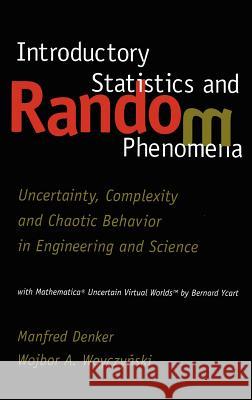
W. Woyczynski; M. Denker;Denker
Introductory Statistics and Random Phenomena: Uncertainty, Complexity and Chaotic Behavior in Engineering and Science Denker, Manfred 9780817640316 Birkhauser - książkaWidoczna okładka, to zdjęcie poglądowe, a rzeczywista szata graficzna może różnić się od prezentowanej.

Introductory Statistics and Random Phenomena: Uncertainty, Complexity and Chaotic Behavior in Engineering and Science

ISBN-13: 9780817640316 / Angielski / Twarda / 1998 / 509 str.

W. Woyczynski; M. Denker;Denker
cena 201,72 zł
(netto: 192,11 VAT:  5%)

Najniższa cena z 30 dni: 192,74 zł
Termin realizacji zamówienia:
ok. 22 dni roboczych
Bez gwarancji dostawy przed świętami

Darmowa dostawa!
inne wydania

The present book is based on a course developed as partofthe large NSF-funded GatewayCoalitionInitiativeinEngineeringEducationwhichincludedCaseWest ern Reserve University, Columbia University, Cooper Union, Drexel University, Florida International University, New Jersey Institute ofTechnology, Ohio State University, University ofPennsylvania, Polytechnic University, and Universityof South Carolina. The Coalition aimed to restructure the engineering curriculum by incorporating the latest technological innovations and tried to attract more and betterstudents to engineering and science. Draftsofthis textbookhave been used since 1992instatisticscoursestaughtatCWRU, IndianaUniversity, Bloomington, and at the universities in Gottingen, Germany, and Grenoble, France. Another purpose of this project was to develop a courseware that would take advantage ofthe Electronic Learning Environment created by CWRUnet-the all fiber-optic Case Western Reserve University computer network, and its ability to let students run Mathematica experiments and projects in their dormitory rooms, and interactpaperlessly with the instructor. Theoretically, onecould try togothroughthisbook withoutdoing Mathematica experimentsonthecomputer, butitwouldbelikeplayingChopin's Piano Concerto in E-minor, or Pink Floyd's The Wall, on an accordion. One would get an idea ofwhatthe tune was without everexperiencing the full richness andpowerofthe entire composition, and the whole ambience would be miscued.


Kategorie:
Nauka, Matematyka
Kategorie BISAC:
Mathematics > Prawdopodobieństwo i statystyka
Mathematics > Matematyka stosowana
Computers > Computer Science
Wydawca:
Birkhauser
Seria wydawnicza:
Statistics for Industry and Technology
Język:
Angielski
ISBN-13:
9780817640316
Rok wydania:
1998
Wydanie:
1998
Numer serii:
000050634
Ilość stron:
509
Waga:
2.05 kg
Wymiary:
23.5 x 15.5
Oprawa:
Twarda
Wolumenów:
01
Dodatkowe informacje:
Wydanie ilustrowane

"This is an innovative book... Well-constructed computer exercises with a bundled easily usable software package 'Mathematica® Uncertain Virtual Worlds®'... The bibliographical notes that accompany each chapter...are clearly written with a keen eye toward encouraging students to enrich their understanding by pursuing additional reading...A lucidly written text and many well-designed computer experiments that enable students to simulate the whole process of some dynamic systems."  -Technometrics

"Highly data-oriented, with an unusually large collection of real-life examples taken from industry and various scientific disciplines... The book departs from the standard fare, by [also] including detailed coverage of such contemporary topics as chaotic dynamical systems, the nature of randomness, computability and Kolmogorov complexity, encryption, ergodicity, entropy, and even fractals."  -Short Book Reviews (Int'l Statistical Institute)

"The novelty of the book is the integration of ideas about statistics of random phenomena stemming from algorithmic computational complexity, classical probability theory and chaotic behavior in nonlinear systems, and the broad use of Mathematica in the exposition. Moreover, the examples of statistical problems used arise in real-life industrial and scientific lab situations and have been collected from the engineering and scientific literature, or through direct interaction with practicing engineers and scientists. The authors' goal is to give engineering and science students a forward-looking alternative to the usual introductory statistics courses...In summary, I find  Introductory statistics and random phenomena an excellent textbook, and I strongly recommend it as an introductory technical statistics course to engineering and science students who have had a basic programming course in computer science. I expect it to become a classic."   -Mathematical Reviews

I Descriptive Statistics-Compressing Data.- 1 Why One Needs to Analyze Data.- 1.1 Coin tossing, lottery, and the stock market.- 1.2 Inventory problems in management.- 1.3 Battery life and quality control in manufacturing.- 1.4 Reliability of complex systems.- 1.5 Point processes in time and space.- 1.6 Polls-social sciences.- 1.7 Time series.- 1.8 Repeated experiments and testing.- 1.9 Simple chaotic dynamical systems.- 1.10 Complex dynamical systems.- 1.11 Pseudorandom number generators and the Monte-Carlo methods.- 1.12 Fractals and image reconstruction.- 1.13 Coding and decoding, unbreakable ciphers.- 1.14 Experiments, exercises, and projects.- 1.15 Bibliographical notes.- 2 Data Representation and Compression.- 2.1 Data types, categorical data.- 2.2 Numerical data: order statistics, median, quantiles.- 2.3 Numerical data: histograms, means, moments.- 2.4 Location, dispersion, and shape parameters.- 2.5 Probabilities: a frequentist viewpoint.- 2.6 Multidimensional data: histograms and other graphical representations.- 2.7 2-D data: regression and correlations.- 2.8 Fractal data.- 2.9 Measuring information content:entropy.- 2.10 Experiments, exercises, and projects.- 2.11 Bibliographical notes.- 3 Analytic Representation of Random Experimental Data.- 3.1 Repeated experiments and the law of large numbers.- 3.2 Characteristics of experiments: distribution functions, densities, means, variances.- 3.3 Uniform distributions, simulation of random quantities, the Monte Carlo method.- 3.4 Bernoulli and binomial distributions.- 3.5 Rescaling probabilities: Poisson approximation.- 3.6 Stability of Fluctuations Law: Gaussian approximation.- 3.7 How to estimate p in Bernoulli experiments.- 3.8 Other continuous distributions; Gamma function calculus.- 3.9 Testing the fit of a distribution.- 3.10 Random vectors and multivariate distributions.- 3.11 Experiments, exercises, and projects.- 3.12 Bibliographical notes.- II Modeling Uncertainty.- 4 Algorithmic Complexity and Random Strings.- 4.1 Heart of randomness: when is random — random?.- 4.2 Computable strings and the Turing machine.- 4.3 Kolmogorov complexity and random strings.- 4.4 Typical sequences: Martin-Löf tests of randomness.- 4.5 Stability of subsequences: von Mises randomness.- 4.6 Computable framework of randomness: degrees of irregularity.- 4.7 Experiments, exercises, and projects.- 4.8 Bibliographical notes.- 5 Statistical Independence and Kolmogorov’s Probability Theory.- 5.1 Description of experiments, random variables, and Kolmogorov’s axioms.- 5.2 Uniform discrete distributions and counting.- 5.3 Statistical independence as a model for repeated experiments..- 5.4 Expectations and other characteristics of random variables.- 5.4.1 Expectations.- 5.4.2 Expectations of functions of random variables. Variance.- 5.4.3 Expectations of functions of vectors. Covariance.- 5.4.4 Expectation of the product. Variance of the sum of independent random variables.- 5.4.5 Moments and the moment generating function.- 5.4.6 Expectations of general random variables.- 5.5 Averages of independent random variables.- 5.6 Laws of large numbers and small deviations.- 5.7 Central limit theorem and large deviations.- 5.8 Experiments, exercises, and projects.- 5.9 Bibliographical Notes.- 6 Chaos in Dynamical Systems: How Uncertainty Arises in Scientific and Engineering Phenomena.- 6.1 Dynamical systems: general concepts and typical examples.- 6.2 Orbits and fixed points.- 6.3 Stability of frequencies and the ergodic theorem.- 6.4 Stability of fluctuations and the central limit theorem.- 6.5 Attractors, fractals, and entropy.- 6.6 Experiments, exercises, and projects.- 6.7 Bibliographical notes.- III Model Specification-Design of Experiments.- 7 General Principles of Statistical Analysis.- 7.1 Design of experiments and planning of investigation.- 7.2 Model selection.- 7.3 Determining the method of statistical inference.- 7.3.1 Maximum likelihood estimator (MLE).- 7.3.2 Least squares estimator (LSE).- 7.3.3 Method of moments (MM).- 7.3.4 Concluding remarks.- 7.4 Estimation of fractal dimension.- 7.5 Practical side of data collection and analysis.- 7.6 Experiments, exercises, and projects.- 7.7 Bibliographical notes.- 8 Statistical Inference for Normal Populations.- 8.1 Introduction; parametric inference.- 8.2 Confidence intervals for one-sample model.- 8.3 From confidence intervals to hypothesis testing.- 8.4 Statistical inference for two—sample normal models.- 8.5 Regression analysis for the normal model.- 8.6 Testing for goodness-of-fit.- 8.7 Experiments, exercises, and projects.- 8.8 Bibliographical notes.- 9 Analysis of Variance.- 9.1 Single-factor ANOVA.- 9.2 Two-factor ANOVA.- 9.3 Experiments, exercises, and projects.- 9.4 Bibliographical notes.- A Uncertainty Principle in Signal Processing and Quantum Mechanics.- B Fuzzy Systems and Logic.- C A Critique of Pure Reason.- D The Remarkable Bernoulli Family.- F Tables.


Udostępnij

Facebook - konto krainaksiazek.pl


Opinie o Krainaksiazek.pl na Opineo.pl

Partner Mybenefit

Krainaksiazek.pl w programie rzetelna firma Krainaksiaze.pl - płatności przez paypal

Czytaj nas na:

Facebook - krainaksiazek.pl
  • książki na zamówienie
  • granty
  • książka na prezent
  • kontakt
  • pomoc
  • opinie
  • regulamin
  • polityka prywatności

Zobacz:

  • Księgarnia czeska

  • Wydawnictwo Książkowe Klimaty

1997-2025 DolnySlask.com Agencja Internetowa

© 1997-2022 krainaksiazek.pl
     
KONTAKT | REGULAMIN | POLITYKA PRYWATNOŚCI | USTAWIENIA PRYWATNOŚCI
Zobacz: Księgarnia Czeska | Wydawnictwo Książkowe Klimaty | Mapa strony | Lista autorów
KrainaKsiazek.PL - Księgarnia Internetowa

Polityka prywatnosci - link
Krainaksiazek.pl - płatnośc Przelewy24
Przechowalnia Przechowalnia





