• Wyszukiwanie zaawansowane
  • Kategorie
  • Kategorie BISAC
  • Książki na zamówienie
  • Promocje
  • Granty
  • Książka na prezent
  • Opinie
  • Pomoc
  • Załóż konto
  • Zaloguj się

Introductory Physics with Algebra as a Second Language: Mastering Problem-Solving » książka


zaloguj się | załóż konto
Logo Krainaksiazek.pl

koszyk

konto

szukaj
topmenu
Księgarnia internetowa
Szukaj
Książki na zamówienie
Promocje
Granty
Książka na prezent
Moje konto
Pomoc
 
 
Wyszukiwanie zaawansowane
Pusty koszyk
Bezpłatna dostawa dla zamówień powyżej 20 złBezpłatna dostawa dla zamówień powyżej 20 zł

Kategorie główne

• Nauka
 [2946600]
• Literatura piękna
 [1856966]

  więcej...
• Turystyka
 [72221]
• Informatyka
 [151456]
• Komiksy
 [35826]
• Encyklopedie
 [23190]
• Dziecięca
 [619653]
• Hobby
 [140543]
• AudioBooki
 [1577]
• Literatura faktu
 [228355]
• Muzyka CD
 [410]
• Słowniki
 [2874]
• Inne
 [445822]
• Kalendarze
 [1744]
• Podręczniki
 [167141]
• Poradniki
 [482898]
• Religia
 [510455]
• Czasopisma
 [526]
• Sport
 [61590]
• Sztuka
 [243598]
• CD, DVD, Video
 [3423]
• Technologie
 [219201]
• Zdrowie
 [101638]
• Książkowe Klimaty
 [124]
• Zabawki
 [2473]
• Puzzle, gry
 [3898]
• Literatura w języku ukraińskim
 [254]
• Art. papiernicze i szkolne
 [8170]
Kategorie szczegółowe BISAC

Introductory Physics with Algebra as a Second Language: Mastering Problem-Solving

ISBN-13: 9780471762508 / Angielski / Miękka / 2006 / 288 str.
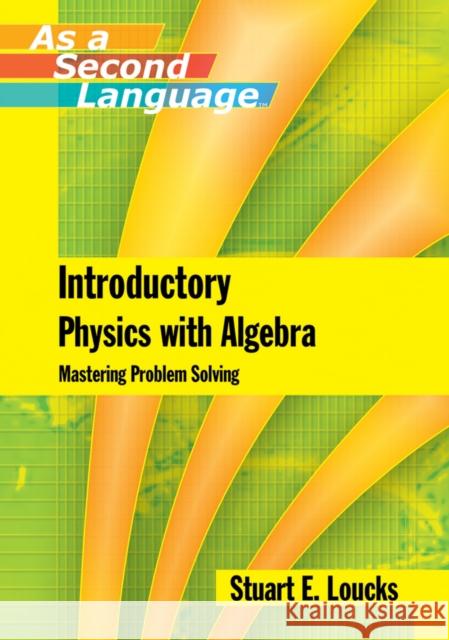
Stuart E. Loucks
Introductory Physics with Algebra as a Second Language: Mastering Problem-Solving Loucks, Stuart E. 9780471762508 John Wiley & Sons - książkaWidoczna okładka, to zdjęcie poglądowe, a rzeczywista szata graficzna może różnić się od prezentowanej.

Introductory Physics with Algebra as a Second Language: Mastering Problem-Solving

ISBN-13: 9780471762508 / Angielski / Miękka / 2006 / 288 str.

Stuart E. Loucks
cena 296,94 zł
(netto: 282,80 VAT:  5%)

Najniższa cena z 30 dni: 294,50 zł
Termin realizacji zamówienia:
ok. 30 dni roboczych
Bez gwarancji dostawy przed świętami

Darmowa dostawa!

Get a better grade in Physics
Physics may be challenging, but with training and practice you can come out of your physics class with the grade you want With Stuart Loucks' Introductory Physics with Algebra as a Second Language(TM): Mastering Problem-Solving, you'll get the practice and training you need to better understand fundamental principles, build confidence, and solve problems.

Here's how you can get a better grade in physics:

Understand the basic language of physics
Introductory Physics with Algebra as a Second Language(TM) will help you make sense of your textbook and class notes so that you can use them more effectively. The text explains key topics in algebra-based physics in clear, easy-to-understand language.
Break problems down into simple steps
Introductory Physics with Algebra as a Second Language(TM) teaches you to recognize details that tell you how to begin new problems. You will learn how to effectively organize the information, decide on the correct equations, and ultimately solve the problem.

Learn how to tackle unfamiliar physics problems
Stuart Loucks coaches you in the fundamental concepts and approaches needed to set up and solve the major problem types. As you learn how to deal with these kinds of problems, you will be better equipped to tackle problems you have never seen before.

Improve your problem-solving skills
You'll learn timesaving problem-solving strategies that will help you focus your efforts and avoid potential pitfalls.


Kategorie:
Nauka, Fizyka
Kategorie BISAC:
Science > Fizyka
Science > Fizyka matematyczna
Wydawca:
John Wiley & Sons
Język:
Angielski
ISBN-13:
9780471762508
Rok wydania:
2006
Ilość stron:
288
Waga:
0.33 kg
Wymiary:
23.52 x 15.85 x 0.99
Oprawa:
Miękka
Wolumenów:
01
Dodatkowe informacje:
Wydanie ilustrowane

CHAPTER 1. THE BOTTOM LINE FOR SOLVING PHYSICS PROBLEMS .

CHAPTER 2. LINEAR VELOCITY AND ACCELERATION .

2.1 Linear Motion Equations.

2.2 The Idea Behind How to Use Motion Equations.

2.3 Constant/Average Speed or Velocity Problems.

2.4 Constant/Average Speed or Velocity—Two Intervals, Same Direction.

2.5 Constant/Average Speed or Velocity—Two Intervals, Direction Change.

2.6 Constant/Average Speed or Velocity—Two Objects.

2.7 How to Set Up Constant/Average Speed or Velocity Problems.

2.8 Constant/Average Acceleration Problems.

2.9 Constant/Average Acceleration—One Interval.

2.10 Constant/Average Acceleration—Multiple Intervals.

2.11 Constant/Average Acceleration—“Free–Fall”.

2.12 Constant/Average Acceleration—Two Objects.

2.13 How to Set Up Constant/Average Acceleration Problems.

CHAPTER 3.   VECTORS.

3.1 Magnitude and Direction, and x– and y–Components.

3.2 Vectors along One Axis.

3.3 Vector Addition.

3.4 How to Set Up Vector Problems.

3.5 “Back Where You Started”—When Vectors Add to Zero.

3.6 Subtracting Vectors, OR, When One of the Added Vectors Is Unknown.

CHAPTER 4.   PROJECTILE MOTION.

4.1 Projectile Motion: Combining Three Basic Concepts.

4.2 When Initial Velocity Is Horizontal.

4.3 How to Set Up Projectile Motion Problems.

4.4 When Final Velocity Is Horizontal (at Maximum Height).

4.5 When Initial and Final Heights Are Equal.

4.6 When Both Initial and Final Velocities Are at Angles.

CHAPTER 5.   FORCE AND NEWTON’S LAWS OF MOTION.

5.1 How to Draw a Free–Body Diagram (FBD).

5.2 Forces in 1D.

5.3 How to Set Up Force Problems.

5.4 Motion Intervals in Force Problems.

5.5 Objects Connected by Strings, Ropes, and so on.

5.6 Forces in 2D.

5.7 Sliding—Kinetic Friction.

5.8 “Just about to Slip”—Maximum Static Friction.

5.9 Inclines or Ramps.

5.10 Objects Pushing on Each Other.

CHAPTER 6.   CIRCULAR MOTION AND CENTRIPETAL FORCE.

6.1 Tangential Speed and Centripetal Acceleration.

6.2 Comparing Circular Motion at Two Different Radii.

6.3 Comparing Circular Motion at Two Different Speeds.

6.4 How to Set Up Circular Motion Comparison Problems.

6.5 How to Think about Centripetal Force Problems.

6.6 Circular Motion with a Horizontal String.

6.7 How to Set Up Centripetal Force Problems.

6.8 Circular Motion with a String at an Angle.

6.9 Circular Motion on an Unbanked Road with Friction.

6.10 Circular Motion on a Banked Road without Friction.

6.11 Vertical Circular Motion—Lowest Point.

6.12 Vertical Circular Motion—Highest Point, Upside–Down.

6.13 Vertical Circular Motion—Highest Point, Right–Side–Up.

CHAPTER 7.   GRAVITATION AND ORBITS.

7.1 Weight and g at a Planet’s Surface.

7.2 Adding Gravitational Force Vectors.

7.3 Circular Orbit Problems.

7.4 Circular Orbit Equations.

7.5 Comparing Orbits at Two Different Radii.

CHAPTER 8.   WORK AND ENERGY.

8.1 Work Done by a Constant/Average Force.

8.2 Work Problems—with Two or More Forces.

8.3 Work Problems—when Forces Are Not Given.

8.4 How to Set Up Work Problems.

8.5 The Work–Energy Theorem—KE Only.

8.6 How to Set Up Work–Energy Problems—KE only.

8.7 Potential Energy, Conservative and Nonconservative Forces.

8.8 The Work–Energy Theorem—KE and PE.

8.9 How to Set Up Work–Energy Problems—KE and PE.

8.10 Conservation of Energy—When Wnc 0.

8.11 How to Set Up Conservation of Energy Problems.

8.12 How to Split Up a Difficult Problem.

CHAPTER 9.   IMPULSE, MOMENTUM, AND CENTER OF MASS.

9.1 The Impulse–Momentum Theorem.

9.2 1D Impulse and Momentum.

9.3 2D Impulse and Momentum.

9.4 How to Set Up Impulse and Momentum Problems.

9.5 Conservation of Momentum.

9.6 1D Collisions—Objects Coming Together.

9.7 1D Explosions—Objects Pushing Apart.

9.8 1D Elastic Collisions.

9.9 2D Collisions.

9.10 How to Set Up Conservation of Momentum Problems.

9.11 Center of Mass.

9.12 1D Center of Mass.

9.13 2D Center of Mass.

9.14 How to Set Up Center of Mass Problems.

CHAPTER 10.   ANGULAR VELOCITY AND ACCELERATION.

10.1 How to Relate Angular and Tangential or Linear Quantities.

10.2 Two–Object, Two–Circle Problems.

10.3 How to Set Up Two–Object, Two–Circle Problems.

10.4 Constant/Average Angular Velocity.

10.5 How to Set Up Constant/Average Angular Velocity Problems.

10.6 Constant/Average Angular Acceleration.

10.7 Constant/Average Angular Acceleration—Multiple Intervals.

10.8 Constant/Average Angular Acceleration—with Tangential or Linear Acceleration.

10.9 Constant/Average Angular Acceleration—with Centripetal Acceleration.

10.10 Summary of Angular Velocity and Acceleration Equations.

10.11 How to Set Up Constant/Average Angular Acceleration Problems.

CHAPTER 11.   TORQUE AND EQUILIBRIUM.

11.1 Torque.

11.2 How to Set Up Torque Problems.

11.3 Equilibrium for “Rigid” Bodies.

11.4 Equilibrium—With Only 90 Angles.

11.5 Equilibrium—With Non–90 Angles.

11.6 How to Set Up Equilibrium Problems.

CHAPTER 12. MORE ANGULAR MOTION.

12.1 Moment of Inertia.

12.2 Torque and Angular Acceleration Problems.

12.3 How to Set Up Torque and Angular Acceleration Problems.

12.4 Rotational Kinetic Energy and Conservation of Energy.

12.5 Conservation of Angular Momentum.

12.6 Conservation of Angular Momentum Problems—First Type.

12.7 Conservation of Angular Momentum Problems—Second Type.

12.8 How to Set Up Conservation of Angular Momentum Problems.

INDEX .

Stuart Loucks is a Professor of Physics at American River College in Sacramento, California.

Get a better grade in Physics!
Physics may be challenging, but with training and practice you can come out of your physics class with the grade you want! With Stuart Loucks’ Introductory Physics with Algebra as a Second Language™: Mastering Problem–Solving, you’ll get the practice and training you need to better understand fundamental principles, build confidence, and solve problems.

Here’s how you can get a better grade in physics:

Understand the basic language of physics
Introductory Physics with Algebra as a Second Language™ will help you make sense of your textbook and class notes so that you can use them more effectively. The text explains key topics in algebra–based physics in clear, easy–to–understand language.

Break problems down into simple steps

Introductory Physics with Algebra as a Second Language™ teaches you to recognize details that tell you how to begin new problems. You will learn how to effectively organize the information, decide on the correct equations, and ultimately solve the problem.

Learn how to tackle unfamiliar physics problems
Stuart Loucks coaches you in the fundamental concepts and approaches needed to set up and solve the major problem types. As you learn how to deal with these kinds of problems, you will be better equipped to tackle problems you have never seen before.

Improve your problem–solving skills
You’ll learn timesaving problem–solving strategies that will help you focus your efforts and avoid potential pitfalls.

Loucks, Stuart E. Stuart Loucks is a Professor of Physics at America... więcej >


Udostępnij

Facebook - konto krainaksiazek.pl


Opinie o Krainaksiazek.pl na Opineo.pl

Partner Mybenefit

Krainaksiazek.pl w programie rzetelna firma Krainaksiaze.pl - płatności przez paypal

Czytaj nas na:

Facebook - krainaksiazek.pl
  • książki na zamówienie
  • granty
  • książka na prezent
  • kontakt
  • pomoc
  • opinie
  • regulamin
  • polityka prywatności

Zobacz:

  • Księgarnia czeska

  • Wydawnictwo Książkowe Klimaty

1997-2025 DolnySlask.com Agencja Internetowa

© 1997-2022 krainaksiazek.pl
     
KONTAKT | REGULAMIN | POLITYKA PRYWATNOŚCI | USTAWIENIA PRYWATNOŚCI
Zobacz: Księgarnia Czeska | Wydawnictwo Książkowe Klimaty | Mapa strony | Lista autorów
KrainaKsiazek.PL - Księgarnia Internetowa

Polityka prywatnosci - link
Krainaksiazek.pl - płatnośc Przelewy24
Przechowalnia Przechowalnia




