• Wyszukiwanie zaawansowane
  • Kategorie
  • Kategorie BISAC
  • Książki na zamówienie
  • Promocje
  • Granty
  • Książka na prezent
  • Opinie
  • Pomoc
  • Załóż konto
  • Zaloguj się

Introduction to Theoretical Population Genetics » książka


zaloguj się | załóż konto
Logo Krainaksiazek.pl

koszyk

konto

szukaj
topmenu
Księgarnia internetowa
Szukaj
Książki na zamówienie
Promocje
Granty
Książka na prezent
Moje konto
Pomoc
 
 
Wyszukiwanie zaawansowane
Pusty koszyk
Bezpłatna dostawa dla zamówień powyżej 20 złBezpłatna dostawa dla zamówień powyżej 20 zł

Kategorie główne

• Nauka
 [2946600]
• Literatura piękna
 [1856966]

  więcej...
• Turystyka
 [72221]
• Informatyka
 [151456]
• Komiksy
 [35826]
• Encyklopedie
 [23190]
• Dziecięca
 [619653]
• Hobby
 [140543]
• AudioBooki
 [1577]
• Literatura faktu
 [228355]
• Muzyka CD
 [410]
• Słowniki
 [2874]
• Inne
 [445822]
• Kalendarze
 [1744]
• Podręczniki
 [167141]
• Poradniki
 [482898]
• Religia
 [510455]
• Czasopisma
 [526]
• Sport
 [61590]
• Sztuka
 [243598]
• CD, DVD, Video
 [3423]
• Technologie
 [219201]
• Zdrowie
 [101638]
• Książkowe Klimaty
 [124]
• Zabawki
 [2473]
• Puzzle, gry
 [3898]
• Literatura w języku ukraińskim
 [254]
• Art. papiernicze i szkolne
 [8170]
Kategorie szczegółowe BISAC

Introduction to Theoretical Population Genetics

ISBN-13: 9783642762161 / Angielski / Miękka / 2011 / 369 str.
Thomas Nagylaki
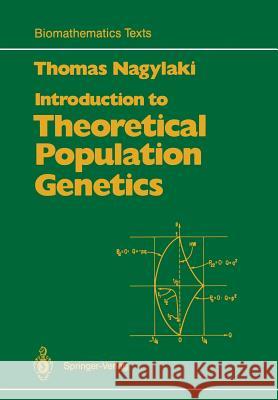
Introduction to Theoretical Population Genetics Thomas Nagylaki 9783642762161 Springer - książkaWidoczna okładka, to zdjęcie poglądowe, a rzeczywista szata graficzna może różnić się od prezentowanej.

Introduction to Theoretical Population Genetics

ISBN-13: 9783642762161 / Angielski / Miękka / 2011 / 369 str.

Thomas Nagylaki
cena 443,82 zł
(netto: 422,69 VAT:  5%)

Najniższa cena z 30 dni: 424,07 zł
Termin realizacji zamówienia:
ok. 22 dni roboczych
Bez gwarancji dostawy przed świętami

Darmowa dostawa!

This book covers those areas of theoretical population genetics that can be investigated rigorously by elementary mathematical methods. I have tried to formulate the various models fairly generally and to state the biological as sumptions quite explicitly. I hope the choice and treatment of topics will en able the reader to understand and evaluate detailed analyses of many specific models and applications in the literature. Models in population genetics are highly idealized, often even over idealized, and their connection with observation is frequently remote. Further more, it is not practicable to measure the parameters and variables in these models with high accuracy. These regrettable circumstances amply justify the use of appropriate, lucid, and rigorous approximations in the analysis of our models, and such approximations are often illuminating even when exact solu tions are available. However, our empirical and theoretical limitations justify neither opaque, incomplete formulations nor unconvincing, inadequate analy ses, for these may produce uninterpretable, misleading, or erroneous results. Intuition is a principal source of ideas for the construction and investigation of models, but it can replace neither clear formulation nor careful analysis. Fisher (1930; 1958, pp. x, 23-24, 38) not only espoused similar ideas, but he recognized also that our concepts of intuition and rigor must evolve in time. The book is neither a review of the literature nor a compendium of results. The material is almost entirely self-contained. The first eight chapters are a thoroughly revised and greatly extended version of my published lecture notes (Nagylaki, 1977a)."


Kategorie:
Nauka, Biologia i przyroda
Kategorie BISAC:
Science > Life Sciences - Genetics & Genomics
Science > Biologia i przyroda
Gardening > General
Wydawca:
Springer
Seria wydawnicza:
Biomathematics
Język:
Angielski
ISBN-13:
9783642762161
Rok wydania:
2011
Wydanie:
Softcover Repri
Numer serii:
000042237
Ilość stron:
369
Waga:
0.66 kg
Wymiary:
24.2 x 17.0
Oprawa:
Miękka
Wolumenów:
01

1. Introduction.- 2. Asexual Haploid Populations.- 2.1 Selection.- 2.2 Mutation and Selection.- 2.3 Migration and Selection.- 2.4 Continuous Model with Overlapping Generations.- 2.5 Random Drift.- 2.6 Problems.- 3. Panmictic Populations.- 3.1 The Hardy-Weinberg Law.- 3.2 X-Linkage.- 3.3 Two Loci.- 3.4 Population Subdivision.- 3.5 Genotypic Frequencies in a Finite Population.- 3.6 Problems.- 4. Selection at an Autosomal Locus.- 4.1 Formulation for Multiple Alleles.- 4.2 Dynamics with Two Alleles.- 4.3 Dynamics with Multiple Alleles.- 4.4 Two Alleles with Inbreeding.- 4.5 Variable Environments.- 4.6 Intra-Family Selection.- 4.7 Maternal Inheritance.- 4.8 Meiotic Drive.- 4.9 Mutation and Selection.- 4.10 Continuous Model with Overlapping Generations.- 4.11 Density and Frequency Dependence.- 4.12 Problems.- 5. Nonrandom Mating.- 5.1 Selfing with Selection.- 5.2 Assortative Mating with Multiple Alleles and Distinguishable Genotypes.- 5.3 Assortative Mating with Two Alleles and Complete Dominance.- 5.4 Random Mating with Differential Fertility.- 5.5 Self-Incompatibility Alleles.- 5.6 Pollen and Zygote Elimination.- 5.7 Problems.- 6. Migration and Selection.- 6.1 The Island Model.- 6.2 General Analysis.- 6.3 The Levene Model.- 6.4 Two Diallelic Niches.- 6.5 Problems.- 7. X-Linkage.- 7.1 Formulation for Multiallelic Selection and Mutation.- 7.2 Selection with Two Alleles.- 7.3 Mutation-Selection Balance.- 7.4 Weak Selection.- 7.5 Problems.- 8. Two Loci.- 8.1 General Formulation for Multiple Loci.- 8.2 Analysis for Two Multiallelic Loci.- 8.3 Two Diallelic Loci.- 8.4 Continuous Model with Overlapping Generations.- 8.5 Problems.- 9. Inbreeding and Random Drift.- 9.1 The Inbreeding Coefficient.- 9.2 Calculation of the Inbreeding Coefficient from Pedigrees.- 9.3 Identity Relations Between Relatives.- 9.4 Phenotypic Effects of Inbreeding.- 9.5 Regular Systems of Inbreeding.- 9.6 Panmixia in Finite Populations.- 9.7 Heterozygosity under Mutation and Random Drift.- 9.8 The Inbreeding Effective Population Number.- 9.9 The Model for Random Drift of Gene Frequencies.- 9.10 Random Drift of Gene Frequencies.- 9.11 Gene-Frequency Change due to Mutation and Random Drift.- 9.12 The Island Model.- 9.13 The Variance Effective Population Number.- 9.14 Problems.- 10. Quantitative Genetics.- 10.1 The Decomposition of the Variance with Panmixia.- 10.2 The Correlation Between Relatives with Panmixia.- 10.3 The Change in Variance due to Assortative Mating.- 10.4 The Correlation Between Relatives with Assortative Mating.- 10.5 Selection.- 10.6 Mutation-Selection Balance.- 10.7 Problems.- References.- Author Index.


Udostępnij

Facebook - konto krainaksiazek.pl


Opinie o Krainaksiazek.pl na Opineo.pl

Partner Mybenefit

Krainaksiazek.pl w programie rzetelna firma Krainaksiaze.pl - płatności przez paypal

Czytaj nas na:

Facebook - krainaksiazek.pl
  • książki na zamówienie
  • granty
  • książka na prezent
  • kontakt
  • pomoc
  • opinie
  • regulamin
  • polityka prywatności

Zobacz:

  • Księgarnia czeska

  • Wydawnictwo Książkowe Klimaty

1997-2025 DolnySlask.com Agencja Internetowa

© 1997-2022 krainaksiazek.pl
     
KONTAKT | REGULAMIN | POLITYKA PRYWATNOŚCI | USTAWIENIA PRYWATNOŚCI
Zobacz: Księgarnia Czeska | Wydawnictwo Książkowe Klimaty | Mapa strony | Lista autorów
KrainaKsiazek.PL - Księgarnia Internetowa

Polityka prywatnosci - link
Krainaksiazek.pl - płatnośc Przelewy24
Przechowalnia Przechowalnia





