• Wyszukiwanie zaawansowane
  • Kategorie
  • Kategorie BISAC
  • Książki na zamówienie
  • Promocje
  • Granty
  • Książka na prezent
  • Opinie
  • Pomoc
  • Załóż konto
  • Zaloguj się

Introduction to Statistics for Forensic Scientists » książka


zaloguj się | załóż konto
Logo Krainaksiazek.pl

koszyk

konto

szukaj
topmenu
Księgarnia internetowa
Szukaj
Książki na zamówienie
Promocje
Granty
Książka na prezent
Moje konto
Pomoc
 
 
Wyszukiwanie zaawansowane
Pusty koszyk
Bezpłatna dostawa dla zamówień powyżej 20 złBezpłatna dostawa dla zamówień powyżej 20 zł

Kategorie główne

• Nauka
 [2949965]
• Literatura piękna
 [1857847]

  więcej...
• Turystyka
 [70818]
• Informatyka
 [151303]
• Komiksy
 [35733]
• Encyklopedie
 [23180]
• Dziecięca
 [617748]
• Hobby
 [139972]
• AudioBooki
 [1650]
• Literatura faktu
 [228361]
• Muzyka CD
 [398]
• Słowniki
 [2862]
• Inne
 [444732]
• Kalendarze
 [1620]
• Podręczniki
 [167233]
• Poradniki
 [482388]
• Religia
 [509867]
• Czasopisma
 [533]
• Sport
 [61361]
• Sztuka
 [243125]
• CD, DVD, Video
 [3451]
• Technologie
 [219309]
• Zdrowie
 [101347]
• Książkowe Klimaty
 [123]
• Zabawki
 [2362]
• Puzzle, gry
 [3791]
• Literatura w języku ukraińskim
 [253]
• Art. papiernicze i szkolne
 [7933]
Kategorie szczegółowe BISAC

Introduction to Statistics for Forensic Scientists

ISBN-13: 9780470022009 / Angielski / Twarda / 2006 / 266 str.
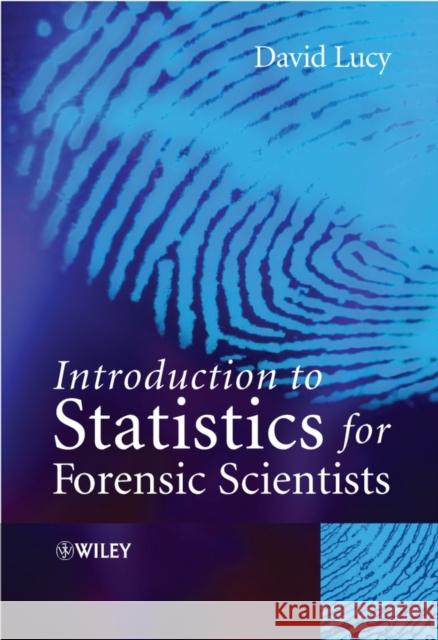
David Lucy
Introduction to Statistics for Forensic Scientists David Lucy 9780470022009 John Wiley & Sons - książkaWidoczna okładka, to zdjęcie poglądowe, a rzeczywista szata graficzna może różnić się od prezentowanej.

Introduction to Statistics for Forensic Scientists

ISBN-13: 9780470022009 / Angielski / Twarda / 2006 / 266 str.

David Lucy
cena 698,04 zł
(netto: 664,80 VAT:  5%)

Najniższa cena z 30 dni: 690,90 zł
Termin realizacji zamówienia:
ok. 30 dni roboczych
Bez gwarancji dostawy przed świętami

Darmowa dostawa!

Introduction to Statistics for Forensic Scientists is an essential introduction to the subject, gently guiding the reader through the key statistical techniques used to evaluate various types of forensic evidence. Assuming only a modest mathematical background, the book uses real-life examples from the forensic science literature and forensic case-work to illustrate relevant statistical concepts and methods. Opening with a brief overview of the history and use of statistics within forensic science, the text then goes on to introduce statistical techniques commonly used to examine data obtained during laboratory experiments. There is a strong emphasis on the evaluation of scientific observation as evidence and modern Bayesian approaches to interpreting forensic data for the courts. The analysis of key forms of evidence are discussed throughout with a particular focus on DNA, fibres and glass. An invaluable introduction to the statistical interpretation of forensic evidence; this book will be invaluable for all undergraduates taking courses in forensic science.

  • Introduction to the key statistical techniques used in the evaluation of forensic evidence
  • Includes end of chapter exercises to enhance student understanding
  • Numerous examples taken from forensic science to put the subject into context

Kategorie:
Nauka, Medycyna
Kategorie BISAC:
Medical > Biostatistics
Mathematics > Prawdopodobieństwo i statystyka
Wydawca:
John Wiley & Sons
Język:
Angielski
ISBN-13:
9780470022009
Rok wydania:
2006
Ilość stron:
266
Waga:
0.63 kg
Wymiary:
24.64 x 17.27 x 2.29
Oprawa:
Twarda
Wolumenów:
01
Dodatkowe informacje:
Bibliografia
Wydanie ilustrowane

It deserves a place in the library of any serious forensic scientist and I congratulate the author on his achievement.   (Significance, 1 March 2006)

" it does a wonderful job of connecting forensic science to the field of statistics." ( Technometrics, August 2007)

Preface.

List of Figures.

1. A short history of the statistics in the law.

1.1 History.

1.2 Some recent uses of statistics in forensic science.

1.3 What is probability?.

2. Data types, location and dispersion.

2.1 Types of data.

2.2 Populations and samples.

2.3 Distributions.

2.4 Location.

2.5 Dispersion.

2.6 Hierarchies of variation.

3. Probability.

3.1 Aleatory probability.

One throw of a six–sided die.

A single throw with more than one outcome of interest.

Two–sided dice.

3.2 Binomial probability.

3.3 Poisson probability.

3.4 Empirical probability.

Modelled empirical probabilities.

Truly empirical probabilities.

4. The normal distribution.

4.1 The normal distribution.

4.2 Standard deviation and standard error of the mean.

4.3 Percentage points of the normal distribution.

4.4 The t–distribution and the standard error of the mean.

4.5 t–testing between two independent samples.

4.6 Testing between paired observations.

4.7 Confidence, significance and p–values.

5. Measures of nominal and ordinal association.

5.1 Association between discrete variables.

5.2 X2 test for 2 x 2 table.

5.3 Yules Q.

5.4 X2 tests for greater than 2 x 2 tables.

5.5 02 and Cramers V2.

5.6 The limitations of X2 testing.

5.7 Interpretation and conclusions.

6. Correlation.

6.1 Significance tests for correlation coefficients.

6.2 Correlation coefficients for non–linear data.

6.3 The coefficient of determination.

6.4 Partial correlation.

6.5 Partial correlation controlling for two or more covariates.

7. Regression and calibration.

7.1 Linear models.

7.2 Calculation of a linear regression model.

7.3 Testing ′goodness of fit′.

7.4 Testing coefficients a and b.

7.5 Residuals.

7.6 Calibration.

A linear calibration model.

Calculation of a confidence interval for a point.

7.7 Points to remember.

8. Evidence evaluation.

8.1 Verbal statements of evidential value.

8.2 Evidence types.

8.3 The value of evidence.

8.4 Significance testing and evidence evaluation.

9. Conditional probability and Bayes′ theorem.

9.1 Conditional probability.

9.2 Bayes′ theorem.

9.3 The value of evidence.

10. Relevance and the formulation of propositions.

10.1 Relevance.

10.2 Hierarchy of propositions.

10.3 Likelihood ratios and relevance.

10.4 The logic of relevance.

10.5 The formulation of propositions.

10.6 What kind of propositions can we not evaluate?.

11. Evaluation of evidence in practice.

11.1 Which database to use.

Type and geographic factors.

DNA and database selection.

11.2 Verbal equivalence of the likelihood ratio.

11.3 Some common criticisms of statistical approaches.

12. Evidence evaluation examples.

12.1 Blood group frequencies.

12.2 Trouser fibres.

12.3 Shoe types.

12.4 Airweapon projectiles.

12.5 Height description from eyewitness.

13. Errors in interpretation.

13.1 Statistically based errors of interpretation.

Transposed conditional.

Defender′s fallacy.

Another match error.

Numerical conversion error.

13.2 Methodological errors of interpretation.

Different level error.

Defendant′s database fallacy.

independence assumption.

14. DNA I.

14.1 Loci and alleles.

14.2 Simple case genotypic frequencies.

14.3 Hardy–weinberg equilibrium.

14.4 Simple case allelic frequencies.

14.5 Accounting for sub–populations.

15. DNA II.

15.1 Paternity – mother and father unrelated.

15.2 Database searches and value of evidence.

15.3 Discussion.

16. Sampling and sample size estimation.

16.1 Estimation of a mean.

16.2 Sample sizes for t–tests.

Two sample t–test.

One sample t–test.

16.3 How many drugs to sample.

16.4 Concluding comments.

17. Epilogue.

17.1 Graphical models and bayesian networks.

Graphical models.

Bayesian networks.

17.2 Kernel density estimation.

17.3 Multivariate continuous matching.

Appendix A: Worked solutions to questions.

Appendix B: Percentage points of the standard normal distribution.

Appendix C: Percentage points of t–distributions.

Appendix D: Percentage points of  X2–distributions.

Appendix E: Percentage points of beta–beta distributions.

Appendix F: Percentage points of f–distributions.

Appendix G: Calculating partial correlations using excel software.

Appendix H: Further algebra using the "third law".

References.

Index.

Dr. David Lucy, School of Mathematics, The University of Edinburgh

Introduction to Statistics for Forensic Scientists gently guides the reader through the key statistical techniques used to evaluate various types of forensic evidence. Assuming only a modest mathematical background, the book uses real–life examples from forensic science literature and forensic case–work to illustrate relevant statistical concepts and methods.

Opening with a brief overview of the history and use of statistics within forensic science, the text goes on to introduce statistical techniques commonly used to examine data obtained during laboratory experiments. There is a strong emphasis of the evaluation of scientific observation as evidence and modern Bayesian approaches to interpreting forensic data for the courts. The analysis of key forms of evidence is discussed throughout with a particular forces on DNA, fibres and glass.

  • Introduces key statistical techniques used in the evaluation of forensic evidence.
  • Included the end of chapter exercises to enhance student understanding.
  • Numerous examples taken from forensic science put the subject into context.

An essential introduction to the statistical interpretation of forensic evidence, this book be invaluable for all undergraduates taking courses in forensic science.

Lucy, David Dr. David Lucy, School of Mathematics, The Univers... więcej >


Udostępnij

Facebook - konto krainaksiazek.pl


Opinie o Krainaksiazek.pl na Opineo.pl

Partner Mybenefit

Krainaksiazek.pl w programie rzetelna firma Krainaksiaze.pl - płatności przez paypal

Czytaj nas na:

Facebook - krainaksiazek.pl
  • książki na zamówienie
  • granty
  • książka na prezent
  • kontakt
  • pomoc
  • opinie
  • regulamin
  • polityka prywatności

Zobacz:

  • Księgarnia czeska

  • Wydawnictwo Książkowe Klimaty

1997-2025 DolnySlask.com Agencja Internetowa

© 1997-2022 krainaksiazek.pl
     
KONTAKT | REGULAMIN | POLITYKA PRYWATNOŚCI | USTAWIENIA PRYWATNOŚCI
Zobacz: Księgarnia Czeska | Wydawnictwo Książkowe Klimaty | Mapa strony | Lista autorów
KrainaKsiazek.PL - Księgarnia Internetowa

Polityka prywatnosci - link
Krainaksiazek.pl - płatnośc Przelewy24
Przechowalnia Przechowalnia







