• Wyszukiwanie zaawansowane
  • Kategorie
  • Kategorie BISAC
  • Książki na zamówienie
  • Promocje
  • Granty
  • Książka na prezent
  • Opinie
  • Pomoc
  • Załóż konto
  • Zaloguj się

Introduction to Semiconductor Physics and Devices » książka


zaloguj się | załóż konto
Logo Krainaksiazek.pl

koszyk

konto

szukaj
topmenu
Księgarnia internetowa
Szukaj
Książki na zamówienie
Promocje
Granty
Książka na prezent
Moje konto
Pomoc
 
 
Wyszukiwanie zaawansowane
Pusty koszyk
Bezpłatna dostawa dla zamówień powyżej 20 złBezpłatna dostawa dla zamówień powyżej 20 zł

Kategorie główne

• Nauka
 [2946600]
• Literatura piękna
 [1856966]

  więcej...
• Turystyka
 [72221]
• Informatyka
 [151456]
• Komiksy
 [35826]
• Encyklopedie
 [23190]
• Dziecięca
 [619653]
• Hobby
 [140543]
• AudioBooki
 [1577]
• Literatura faktu
 [228355]
• Muzyka CD
 [410]
• Słowniki
 [2874]
• Inne
 [445822]
• Kalendarze
 [1744]
• Podręczniki
 [167141]
• Poradniki
 [482898]
• Religia
 [510455]
• Czasopisma
 [526]
• Sport
 [61590]
• Sztuka
 [243598]
• CD, DVD, Video
 [3423]
• Technologie
 [219201]
• Zdrowie
 [101638]
• Książkowe Klimaty
 [124]
• Zabawki
 [2473]
• Puzzle, gry
 [3898]
• Literatura w języku ukraińskim
 [254]
• Art. papiernicze i szkolne
 [8170]
Kategorie szczegółowe BISAC

Introduction to Semiconductor Physics and Devices

ISBN-13: 9783031084607 / Angielski / Miękka / 2023
Mykhaylo Evstigneev
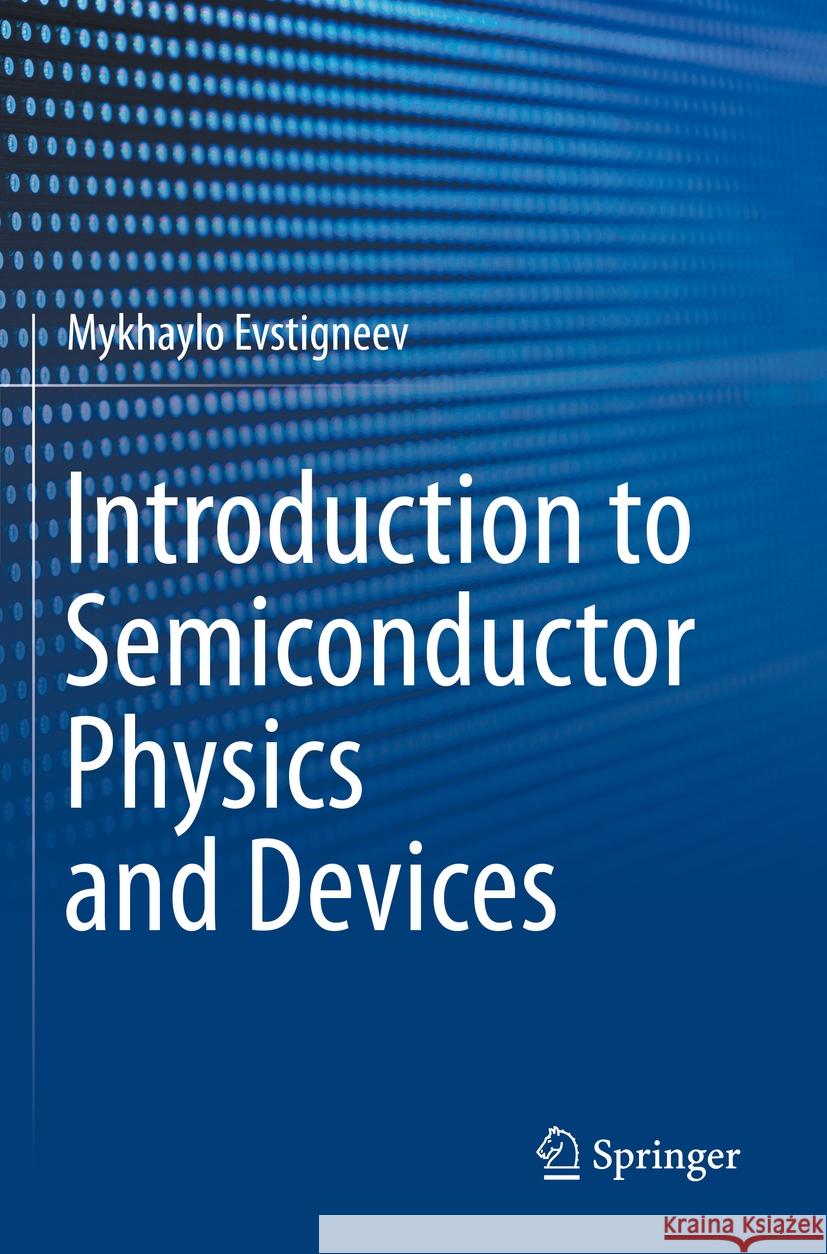
Introduction to Semiconductor Physics and Devices Mykhaylo Evstigneev 9783031084607 Springer International Publishing - książkaWidoczna okładka, to zdjęcie poglądowe, a rzeczywista szata graficzna może różnić się od prezentowanej.

Introduction to Semiconductor Physics and Devices

ISBN-13: 9783031084607 / Angielski / Miękka / 2023

Mykhaylo Evstigneev
cena 201,72 zł
(netto: 192,11 VAT:  5%)

Najniższa cena z 30 dni: 192,74 zł
Termin realizacji zamówienia:
ok. 22 dni roboczych
Bez gwarancji dostawy przed świętami

Darmowa dostawa!
inne wydania

This classroom-tested textbook provides a self-contained one-semester course in semiconductor physics and devices that is ideal preparation for students to enter burgeoning quantum industries. Unlike other textbooks on semiconductor device physics, it provides a brief but comprehensive introduction to quantum physics and statistical physics, with derivations and explanations of the key facts that are suitable for second-year undergraduates, rather than simply postulating the main results. The book is structured into three parts, each of which can be covered in around ten lectures. The first part covers fundamental background material such as quantum and statistical physics, and elements of crystallography and band theory of solids. Since this provides a vital foundation for the rest of the text, concepts are explained and derived in more detail than in comparable texts. For example, the concepts of measurement and collapse of the wave function, which are typically omitted, are presented in this text in language accessible to second-year students. The second part covers semiconductors in and out of equilibrium, and gives details which are not commonly presented, such as a derivation of the density of states using dimensional analysis, and calculation of the concentration of ionized impurities from the grand canonical distribution. Special attention is paid to the solution of Poisson’s equation, a topic that is feared by many undergraduates but is brought back down to earth by techniques and analogies from first-year physics. Finally, in the third part, the material in parts 2 and 3 is applied to describe simple semiconductor devices, including the MOSFET, the Schottky and PN-junction diodes, and optoelectronic devices. With a wide range of exercises, this textbook is readily adoptable for an undergraduate course on semiconductor physics devices, and with its emphasis on consolidating and applying knowledge of fundamental physics, it will leave students in engineering and the physical sciences well prepared for a future where quantum industries proliferate.


Kategorie:
Technologie
Kategorie BISAC:
Technology & Engineering > Electronics - Semiconductors
Technology & Engineering > Microwaves
Science > Optyka
Wydawca:
Springer International Publishing
Język:
Angielski
ISBN-13:
9783031084607
Rok wydania:
2023
Waga:
0.52 kg
Wymiary:
23.5 x 15.5
Oprawa:
Miękka
Dodatkowe informacje:
Wydanie ilustrowane

I Fundamental Physics

1 Principles of Quantum Mechanics

1.1 Wave-particle duality . . . . . . . . . . . . . . . . . . . . . . . 9

1.2 Wavelength of a free particle in terms of its energy . . . . . . 11

1.3 Energy quantization . . . . . . . . . . . . . . . . . . . . . . . 12

1.4 Radiation spectrum of Hydrogen . . . . . . . . . . . . . . . . 13

1.5 The wave function . . . . . . . . . . . . . . . . . . . . . . . . 15

1.6 The wave function of a free particle . . . . . . . . . . . . . . . 16

1.7 Schrödinger's equation . . . . . . . . . . . . . . . . . . . . . . 17

1.7.1 Time-dependent Schrödinger's equation . . . . . . . . . 17

1.7.2 Time-independent Schrödinger's equation . . . . . . . . 19

1.8 Probabilistic interpretation and collapse of the wave function . . .  19

1.9 The many-particle wave function . . . . . . . . . . . . . . . . 22

1.10 Electron states in a Hydrogen atom . . . . . . . . . . . . . . . 22

1.11 Spin . . . . . . . . . . . . . . . . . . . . . . . . . . . . . . . . 23

1.12 Degeneracy . . . . . . . . . . . . . . . . . . . . . . . . . . . . 23

1.13 Indistinguishability of quantum particles . . . . . . . . . . . . 24

1.14 Spin-statistics theorem . . . . . . . . . . . . . . . . . . . . . . 25

1.15 Pauli's exclusion principle . . . . . . . . . . . . . . . . . . . . 26

1.16 Appendix. A crash course in complex numbers . . . . . . . . . 26


2 Crystal Structure of Solids

2.1 Periodic table of elements . . . . . . . . . . . . . . . . . . . . 30

2.2 Chemical bonding . . . . . . . . . . . . . . . . . . . . . . . . . 31

2.3 Atomic order in solids . . . . . . . . . . . . . . . . . . . . . . 33

2.4 Bravais lattices . . . . . . . . . . . . . . . . . . . . . . . . . . 33

2.5 Primitive unit cell . . . . . . . . . . . . . . . . . . . . . . . . . 34

2.6 Crystal basis . . . . . . . . . . . . . . . . . . . . . . . . . . . . 35

2.7 Volume density and atomic packing factor . . . . . . . . . . . 35

2.8 Basic cubic structures . . . . . . . . . . . . . . . . . . . . . . 36

2.9 Formation of diamond structure . . . . . . . . . . . . . . . . . 37

2.10 Miller indices . . . . . . . . . . . . . . . . . . . . . . . . . . . 38

2.11 Miller indices for cubic structures . . . . . . . . . . . . . . . . 40

2.12 Imperfections and impurities in solids . . . . . . . . . . . . . . 41


3 Equilibrium Statistical Mechanics

3.1 Probability theory . . . . . . . . . . . . . . . . . . . . . . . . 43

3.2 Microstates and macrostates . . . . . . . . . . . . . . . . . . . 45

3.3 Probabilistic description . . . . . . . . . . . . . . . . . . . . . 46

3.4 Thermodynamic equilibrium . . . . . . . . . . . . . . . . . . . 46

3.5 Postulate of equal a priori probabilities . . . . . . . . . . . . . 47

3.6 Grand canonical distribution . . . . . . . . . . . . . . . . . . . 48

3.7 Fermi-Dirac distribution . . . . . . . . . . . . . . . . . . . . . 50

3.8 Boltzmann approximation . . . . . . . . . . . . . . . . . . . . 52

3.9 Fermi energy at zero temperature . . . . . . . . . . . . . . . . 53


4 Band Theory of Solids

4.1 Electron states in a crystal lattice . . . . . . . . . . . . . . . . 55

4.2 Bloch's theorem . . . . . . . . . . . . . . . . . . . . . . . . . . 56

4.3 Energy bands . . . . . . . . . . . . . . . . . . . . . . . . . . . 57

4.4 Conduction types of solids . . . . . . . . . . . . . . . . . . . . 59

4.4.1 Completely filled bands do not contribute to conductivity 59

4.4.2 Metals and semimetals . . . . . . . . . . . . . . . . . . 60

4.4.3 Dielectrics and semiconductors . . . . . . . . . . . . . 60

4.5 Conduction and valence bands . . . . . . . . . . . . . . . . . . 61

4.6 Holes . . . . . . . . . . . . . . . . . . . . . . . . . . . . . . . . 62

4.7 Effective mass . . . . . . . . . . . . . . . . . . . . . . . . . . . 63

4.8 Appendix. Proof of Bloch's theorem . . . . . . . . . . . . . . . 64


II Semiconductors in and out of Equilibrium


5 Semiconductors in Equilibrium

5.1 Density of states . . . . . . . . . . . . . . . . . . . . . . . . . 69

5.2 Density of states effective mass vs. conductivity effective mass 72

5.3 Equilibrium carrier concentration . . . . . . . . . . . . . . . . 73

5.4 Mass action law . . . . . . . . . . . . . . . . . . . . . . . . . . 75

5.5 Intrinsic semiconductors . . . . . . . . . . . . . . . . . . . . . 75

5.6 Another expression for electron and hole concentrations . . . . 77

5.7 Doping and extrinsic semiconductors . . . . . . . . . . . . . . 77

5.8 Impurity energy levels . . . . . . . . . . . . . . . . . . . . . . 78

5.9 Statistics of donors and acceptors . . . . . . . . . . . . . . . . 80

5.10 Charge neutrality equation . . . . . . . . . . . . . . . . . . . . 83

5.11 Complete ionization . . . . . . . . . . . . . . . . . . . . . . . . 84

5.12 Intrinsic regime . . . . . . . . . . . . . . . . . . . . . . . . . . 86

5.13 Carrier concentration in a semiconductor with one type of doping

at not too high temperatures . . . . . . . . . . . . . . . . 87

5.14 Electron freeze-out . . . . . . . . . . . . . . . . . . . . . . . . 88

5.15 Numerical determination of Fermi energy and carrier concentrations

. . . . . . . . . . . . . . . . . . . . . . . . . . . . . . 90

5.16 Appendix. Evaluating . . . . . . . . . . . . . . 92


6 Carrier Transport

6.1 Particle current density and electric current density . . . . . . 94

6.2 Diffusion current . . . . . . . . . . . . . . . . . . . . . . . . . 95

6.3 Drift current . . . . . . . . . . . . . . . . . . . . . . . . . . . . 96

6.4 Total current . . . . . . . . . . . . . . . . . . . . . . . . . . . 97

6.5 Conductivity and resistivity . . . . . . . . . . . . . . . . . . . 97

6.6 Temperature and doping level dependence of mobility . . . . . 98

6.7 Einstein's relation . . . . . . . . . . . . . . . . . . . . . . . . . 99


7 Generation-Recombination Processes

7.1 Recombination types . . . . . . . . . . . . . . . . . . . . . . . 101

7.2 Charge carrier dynamics . . . . . . . . . . . . . . . . . . . . . 103

7.2.1 Generation and recombination rates . . . . . . . . . . . 103

7.2.2 Recombination time approximation . . . . . . . . . . . 106

7.3 Radiative recombination . . . . . . . . . . . . . . . . . . . . . 108

7.4 Auger recombination . . . . . . . . . . . . . . . . . . . . . . . 108

7.5 Shockley-Read-Hall (SRH) recombination . . . . . . . . . . . . 109

7.6 Surface recombination . . . . . . . . . . . . . . . . . . . . . . 114

7.7 Continuity equation . . . . . . . . . . . . . . . . . . . . . . . . 116

7.8 Quasi-equilibrium and quasi-Fermi energies . . . . . . . . . . . 118


8 Poisson's equation

8.1 Poisson's equation . . . . . . . . . . . . . . . . . . . . . . . . 121

8.2 Depletion approximation . . . . . . . . . . . . . . . . . . . . . 122

8.3 Band bending . . . . . . . . . . . . . . . . . . . . . . . . . . . 127

8.4 Exact solution of Poisson's equation . . . . . . . . . . . . . . . 127

8.5 Field effect . . . . . . . . . . . . . . . . . . . . . . . . . . . . . 130


III Semiconductor Devices


9 Metal-Semiconductor Contact

9.1 Reasons to study . . . . . . . . . . . . . . . . . . . . . . . . . 135

9.2 Energy band diagram . . . . . . . . . . . . . . . . . . . . . . . 135

9.2.1 Band bending . . . . . . . . . . . . . . . . . . . . . . . 135

9.2.2 Built-in voltage . . . . . . . . . . . . . . . . . . . . . . 137

9.2.3 Schottky barrier . . . . . . . . . . . . . . . . . . . . . . 138

9.3 SCR capacitance . . . . . . . . . . . . . . . . . . . . . . . . . 138

9.4 Ohmic contact . . . . . . . . . . . . . . . . . . . . . . . . . . . 139

9.5 Rectification in a metal-semiconductor contact . . . . . . . . . 141

9.5.1 Metal/n-type semiconductor junction . . . . . . . . . . 141

9.5.2 Metal/p-type semiconductor junction . . . . . . . . . . 145

9.5.3 Non-ideality effects . . . . . . . . . . . . . . . . . . . . 147


10 Metal-Oxide-Semiconductor Field Effect Transistor (MOSFET)

10.1 Reasons to study . . . . . . . . . . . . . . . . . . . . . . . . . 148

10.2 MOSFET schematics and operation principle . . . . . . . . . . 148

10.3 Qualitative description of MOSFET I – V curve . . . . . . . . 150

10.4 Determination of the threshold voltage . . . . . . . . . . . . . 152

10.4.1 Energy band diagram of a MOS structure at zero gate voltage

152

10.4.2 Energy band diagram of a MOS structure for non-zero gate voltage . . . 153

10.4.3 Oxide voltage . . . . . . . . . . . . . . . . . . . . . . . 155

10.4.4 Flat-band voltage . . . . . . . . . . . . . . . . . . . . . 156

10.4.5 Threshold voltage . . . . . . . . . . . . . . . . . . . . . 157

10.5 Quantitative description of a MOSFET I – V curve . . . . . . 158


11 P-N Junction Diode

11.1 The structure of a p-n junction . . . . . . . . . . . . . . . . . 162

11.2 The energy band diagram of a p-n junction at zero bias . . . . 163

11.3 PN junction under an external bias . . . . . . . . . . . . . . . 165

11.4 SCR capacitance . . . . . . . . . . . . . . . . . . . . . . . . . 167

11.5 Current-voltage relation of an ideal p-n junction diode . . . . 168

11.5.1 Charge carrier concentrations near the boundaries of the SCR

 168

11.5.2 Current-voltage relation . . . . . . . . . . . . . . . . . 170

11.5.3 Current densities in a p-n diode . . . . . . . . . . . . . 173

11.5.4 SCR recombination current . . . . . . . . . . . . . . . 174


12 Optoelectronic Devices

12.1 Solar cells (SCs) . . . . . . . . . . . . . . . . . . . . . . . . . . 175

12.1.1 SC operation . . . . . . . . . . . . . . . . . . . . . . . 175

12.1.2 Spectral irradiance . . . . . . . . . . . . . . . . . . . . 176

12.1.3 Light absorption . . . . . . . . . . . . . . . . . . . . . 177

12.1.4 Electron-hole pair generation rate . . . . . . . . . . . . 178

12.1.5 SC current-voltage relation . . . . . . . . . . . . . . . . 179

12.2 Light-emitting diodes (LED's) . . . . . . . . . . . . . . . . . . 181

12.2.1 LED operation . . . . . . . . . . . . . . . . . . . . . . 181

12.2.2 LED spectrum . . . . . . . . . . . . . . . . . . . . . . 181

12.2.3 LED efficiency . . . . . . . . . . . . . . . . . . . . . . . 182

12.2.4 Increasing the LED efficiency . . . . . . . . . . . . . . 186

12.3 Semiconductor lasers . . . . . . . . . . . . . . . . . . . . . . . 187

12.3.1 Lasers vs. LEDs . . . . . . . . . . . . . . . . . . . . . . 187

12.3.2 Stimulated emission . . . . . . . . . . . . . . . . . . . . 187

12.3.3 Physics of stimulated emission . . . . . . . . . . . . . . 187

12.3.4 Einstein coefficients . . . . . . . . . . . . . . . . . . . . 190

12.3.5 Generation of light . . . . . . . . . . . . . . . . . . . . 192

12.3.6 Semiconductor laser operation . . . . . . . . . . . . . . 193

 IV Practice problems

The author initially studied at the Faculty of Radio-Physics, Electronics and Computer Systems of the National Taras Shevchenko University of Kyiv, Ukraine, and then at the Department of Physics and Astronomy, York University, Canada. He obtained his PhD in Physics at York University in 2002, after which he did postdoctoral research at Bielefeld University, Germany. He currently holds a position as an Associate Professor in the Department of Physics and Physical Oceanography at the Memorial University of Newfoundland, Canada. He has published papers in non-equilibrium statistical physics, stochastic processes, surface science, biophysics, and semiconductor physics.

This classroom-tested textbook provides a self-contained one-semester course in semiconductor physics and devices that is ideal preparation for students to enter burgeoning quantum industries. Unlike other textbooks on semiconductor device physics, it provides a brief but comprehensive introduction to quantum physics and statistical physics, with derivations and explanations of the key facts that are suitable for second-year undergraduates, rather than simply postulating the main results. The book is structured into three parts, each of which can be covered in around ten lectures. The first part covers fundamental background material such as quantum and statistical physics, and elements of crystallography and band theory of solids. Since this provides a vital foundation for the rest of the text, concepts are explained and derived in more detail than in comparable texts. For example, the concepts of measurement and collapse of the wave function, which are typically omitted, are presented in this text in language accessible to second-year students. The second part covers semiconductors in and out of equilibrium, and gives details which are not commonly presented, such as a derivation of the density of states using dimensional analysis, and calculation of the concentration of ionized impurities from the grand canonical distribution. Special attention is paid to the solution of Poisson’s equation, a topic that is feared by many undergraduates but is brought back down to earth by techniques and analogies from first-year physics. Finally, in the third part, the material in parts 2 and 3 is applied to describe simple semiconductor devices, including the MOSFET, the Schottky and PN-junction diodes, and optoelectronic devices. With a wide range of exercises, this textbook is readily adoptable for an undergraduate course on semiconductor physics devices, and with its emphasis on consolidating and applying knowledge of fundamental physics, it will leave students in engineering and the physical sciences well prepared for a future where quantum industries proliferate.




Udostępnij

Facebook - konto krainaksiazek.pl


Opinie o Krainaksiazek.pl na Opineo.pl

Partner Mybenefit

Krainaksiazek.pl w programie rzetelna firma Krainaksiaze.pl - płatności przez paypal

Czytaj nas na:

Facebook - krainaksiazek.pl
  • książki na zamówienie
  • granty
  • książka na prezent
  • kontakt
  • pomoc
  • opinie
  • regulamin
  • polityka prywatności

Zobacz:

  • Księgarnia czeska

  • Wydawnictwo Książkowe Klimaty

1997-2025 DolnySlask.com Agencja Internetowa

© 1997-2022 krainaksiazek.pl
     
KONTAKT | REGULAMIN | POLITYKA PRYWATNOŚCI | USTAWIENIA PRYWATNOŚCI
Zobacz: Księgarnia Czeska | Wydawnictwo Książkowe Klimaty | Mapa strony | Lista autorów
KrainaKsiazek.PL - Księgarnia Internetowa

Polityka prywatnosci - link
Krainaksiazek.pl - płatnośc Przelewy24
Przechowalnia Przechowalnia




