• Wyszukiwanie zaawansowane
  • Kategorie
  • Kategorie BISAC
  • Książki na zamówienie
  • Promocje
  • Granty
  • Książka na prezent
  • Opinie
  • Pomoc
  • Załóż konto
  • Zaloguj się

Introduction to Modern Austrian Capital Theory » książka


zaloguj się | załóż konto
Logo Krainaksiazek.pl

koszyk

konto

szukaj
topmenu
Księgarnia internetowa
Szukaj
Książki na zamówienie
Promocje
Granty
Książka na prezent
Moje konto
Pomoc
 
 
Wyszukiwanie zaawansowane
Pusty koszyk
Bezpłatna dostawa dla zamówień powyżej 20 złBezpłatna dostawa dla zamówień powyżej 20 zł

Kategorie główne

• Nauka
 [2950560]
• Literatura piękna
 [1849509]

  więcej...
• Turystyka
 [71097]
• Informatyka
 [151150]
• Komiksy
 [35848]
• Encyklopedie
 [23178]
• Dziecięca
 [617388]
• Hobby
 [139064]
• AudioBooki
 [1657]
• Literatura faktu
 [228597]
• Muzyka CD
 [383]
• Słowniki
 [2855]
• Inne
 [445295]
• Kalendarze
 [1464]
• Podręczniki
 [167547]
• Poradniki
 [480102]
• Religia
 [510749]
• Czasopisma
 [516]
• Sport
 [61293]
• Sztuka
 [243352]
• CD, DVD, Video
 [3414]
• Technologie
 [219456]
• Zdrowie
 [101002]
• Książkowe Klimaty
 [124]
• Zabawki
 [2311]
• Puzzle, gry
 [3459]
• Literatura w języku ukraińskim
 [254]
• Art. papiernicze i szkolne
 [8079]
Kategorie szczegółowe BISAC

Introduction to Modern Austrian Capital Theory

ISBN-13: 9783540091219 / Angielski / Miękka / 1979 / 201 str.
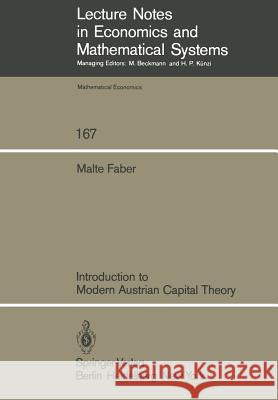
Malte Faber
Introduction to Modern Austrian Capital Theory Malte Faber 9783540091219 Springer-Verlag Berlin and Heidelberg GmbH &  - książkaWidoczna okładka, to zdjęcie poglądowe, a rzeczywista szata graficzna może różnić się od prezentowanej.

Introduction to Modern Austrian Capital Theory

ISBN-13: 9783540091219 / Angielski / Miękka / 1979 / 201 str.

Malte Faber
cena 201,24
(netto: 191,66 VAT:  5%)

Najniższa cena z 30 dni: 192,74
Termin realizacji zamówienia:
ok. 22 dni roboczych
Dostawa w 2026 r.

Darmowa dostawa!

During the fifties and the sixties the neoclassical concept of the production function was criticized in numerous papers. In particular, the aggregation of different capital goods into a single number was reprehended. A second essential disadvantage, namely the neglect of the time structure of the production process, found, however, rela tively little attention. While up to the thirties the Austrian capital theory which stressed the time aspect of production was an important school, it fell into oblivion after the great capital controversies of the thirties. It took over thirty years, i. e. till the beginning of the seventies be fore it came to a renaissance of the Austrian capital theory by var ious writers. We may roughly classify the different attempts of Hits rebirth in modern economics" into three groups: 1. The approach of 1970, 1973, 1973a] has received most of the attention in the literature (Burmeister 1974], Faber 1975], Fehl 1975], 1975], Hagemann and 1976]). It will be shown in Chapter 9 that is only in so far a Neo-Austrian as he does explicitly take into consideration the vertical time structure of the production process. But he does not use the Austrian concepts of superiority of roundabout methods, of time preference and of the period of production. 2. The latter concept has been revived by the second group, to which Tintner 1970], von Weizs cker 1971a, 1971b, 1974], 1971, 1976 and 1973, 1975, 1976] belong."


Kategorie:
Nauka, Ekonomia i biznes
Kategorie BISAC:
Business & Economics > Ekonomia
Wydawca:
Springer-Verlag Berlin and Heidelberg GmbH &
Seria wydawnicza:
Lecture Notes in Economics and Mathematical Systems
Język:
Angielski
ISBN-13:
9783540091219
Rok wydania:
1979
Dostępne języki:
Angielski
Wydanie:
Softcover Repri
Numer serii:
000221492
Ilość stron:
201
Waga:
0.38 kg
Wymiary:
24.424.4 x 17.0
Oprawa:
Miękka
Wolumenów:
01

I: Austrian Capital Theory and the von Neumann-Model.- 1. Introduction.- 1.1 Problems.- 2. The Austrian Theory of Interest.- 2.1 von Böhm-Bawerk.- 2.2 von Stackelberg.- 2.3 An Assessment of Austrian Interest Theory.- 2.4 Problems.- 3. The von Neumann-Model and its Relations to Austrian Capital and Interest Theory.- 3.1 Introduction.- 3.2 The Meaning, Import and Historical Point of Departure of the Ideas of the von Neumann-Model.- 3.3 The von Neumann-Model.- 3.4 Criticism and Generalization of the von Neumann-Model.- 3.5 Solutions to Problems of Austrian Capital Theory.- 3.6 The Interest Rate in the Stationary State.- 3.7 Problems.- II: Modern Austrian Capital Theory.- 4. A Two-Period Two-Sector Neo-Austrian Model.- 4.1 Outline of the Procedure.- 4.2 The Technology.- 4.3 The Transformation Curve.- 4.4 Condition for Roundaboutness.- 4.5 Condition for Superiority.- 4.6 Prices in a Planned Economy.- 4.7 The Rate of Interest in a Planned Economy.- 4.8 Decentralizing the Decisions.- 4.9 Problems.- 5. A Multiperiod Two-Sector Model.- 5.1 Extension of the Model.- 5.2 A Model with n-Period Horizon.- 5.3 A Model with Two Techniques Using a Capital Good.- 5.3.1 The Model.- 5.3.2 The Sign of the Rate of Interest.- 5.4 Problems.- 6. A Multisector Model.- 6.1 The Problem and the Main Results.- 6.2 The Model.- 6.3 Superiority, Roundaboutness and Positive Rate of Interest.- 6.4 A Finite Economic Horizon with More than two Periods.- 6.5 Problems.- 7. The Schumpeter-von Böhm-Bawerk Controversy on the Rate of Interest in the Stationary State.- 7.1 Introduction.- 7.2 The Origins of the Controversy.- 7.3 The Rate of Interest in a Stationary State.- 7.4 Schumpeter’s Dynamic Theory of Interest.- 7.5 Problems.- III: Relationship to other Approaches to Capital Theory.- 8. A Comparison with Results of Neoclassical Capital and Growth Theory.- 8.1 Introduction.- 8.2 A Simple Growth Model.- 8.3 A Neoclassical Version for Steady States.- 8.3.1 Factor-Price Frontier for T*3 and T*4.- 8.3.2 Factor-Price Frontier for T1 and T2.- 8.3.3 Consumption-Growth Frontier.- 8.3.4 The Relationship between the Interest Rate and the Growth Rate.- 8.4 Charcteristics of Optimal Steady State Programs.- 8.5 Problems.- 9. Hicks’ Neo-Austrian Theory of Capital.- 9.1 Introduction.- 9.2 Hicks’ Model.- 9.3 The Index of Improvement in Efficiency.- 9.4 Hicks’ New Classification of Technological Change.- 9.5 Superiority and the Index of Efficiency.- 9.6 Concluding Remarks.- 9.7 Problems.- References.- Author Index.


Udostępnij

Facebook - konto krainaksiazek.pl


Opinie o Krainaksiazek.pl na Opineo.pl

Partner Mybenefit

Krainaksiazek.pl w programie rzetelna firma Krainaksiaze.pl - płatności przez paypal

Czytaj nas na:

Facebook - krainaksiazek.pl
  • książki na zamówienie
  • granty
  • książka na prezent
  • kontakt
  • pomoc
  • opinie
  • regulamin
  • polityka prywatności

Zobacz:

  • Księgarnia czeska

  • Wydawnictwo Książkowe Klimaty

1997-2025 DolnySlask.com Agencja Internetowa

© 1997-2022 krainaksiazek.pl
     
KONTAKT | REGULAMIN | POLITYKA PRYWATNOŚCI | USTAWIENIA PRYWATNOŚCI
Zobacz: Księgarnia Czeska | Wydawnictwo Książkowe Klimaty | Mapa strony | Lista autorów
KrainaKsiazek.PL - Księgarnia Internetowa

Polityka prywatnosci - link
Krainaksiazek.pl - płatnośc Przelewy24
Przechowalnia Przechowalnia





