• Wyszukiwanie zaawansowane
  • Kategorie
  • Kategorie BISAC
  • Książki na zamówienie
  • Promocje
  • Granty
  • Książka na prezent
  • Opinie
  • Pomoc
  • Załóż konto
  • Zaloguj się

Introduction to Finite Element Analysis » książka


zaloguj się | załóż konto
Logo Krainaksiazek.pl

koszyk

konto

szukaj
topmenu
Księgarnia internetowa
Szukaj
Książki na zamówienie
Promocje
Granty
Książka na prezent
Moje konto
Pomoc
 
 
Wyszukiwanie zaawansowane
Pusty koszyk
Bezpłatna dostawa dla zamówień powyżej 20 złBezpłatna dostawa dla zamówień powyżej 20 zł

Kategorie główne

• Nauka
 [2946600]
• Literatura piękna
 [1856966]

  więcej...
• Turystyka
 [72221]
• Informatyka
 [151456]
• Komiksy
 [35826]
• Encyklopedie
 [23190]
• Dziecięca
 [619653]
• Hobby
 [140543]
• AudioBooki
 [1577]
• Literatura faktu
 [228355]
• Muzyka CD
 [410]
• Słowniki
 [2874]
• Inne
 [445822]
• Kalendarze
 [1744]
• Podręczniki
 [167141]
• Poradniki
 [482898]
• Religia
 [510455]
• Czasopisma
 [526]
• Sport
 [61590]
• Sztuka
 [243598]
• CD, DVD, Video
 [3423]
• Technologie
 [219201]
• Zdrowie
 [101638]
• Książkowe Klimaty
 [124]
• Zabawki
 [2473]
• Puzzle, gry
 [3898]
• Literatura w języku ukraińskim
 [254]
• Art. papiernicze i szkolne
 [8170]
Kategorie szczegółowe BISAC

Introduction to Finite Element Analysis

ISBN-13: 9780470977286 / Angielski / Twarda / 2011 / 384 str.
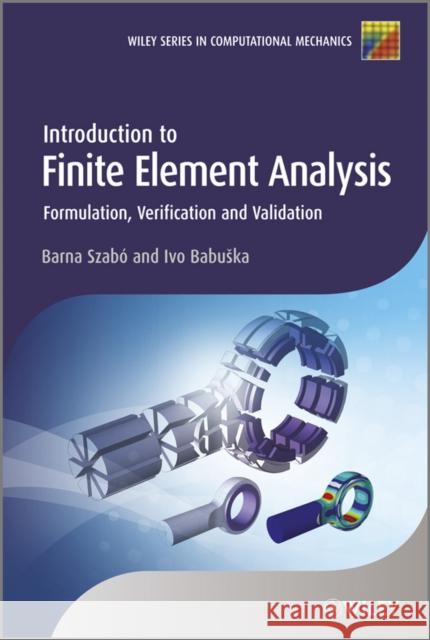
Barna Szabo; Ivo Babuska
Introduction to Finite Element Analysis Szabó, Barna 9780470977286  - książkaWidoczna okładka, to zdjęcie poglądowe, a rzeczywista szata graficzna może różnić się od prezentowanej.

Introduction to Finite Element Analysis

ISBN-13: 9780470977286 / Angielski / Twarda / 2011 / 384 str.

Barna Szabo; Ivo Babuska
cena 451,58 zł
(netto: 430,08 VAT:  5%)

Najniższa cena z 30 dni: 446,96 zł
Termin realizacji zamówienia:
ok. 30 dni roboczych
Bez gwarancji dostawy przed świętami

Darmowa dostawa!

When using numerical simulation to make a decision, how can its reliability be determined? What are the common pitfalls and mistakes when assessing the trustworthiness of computed information, and how can they be avoided? Whenever numerical simulation is employed in connection with engineering decision-making, there is an implied expectation of reliability: one cannot base decisions on computed information without believing that information is reliable enough to support those decisions. Using mathematical models to show the reliability of computer-generated information is an essential part of any modelling effort. Giving users of finite element analysis (FEA) software an introduction to verification and validation procedures, this book thoroughly covers the fundamentals of assuring reliability in numerical simulation. The renowned authors systematically guide readers through the basic theory and algorithmic structure of the finite element method, using helpful examples and exercises throughout.

  • Delivers the tools needed to have a working knowledge of the finite element method
  • Illustrates the concepts and procedures of verification and validation
  • Explains the process of conceptualization supported by virtual experimentation
  • Describes the convergence characteristics of the h-, p- and hp-methods
  • Covers the hierarchic view of mathematical models and finite element spaces
  • Uses examples and exercises which illustrate the techniques and procedures of quality assurance
  • Ideal for mechanical and structural engineering students, practicing engineers and applied mathematicians
  • Includes parameter-controlled examples of solved problems in a companion website (www.wiley.com/go/szabo)


Kategorie:
Technologie
Kategorie BISAC:
Technology & Engineering > Drafting & Mechanical Drawing
Technology & Engineering > Engineering (General)
Język:
Angielski
ISBN-13:
9780470977286
Rok wydania:
2011
Numer serii:
000420947
Ilość stron:
384
Waga:
0.74 kg
Wymiary:
24.89 x 17.27 x 2.54
Oprawa:
Twarda
Wolumenów:
01
Dodatkowe informacje:
Bibliografia
Wydanie ilustrowane

I highly recommend this as a textbook for an undergraduate engineering course on FE analysis. Moreover, I recommend this book to every engineer who practices FE computation, since this is a well–written and unique source for studying the extremely important issue of reliability of FE analysis in practice.   (IACM Expressions, 1 September 2012)

About the Authors.

Series Preface.

Preface.

1 Introduction.

1.1 Numerical simulation.

1.2 Why is numerical accuracy important?

1.3 Chapter summary.

2 An outline of the finite element method.

2.1 Mathematical models in one dimension.

2.2 Approximate solution.

2.3 Generalized formulation in one dimension.

2.4 Finite element approximations.

2.5 FEM in one dimension.

2.6 Properties of the generalized formulation.

2.7 Error estimation based on extrapolation.

2.8 Extraction methods.

2.9 Laboratory exercises.

2.10 Chapter summary.

3 Formulation of mathematical models.

3.1 Notation.

3.2 Heat conduction.

3.3 The scalar elliptic boundary value problem.

3.4 Linear elasticity.

3.5 Incompressible elastic materials.

3.6 Stokes′ flow.

3.7 The hierarchic view of mathematical models.

3.8 Chapter summary.

4 Generalized formulations.

4.1 The scalar elliptic problem.

4.2 The principle of virtual work.

4.3 Elastostatic problems.

4.4 Elastodynamic models.

4.5 Incompressible materials.

4.6 Chapter summary.

5 Finite element spaces.

5.1 Standard elements in two dimensions.

5.2 Standard polynomial spaces.

5.3 Shape functions.

5.4 Mapping functions in two dimensions.

5.5 Elements in three dimensions.

5.6 Integration and differentiation.

5.7 Stiffness matrices and load vectors.

5.8 Chapter summary.

6 Regularity and rates of convergence.

6.1 Regularity.

6.2 Classification.

6.3 The neighborhood of singular points.

6.4 Rates of convergence.

6.5 Chapter summary.

7 Computation and verification of data.

7.1 Computation of the solution and its first derivatives.

7.2 Nodal forces.

7.3 Verification of computed data.

7.4 Flux and stress intensity factors.

7.5 Chapter summary.

8 What should be computed and why?

8.1 Basic assumptions.

8.2 Conceptualization: drivers of damage accumulation.

8.3 Classical models of metal fatigue.

8.4 Linear elastic fracture mechanics.

8.5 On the existence of a critical distance.

8.6 Driving forces for damage accumulation.

8.7 Cycle counting.

8.8 Validation.

8.9 Chapter summary.

9 Beams, plates and shells.

9.1 Beams.

9.2 Plates.

9.3 Shells.

9.4 The Oak Ridge experiments.

9.5 Chapter summary.

10 Nonlinear models.

10.1 Heat conduction.

10.2 Solid mechanics.

10.3 Chapter summary.

A Definitions.

A.1 Norms and seminorms.

A.2 Normed linear spaces.

A.3 Linear functionals.

A.4 Bilinear forms.

A.5 Convergence.

A.6 Legendre polynomials.

A.7 Analytic functions.

A.8 The Schwarz inequality for integrals.

B Numerical quadrature.

B.1 Gaussian quadrature.

B.2 Gauss Lobatto quadrature.

C Properties of the stress tensor.

C.1 The traction vector.

C.2 Principal stresses.

C.3 Transformation of vectors.

C.4 Transformation of stresses.

D Computation of stress intensity factors.

D.1 The contour integral method.

D.2 The energy release rate.

E Saint–Venant′s principle.

E.1 Green′s function for the Laplace equation.

E.2 Model problem.

F Solutions for selected exercises.

Bibliography.

Index.

Barna Szabó is co–founder and president of Engineering Software Research and Development, Inc. (ESRD), the company that produces the professional finite element analysis software StressCheck®. Prior to his retirement from the School of Engineering and Applied Science of Washington University in 2006 he served as the Albert P. and Blanche Y. Greensfelder Professor of Mechanics. His primary research interest is assurance of quality and reliability in the numerical stimulation of structural and mechanical systems by the finite element method. He has published over 150 papers in refereed technical journals. Several of them in collaboration with Professor Ivo Babu ka, with whom he also published a book on finite element analysis (John Wiley & Sons, Inc., 1991). He is a founding member and Fellow of the US Association for Computational Mechanics. Among his honors are election to the Hungarian Academy of Sciences as External Member and an honorary doctorate.

Ivo Babu ka s research has been concerned mainly with the reliability of computational analysis of mathematical problems and their applications, especially by the finite element method. He was the first to address a posteriori error estimation and adaptivity in finite element analysis. His research papers on these subjects published in the 1970s have been widely cited. His joint work with Barna Szabó on the p–version of the finite element method established the theoretical foundations and the algorithmic structure for this method. His recent work has been concerned with the mathematical formulation and treatment of uncertainties which are present in every mathematical model. In recognition of his numerous important contributions, Professor Babu ka received may honors, which include honorary doctorates, medals and prizes and election to prestigious academies.

When using numerical simulation to make a decision, how can its reliability be determined? What are the common pitfalls and mistakes when assessing the trustworthiness of computed information, and how can they be avoided?

Whenever numerical simulation is employed in connection with engineering decision–making, there is an implied expectation of reliability: one cannot base decisions on computed information without believing that information is reliable enough to support those decisions. Using mathematical models to show the reliability of computer–generated information is an essential part of any modelling effort.

Giving users of finite element analysis (FEA) software an introduction to verification and validation procedures, this book thoroughly covers the fundamentals of assuring reliability in numerical simulation. The renowned authors systematically guide readers through the basic theory and algorithmic structure of the finite element method, using helpful examples and exercises throughout.

  • Delivers the tools needed to have a working knowledge of the finite element method
  • Illustrates the concepts and procedures of verification and validation
  • Explains the process of conceptualization supported by virtual experimentation
  • Describes the convergence characteristics of the h–, p– and hp–methods
  • Covers the hierarchic view of mathematical models and finite element spaces
  • Uses examples and exercises which illustrate the techniques and procedures of quality assurance
  • Ideal for mechanical and structural engineering students, practicing engineers and applied mathematicians
  • Includes parameter–controlled examples of solved problems in a companion website (www.wiley.com/go/szabo)



Udostępnij

Facebook - konto krainaksiazek.pl


Opinie o Krainaksiazek.pl na Opineo.pl

Partner Mybenefit

Krainaksiazek.pl w programie rzetelna firma Krainaksiaze.pl - płatności przez paypal

Czytaj nas na:

Facebook - krainaksiazek.pl
  • książki na zamówienie
  • granty
  • książka na prezent
  • kontakt
  • pomoc
  • opinie
  • regulamin
  • polityka prywatności

Zobacz:

  • Księgarnia czeska

  • Wydawnictwo Książkowe Klimaty

1997-2025 DolnySlask.com Agencja Internetowa

© 1997-2022 krainaksiazek.pl
     
KONTAKT | REGULAMIN | POLITYKA PRYWATNOŚCI | USTAWIENIA PRYWATNOŚCI
Zobacz: Księgarnia Czeska | Wydawnictwo Książkowe Klimaty | Mapa strony | Lista autorów
KrainaKsiazek.PL - Księgarnia Internetowa

Polityka prywatnosci - link
Krainaksiazek.pl - płatnośc Przelewy24
Przechowalnia Przechowalnia




