• Wyszukiwanie zaawansowane
  • Kategorie
  • Kategorie BISAC
  • Książki na zamówienie
  • Promocje
  • Granty
  • Książka na prezent
  • Opinie
  • Pomoc
  • Załóż konto
  • Zaloguj się

Introduction to Engineering Electromagnetics » książka


zaloguj się | załóż konto
Logo Krainaksiazek.pl

koszyk

konto

szukaj
topmenu
Księgarnia internetowa
Szukaj
Książki na zamówienie
Promocje
Granty
Książka na prezent
Moje konto
Pomoc
 
 
Wyszukiwanie zaawansowane
Pusty koszyk
Bezpłatna dostawa dla zamówień powyżej 20 złBezpłatna dostawa dla zamówień powyżej 20 zł

Kategorie główne

• Nauka
 [2952079]
• Literatura piękna
 [1850969]

  więcej...
• Turystyka
 [71058]
• Informatyka
 [151066]
• Komiksy
 [35579]
• Encyklopedie
 [23181]
• Dziecięca
 [620496]
• Hobby
 [139036]
• AudioBooki
 [1646]
• Literatura faktu
 [228729]
• Muzyka CD
 [379]
• Słowniki
 [2932]
• Inne
 [445708]
• Kalendarze
 [1409]
• Podręczniki
 [164793]
• Poradniki
 [480107]
• Religia
 [510956]
• Czasopisma
 [511]
• Sport
 [61267]
• Sztuka
 [243299]
• CD, DVD, Video
 [3411]
• Technologie
 [219640]
• Zdrowie
 [100984]
• Książkowe Klimaty
 [124]
• Zabawki
 [2281]
• Puzzle, gry
 [3363]
• Literatura w języku ukraińskim
 [258]
• Art. papiernicze i szkolne
 [8020]
Kategorie szczegółowe BISAC

Introduction to Engineering Electromagnetics

ISBN-13: 9783031286582 / Angielski
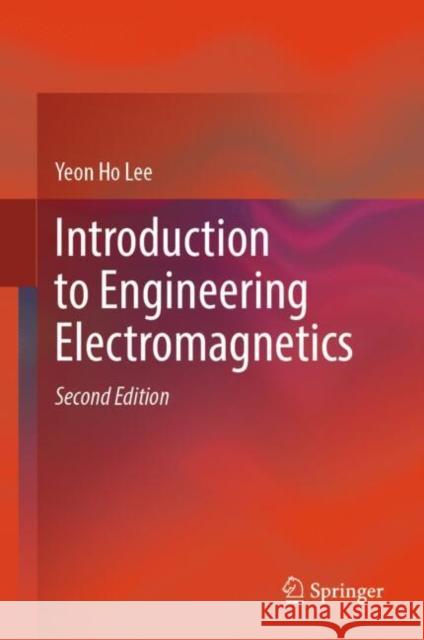
Yeon Ho Lee
Introduction to Engineering Electromagnetics Yeon Ho Lee 9783031286582 Springer - książkaWidoczna okładka, to zdjęcie poglądowe, a rzeczywista szata graficzna może różnić się od prezentowanej.

Introduction to Engineering Electromagnetics

ISBN-13: 9783031286582 / Angielski

Yeon Ho Lee
cena 483,04
(netto: 460,04 VAT:  5%)

Najniższa cena z 30 dni: 462,63
Termin realizacji zamówienia:
ok. 22 dni roboczych
Dostawa w 2026 r.

Darmowa dostawa!
inne wydania

This book provides junior and sophomore college and university students with a thorough understanding of electromagnetic fundamentals through rigorous mathematical procedures and logical reasoning. Electromagnetics is one of the most difficult courses in engineering, because mathematical theorems cannot completely convey the physical concepts underlying electromagnetic principles. This book fills this gap with logical reasoning, such as symmetry considerations and the uniqueness theorem, and clearly distinguishes between mathematical procedures and expressions for physical events. The sign convention is carefully set to distinguish static, phasor, and time-varying quantities, and to be consistent with double-indexed symbols. This book begins with a coverage of vector fields, coordinate systems, and vector calculus, which are customized for the study of electromagnetics. Subsequently, static electric and magnetic fields are discussed. Before discussing time-varying fields and their applications in transmission lines, waveguides, and antennas, the concept of wave motion is explained.Most of the 379 figures are drawn in three dimensions, and the measured data are drawn to scale. A total of 184 examples show rigorous approaches to solving practical problems using the aforementioned concepts, and 301 exercises with answers provide a means of checking whether students correctly understood the concepts. The sections end with 445 review questions, with hints referring to the related equations and figures. This book contains 507 end-of-chapter problems.


This book provides junior and sophomore college and university students with a thorough understanding of electromagnetic fundamentals through rigorous mathematical procedures and logical reasoning. Electromagnetics is one of the most difficult courses in engineering, because mathematical theorems cannot completely convey the physical concepts underlying electromagnetic principles. This book fills this gap with logical reasoning, such as symmetry considerations and the uniqueness theorem, and clearly distinguishes between mathematical procedures and expressions for physical events. The sign convention is carefully set to distinguish static, phasor, and time-varying quantities, and to be consistent with double-indexed symbols. This book begins with a coverage of vector fields, coordinate systems, and vector calculus, which are customized for the study of electromagnetics. Subsequently, static electric and magnetic fields are discussed. Before discussing time-varying fields and their applications in transmission lines, waveguides, and antennas, the concept of wave motion is explained.Most of the 379 figures are drawn in three dimensions, and the measured data are drawn to scale. A total of 184 examples show rigorous approaches to solving practical problems using the aforementioned concepts, and 301 exercises with answers provide a means of checking whether students correctly understood the concepts. The sections end with 445 review questions, with hints referring to the related equations and figures. This book contains 507 end-of-chapter problems.

Kategorie:
Technologie
Kategorie BISAC:
Technology & Engineering > Electrical
Science > Prąd
Wydawca:
Springer
Język:
Angielski
ISBN-13:
9783031286582

Chapter 1  

Vector Algebra and Coordinate System

1.1 Vector and Vector Field

1.2 Vector Algebra

1.2.1 Vector Addition and Subtraction        

1.2.2 Vector Scaling

1.2.3 Scalar or Dot Product

1.2.4 Vector or Cross Product 

1.2.5 Scalar and Vector Triple Products

1.3 Orthogonal Coordinate Systems

1.3.1 Cartesian Coordinate System

1.3.2 Cylindrical Coordinate System

1.3.3 Spherical Coordinate System

1.4 Coordinate Transformation

1.4.1 Cartesian-Cartesian Transformation

1.4.2 Cylindrical-Cartesian Transformation

1.4.3 Spherical-Cartesian Transformation


Chapter 2 

Vector Calculus

2.1 Line and Surface Integrals

2.1.1 Curves  

2.1.2 Line Integral           

2.1.3 Surface Integral

2.2 Directional Derivative and Gradient

2.3 Flux and Flux Density

2.4 Divergence and Divergence Theorem

2.4.1 Divergence of the Flux Density 

2.4.2 Divergence Theorem

2.5 Curl and Stokes’s Theorem

2.5.1 Curl of the Vector Field

2.5.2 Stokes’s Theorem

2.6 Dual Operation of Ñ

2.7 Helmholtz’s Theorem


Chapter 3 

Electrostatics

3.1 Coulomb’s Law

3.2 Electric Field Intensity

3.2.1 Electric Field due to Multiple Charges

3.2.2 Electric Field due to Continuous Charge Distribution

3.3 Electric Flux Density and Gauss’s Law

3.3.1 Electric Flux Density

3.3.2 Gauss’s Law

3.4 Electric Potential

3.4.1 Work Done in Moving Charges

3.4.2 Electric Potential and Potential Difference

3.4.3 Conservative Field

3.4.4 E as the Negative Gradient of V

3.5 Dielectric in Static Electric Field

3.5.1 Electric Polarization

3.5.2 Dielectric Constant

3.5.3 Boundary Conditions at the Dielectric Interface

3.6 Perfect Conductor in Static Electric Field

3.7 Electrostatic Potential Energy

3.8 Electrostatic Boundary-Value Problems

3.8.1 Poisson’s and Laplace’s Equations

3.8.2 Uniqueness Theorem

3.8.3 Examples of Boundary-Value Problems

3.8.4 The Method of Images

3.8.4.1 Line Images

3.9 Capacitor and Capacitance

3.9.1 Parallel-Plate Capacitor

3.9.1.1 The Principle of Virtual Displacement

3.9.2 Examples of Capacitors


Chapter 4

Steady Electric Current

4.1 Convection Current

4.2 Conduction Current and Ohm’s Law

4.3 The Equation of Continuity

4.3.1 Relaxation Time

4.4 Steady Currents at the Interface

4.5 The Charge Relaxation Method

4.6 Resistance

4.7 Power Dissipation and Joule’s Law

4.8 Analogy between D and J


Chapter 5 

Magnetostatics

5.1 Lorentz Force Equation

5.2 The Biot-Savart Law

5.3 Ampere’s Circuital Law

5.4 Magnetic Flux Density

5.5 Vector Magnetic Potential

5.5.1 Ampere’s Circuital Law from the Biot-Savart Law

5.6 Magnetic Dipole

5.7 Magnetic Materials

5.7.1 Magnetization and Magnetization Current

5.7.2 Permeability

5.7.3 Hysteresis of Ferromagnetic Materials

5.7.4 Magnetic Boundary Conditions

5.8 Inductance and Inductor

5.9 Magnetic Energy

5.9.1 Magnetic Energy in Inductor

5.9.2 Magnetic Energy in Terms of Magnetic Field

5.10 Magnetic Force and Torque

5.10.1 Magnetic Force on Current-Carrying Conductor

5.10.2 Magnetic Force and Virtual Work

5.10.3 Magnetic Torque


Chapter 6 

Time-Varying Fields and Maxwell’s Equations

6.1 Faraday’s Law

6.1.1 Transformer emf               

6.1.1.1 Ideal Transformer

6.1.2 Motional emf

6.1.3 Loop Moving in Time-Varying Magnetic Field 

6.2 Displacement Current Density

6.3 Maxwell’s Equations

6.3.1 Maxwell’s Equations in Integral Form

6.3.2 Electromagnetic Boundary Conditions

6.4 Retarded Potential


Chapter 7 

Wave Motion

7.1 One-Dimensional Wave

7.1.1 Harmonic Wave

7.1.2 Harmonic Wave in Complex Form

7.1.3 Harmonic Wave in Phasor Form

7.2 Plane Wave in Three-Dimensional Space

7.3 Electromagnetic Plane Wave

7.3.1 Transverse Electromagnetic Wave


Chapter 8

Time-Harmonic Electromagnetic Wave

8.1 Phasor

8.1.1 Maxwell’s Equations in Phasor Form

8.2 Wave in Homogeneous Medium

8.2.1 Uniform Plane Wave in Lossless Dielectric

8.2.2 Flow of Wave Power and Poynting Vector

8.2.3 Wave Polarization

8.2.3.1 Linear Polarization

8.2.3.2 Circular Polarization

8.2.3.3 Elliptical Polarization

8.2.4 Wave Propagation in Lossy Media

8.2.4.1 Plane Wave in Dielectric with Damping Loss

8.2.4.2 Plane Wave in Dielectric with Low Conductivity

8.2.4.3 Plane Wave in Good Conductor

8.3 Plane Waves at the Interface

8.3.1 Normal Incidence of Plane Wave

8.3.1.1 Standing-Wave Ratio

8.3.1.2 Interface Involving Perfect Conductor       

8.3.2 Oblique Incidence of Plane Wave

8.3.2.1 Perpendicular Polarization

8.3.2.2 Parallel Polarization

8.3.2.3 Brewster Angle

8.3.3 Total Internal Reflection

8.3.4 Reflectance and Transmittance

8.4 Wave in Dispersive Media


Chapter 9

Transmission Line

9.1 Transmission Line Equations

9.1.1 Transmission Line Equations in Phasor Form

9.1.2 The Relationship Between Parameters

9.2 Transmission Line Parameters  

9.2.1 Coaxial Transmission Line

9.2.2 Two-Wire Transmission Line

9.2.3 Parallel-Plate Transmission Line

9.3 Wave Propagation on the Transmission Line

9.3.1 Lossless Transmission Line

9.3.2 Distortionless Transmission Line

9.3.3 Power Transmission and Attenuation

9.4 Finite Transmission Line

9.4.1 Reflection Coefficient and Standing-Wave Ratio

9.4.2 Input Impedance

9.4.3 Short-Circuit and Open-Circuit Lines

9.4.3.1 Short-Circuit Line

9.4.3.2 Open-Circuit Line

9.4.3.3 Shortening and Opening of Lossless Line

9.5 The Smith Chart

9.5.1 Relationship Between G and  

9.5.2 Relationship Between G and

9.5.3 Relationship Between G and Standing-Wave Ratio

9.5.4 Admittance on the Smith Chart

9.5.5 Transmission Line Impedance Matching

9.5.5.1 Quarter-Wave Transformer

9.5.5.2 Single-Stub Method


Chapter 10

Waveguide

10.1 Parallel-Plate Waveguide

10.1.1 Transverse Electromagnetic (TEM) Wave

10.1.2 Transverse Electric (TE) Wave

10.1.3 Transverse Magnetic (TM) Wave

10.2 Rectangular Waveguide

10.2.1 Transverse Magnetic (TM) Mode

10.2.1.1 Longitudinal Field Components of TM mode

10.2.1.2 Transverse Field Components of TM mode

10.2.1.3 Orthonormal Set in TM modes

10.2.2 Transverse Electric (TE) Mode

10.2.2.1 Orthonormal Set in TE modes

10.2.3 Power Attenuation

10.3 Rectangular Cavity Resonator

10.3.1 Resonant Frequency

10.3.2 Quality Factor of Cavity Resonator


Chapter 11

Antenna

11.1 The Hertzian Dipole

11.2 Antenna Characteristics

11.3 Linear Antenna

11.3.1 Half-Wave Dipole

11.3.2 Magnetic Dipole Antenna

11.4 Antenna Arrays

11.4.1 Two-Element Array

11.4.2 Uniform Linear Array

11.5 Antenna in Receiving Mode

11.6 The Radar Equation

Yeon Ho Lee is professor emeritus, Sungkyunkwan University, Korea. He is still active in teaching and giving lectures on electromagnetism to undergraduate and graduate students. He was awarded the university’s best teacher of the year several times. Serving as the department head of electrical engineering, he initiated the SKKU-Samsung Electronics joint program and delivered lectures to Samsung Electronics engineers over eight years.

This book provides junior and sophomore college and university students with a thorough understanding of electromagnetic fundamentals through rigorous mathematical procedures and logical reasoning. Electromagnetics is one of the most difficult courses in engineering, because mathematical theorems cannot completely convey the physical concepts underlying electromagnetic principles. This book fills this gap with logical reasoning, such as symmetry considerations and the uniqueness theorem, and clearly distinguishes between mathematical procedures and expressions for physical events. The sign convention is carefully set to distinguish static, phasor, and time-varying quantities, and to be consistent with double-indexed symbols. This book begins with a coverage of vector fields, coordinate systems, and vector calculus, which are customized for the study of electromagnetics. Subsequently, static electric and magnetic fields are discussed. Before discussing time-varying fields and their applications in transmission lines, waveguides, and antennas, the concept of wave motion is explained.

Most of the 379 figures are drawn in three dimensions, and the measured data are drawn to scale. A total of 184 examples show rigorous approaches to solving practical problems using the aforementioned concepts, and 301 exercises with answers provide a means of checking whether students correctly understood the concepts. The sections end with 445 review questions, with hints referring to the related equations and figures. This book contains 507 end-of-chapter problems.




Udostępnij

Facebook - konto krainaksiazek.pl


Opinie o Krainaksiazek.pl na Opineo.pl

Partner Mybenefit

Krainaksiazek.pl w programie rzetelna firma Krainaksiaze.pl - płatności przez paypal

Czytaj nas na:

Facebook - krainaksiazek.pl
  • książki na zamówienie
  • granty
  • książka na prezent
  • kontakt
  • pomoc
  • opinie
  • regulamin
  • polityka prywatności

Zobacz:

  • Księgarnia czeska

  • Wydawnictwo Książkowe Klimaty

1997-2025 DolnySlask.com Agencja Internetowa

© 1997-2022 krainaksiazek.pl
     
KONTAKT | REGULAMIN | POLITYKA PRYWATNOŚCI | USTAWIENIA PRYWATNOŚCI
Zobacz: Księgarnia Czeska | Wydawnictwo Książkowe Klimaty | Mapa strony | Lista autorów
KrainaKsiazek.PL - Księgarnia Internetowa

Polityka prywatnosci - link
Krainaksiazek.pl - płatnośc Przelewy24
Przechowalnia Przechowalnia




