• Wyszukiwanie zaawansowane
  • Kategorie
  • Kategorie BISAC
  • Książki na zamówienie
  • Promocje
  • Granty
  • Książka na prezent
  • Opinie
  • Pomoc
  • Załóż konto
  • Zaloguj się

Introduction to Deep Learning Using R: A Step-By-Step Guide to Learning and Implementing Deep Learning Models Using R » książka


zaloguj się | załóż konto
Logo Krainaksiazek.pl

koszyk

konto

szukaj
topmenu
Księgarnia internetowa
Szukaj
Książki na zamówienie
Promocje
Granty
Książka na prezent
Moje konto
Pomoc
 
 
Wyszukiwanie zaawansowane
Pusty koszyk
Bezpłatna dostawa dla zamówień powyżej 20 złBezpłatna dostawa dla zamówień powyżej 20 zł

Kategorie główne

• Nauka
 [2944077]
• Literatura piękna
 [1814251]

  więcej...
• Turystyka
 [70679]
• Informatyka
 [151074]
• Komiksy
 [35590]
• Encyklopedie
 [23169]
• Dziecięca
 [611005]
• Hobby
 [136031]
• AudioBooki
 [1718]
• Literatura faktu
 [225599]
• Muzyka CD
 [379]
• Słowniki
 [2916]
• Inne
 [443741]
• Kalendarze
 [1187]
• Podręczniki
 [166463]
• Poradniki
 [469211]
• Religia
 [506887]
• Czasopisma
 [481]
• Sport
 [61343]
• Sztuka
 [242115]
• CD, DVD, Video
 [3348]
• Technologie
 [219293]
• Zdrowie
 [98602]
• Książkowe Klimaty
 [124]
• Zabawki
 [2385]
• Puzzle, gry
 [3504]
• Literatura w języku ukraińskim
 [260]
• Art. papiernicze i szkolne
 [7151]
Kategorie szczegółowe BISAC

Introduction to Deep Learning Using R: A Step-By-Step Guide to Learning and Implementing Deep Learning Models Using R

ISBN-13: 9781484227336 / Angielski / Miękka / 2017 / 227 str.
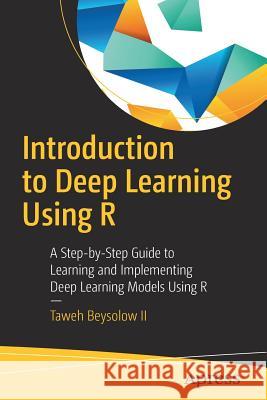
Taweh Beysolow II
Introduction to Deep Learning Using R: A Step-By-Step Guide to Learning and Implementing Deep Learning Models Using R Beysolow II, Taweh 9781484227336 Apress - książkaWidoczna okładka, to zdjęcie poglądowe, a rzeczywista szata graficzna może różnić się od prezentowanej.

Introduction to Deep Learning Using R: A Step-By-Step Guide to Learning and Implementing Deep Learning Models Using R

ISBN-13: 9781484227336 / Angielski / Miękka / 2017 / 227 str.

Taweh Beysolow II
cena 241,50
(netto: 230,00 VAT:  5%)

Najniższa cena z 30 dni: 231,29
Termin realizacji zamówienia:
ok. 22 dni roboczych.

Darmowa dostawa!

Understand deep learning, the nuances of its different models, and where these models can be applied.The abundance of data and demand for superior products/services have driven the development of advanced computer science techniques, among them image and speech recognition. Introduction to Deep Learning Using R provides a theoretical and practical understanding of the models that perform these tasks by building upon the fundamentals of data science through machine learning and deep learning. This step-by-step guide will help you understand the disciplines so that you can apply the methodology in a variety of contexts. All examples are taught in the R statistical language, allowing students and professionals to implement these techniques using open source tools.What You'll Learn

  • Understand the intuition and mathematics that power deep learning models
  • Utilize various algorithms using the R programming language and its packages
  • Use best practices for experimental design and variable selection
  • Practice the methodology to approach and effectively solve problems as a data scientist
  • Evaluate the effectiveness of algorithmic solutions and enhance their predictive power

Who This Book Is For
Students, researchers, and data scientists who are familiar with programming using R. This book also is also of use for those who wish to learn how to appropriately deploy these algorithms in applications where they would be most useful.



Kategorie:
Nauka, Ekonomia i biznes
Kategorie BISAC:
Business & Economics > Industries - Computers & Information Technology
Computers > Languages - General
Computers > Artificial Intelligence - General
Wydawca:
Apress
Język:
Angielski
ISBN-13:
9781484227336
Rok wydania:
2017
Ilość stron:
227
Waga:
0.36 kg
Wymiary:
23.6 x 16.71 x 1.4
Oprawa:
Miękka
Wolumenów:
01
Dodatkowe informacje:
Wydanie ilustrowane

Chapter 1: What is Deep Learning?

Chapter Goal: Review the history of Deep Learning, how where the field is today, and discuss the general goals that the book has for the reader in their progression.

No of pages  10


Chapter 2: A Review of Notation, Vectors and Matrices

Chapter Goal: Establish a sense of understanding in the aforementioned topics within the reader to allow them to understand the models described later. Topics discussed includes the following: Notation, vectors, matrices, inner products, norms, and linear equations.

No of Pages: 50


Apress Proposal Submission Form for Prospective Authors

Chapter 3: A Review of Optimization

Chapter Goal: Discuss/Review Optimization concepts and how it is used in Deep Learning models. Topics discussed include the following: constrained and unconstrained optimization, gradient descent, and newton’s method.

No of pages : 60


Chapter 4: Single Layer Artificial Neural Network (ANNs)

Chapter Goal: Introduce readers to ANNs, it’s uses, the math that powers the model, as well as discussing its limitations

No of pages: 10


Chapter 5: Deep Neural Networks (Multi-layer ANNs)

Chapter Goal: Establish the difference between single and multilayer ANNs as well as discuss the nuances that are created as a product of having multiple hidden layers

No of pages: 10


Chapter 6: Convolutional Neural Networks (CNNs)

Chapter Goal: Build upon the knowledge of neural networks described earlier and begin to branch in the other models, such as CNNs. Here, we will establish what a convolutional layer is, in addition to what the uses of this model are, such as computer vision and processing visual data.

No of pages: 10


Apress Proposal Submission Form for Prospective Authors

Chapter 7: Recurrent Neural Networks (RNNs)

Chapter Goal: Describe the mathematics and intuition behind RNNs and their use cases, such as handwriting recognition and speech recognition. Also describe how the unique structure behind them differentiates themselves from feed forward networks.

No of pages: 10


Chapter 8: Deep Belief Networks and Deep Boltzman Machines

Chapter Goal: Discuss the similarities between these two models and how their disadvantages and advantages in contrast to the prior Deep Learning Models described

No. of pages: 20


Chapter 9: Tuning and Training Deep Network Architectures

Chapter Goal: Establish an understanding of how to properly train Deep Network models and tune their parameters as to avoid common pitfalls such as overfitting.

No. of Pages: 20


Chapter 10: Experimental Design and Variable Selection

Chapter Goal: Now that the reader has an understanding of various Deep Learning Models, and the concepts that power them, it is time to establish an understanding of how to properly perform experiments, including the examples given in the later part of the text. Topics discussed include the following: Fisher’s priciples, Plackett-Burman designs, statistical control, and variable selection techniques.
No. of Pages: 60
 

Chapter 11: Example Problems

Chapter Goal: In this Chapter, the user will be given questions and detailed answer guides in solving the supervised and unsupervised learning example problems. Problems covered are the following: Regression, Classification, and Image Recognition.

No of Pages: 60


Chapter 12: Conclusion and Closing Commentary

Chapter Goal: Give readers recommendations on what resources they should seek moving forward given specific interests, as well as recommendations for what tools they should use related to R.

No. of Pages: 5

Taweh Beysolow II is a Machine Learning Scientist currently based in the United States with a passion for research and applying machine learning methods to solve problems. He has a Bachelor of Science degree in Economics from St. Johns University and a Master of Science in Applied Statistics from Fordham University. Currently, he is extremely passionate about all matters related to machine learning, data science, quantitative finance, and economics.

Understand deep learning, the nuances of its different models, and where these models can be applied.

The abundance of data and demand for superior products/services have driven the development of advanced computer science techniques, among them image and speech recognition. Introduction to Deep Learning Using R provides a theoretical and practical understanding of the models that perform these tasks by building upon the fundamentals of data science through machine learning and deep learning. This step-by-step guide will help you understand the disciplines so that you can apply the methodology in a variety of contexts. All examples are taught in the R statistical language, allowing students and professionals to implement these techniques using open source tools.

What You Will Learn:

• Understand the intuition and mathematics that power deep learning models

• Utilize various algorithms using the R programming language and its packages

• Use best practices for experimental design and variable selection

• Practice the methodology to approach and effectively solve problems as a data scientist

• Evaluate the effectiveness of algorithmic solutions and enhance their predictive power


Udostępnij

Facebook - konto krainaksiazek.pl


Opinie o Krainaksiazek.pl na Opineo.pl

Partner Mybenefit

Krainaksiazek.pl w programie rzetelna firma Krainaksiaze.pl - płatności przez paypal

Czytaj nas na:

Facebook - krainaksiazek.pl
  • książki na zamówienie
  • granty
  • książka na prezent
  • kontakt
  • pomoc
  • opinie
  • regulamin
  • polityka prywatności

Zobacz:

  • Księgarnia czeska

  • Wydawnictwo Książkowe Klimaty

1997-2026 DolnySlask.com Agencja Internetowa

© 1997-2022 krainaksiazek.pl
     
KONTAKT | REGULAMIN | POLITYKA PRYWATNOŚCI | USTAWIENIA PRYWATNOŚCI
Zobacz: Księgarnia Czeska | Wydawnictwo Książkowe Klimaty | Mapa strony | Lista autorów
KrainaKsiazek.PL - Księgarnia Internetowa

Polityka prywatnosci - link
Krainaksiazek.pl - płatnośc Przelewy24
Przechowalnia Przechowalnia




