• Wyszukiwanie zaawansowane
  • Kategorie
  • Kategorie BISAC
  • Książki na zamówienie
  • Promocje
  • Granty
  • Książka na prezent
  • Opinie
  • Pomoc
  • Załóż konto
  • Zaloguj się

Introduction to Computation and Modeling for Differential Equations » książka


zaloguj się | załóż konto
Logo Krainaksiazek.pl

koszyk

konto

szukaj
topmenu
Księgarnia internetowa
Szukaj
Książki na zamówienie
Promocje
Granty
Książka na prezent
Moje konto
Pomoc
 
 
Wyszukiwanie zaawansowane
Pusty koszyk
Bezpłatna dostawa dla zamówień powyżej 20 złBezpłatna dostawa dla zamówień powyżej 20 zł

Kategorie główne

• Nauka
 [2946912]
• Literatura piękna
 [1852311]

  więcej...
• Turystyka
 [71421]
• Informatyka
 [150889]
• Komiksy
 [35717]
• Encyklopedie
 [23177]
• Dziecięca
 [617324]
• Hobby
 [138808]
• AudioBooki
 [1671]
• Literatura faktu
 [228371]
• Muzyka CD
 [400]
• Słowniki
 [2841]
• Inne
 [445428]
• Kalendarze
 [1545]
• Podręczniki
 [166819]
• Poradniki
 [480180]
• Religia
 [510412]
• Czasopisma
 [525]
• Sport
 [61271]
• Sztuka
 [242929]
• CD, DVD, Video
 [3371]
• Technologie
 [219258]
• Zdrowie
 [100961]
• Książkowe Klimaty
 [124]
• Zabawki
 [2341]
• Puzzle, gry
 [3766]
• Literatura w języku ukraińskim
 [255]
• Art. papiernicze i szkolne
 [7810]
Kategorie szczegółowe BISAC

Introduction to Computation and Modeling for Differential Equations

ISBN-13: 9781119018445 / Angielski / Twarda / 2015 / 288 str.
Lennart Edsberg
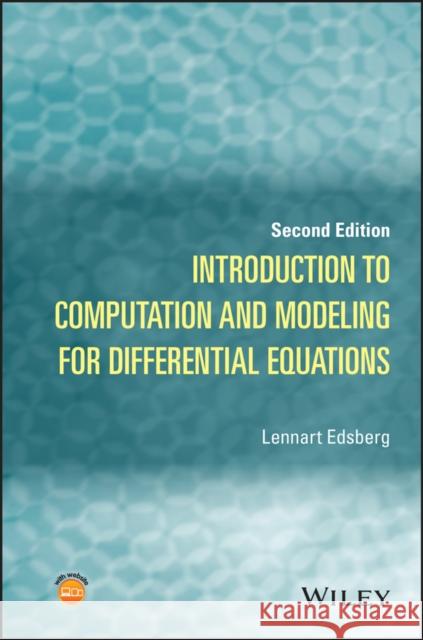
Introduction to Computation and Modeling for Differential Equations Edsberg, Lennart 9781119018445 John Wiley & Sons - książkaWidoczna okładka, to zdjęcie poglądowe, a rzeczywista szata graficzna może różnić się od prezentowanej.

Introduction to Computation and Modeling for Differential Equations

ISBN-13: 9781119018445 / Angielski / Twarda / 2015 / 288 str.

Lennart Edsberg
cena 437,70
(netto: 416,86 VAT:  5%)

Najniższa cena z 30 dni: 436,80
Termin realizacji zamówienia:
ok. 30 dni roboczych
Bez gwarancji dostawy przed świętami

Darmowa dostawa!

Uses mathematical, numerical, and programming tools to solve differential equations for physical phenomena and engineering problems Introduction to Computation and Modeling for Differential Equations, Second Edition features the essential principles and applications of problem solving across disciplines such as engineering, physics, and chemistry. The Second Edition integrates the science of solving differential equations with mathematical, numerical, and programming tools, specifically with methods involving ordinary differential equations; numerical methods for initial value problems (IVPs); numerical methods for boundary value problems (BVPs); partial differential equations (PDEs); numerical methods for parabolic, elliptic, and hyperbolic PDEs; mathematical modeling with differential equations; numerical solutions; and finite difference and finite element methods. The author features a unique -Five-M- approach: Modeling, Mathematics, Methods, MATLAB(R), and Multiphysics, which facilitates a thorough understanding of how models are created and preprocessed mathematically with scaling, classification, and approximation and also demonstrates how a problem is solved numerically using the appropriate mathematical methods. With numerous real-world examples to aid in the visualization of the solutions, Introduction to Computation and Modeling for Differential Equations, Second Edition includes:

  • New sections on topics including variational formulation, the finite element method, examples of discretization, ansatz methods such as Galerkin's method for BVPs, parabolic and elliptic PDEs, and finite volume methods
  • Numerous practical examples with applications in mechanics, fluid dynamics, solid mechanics, chemical engineering, heat conduction, electromagnetic field theory, and control theory, some of which are solved with computer programs MATLAB and COMSOL Multiphysics(R)
  • Additional exercises that introduce new methods, projects, and problems to further illustrate possible applications
  • A related website with select solutions to the exercises, as well as the MATLAB data sets for ordinary differential equations (ODEs) and PDEs
Introduction to Computation and Modeling for Differential Equations, Second Edition is a useful textbook for upper-undergraduate and graduate-level courses in scientific computing, differential equations, ordinary differential equations, partial differential equations, and numerical methods. The book is also an excellent self-study guide for mathematics, science, computer science, physics, and engineering students, as well as an excellent reference for practitioners and consultants who use differential equations and numerical methods in everyday situations.

Kategorie:
Technologie
Kategorie BISAC:
Mathematics > Równania różniczkowe
Wydawca:
John Wiley & Sons
Język:
Angielski
ISBN-13:
9781119018445
Rok wydania:
2015
Wydanie:
Revised
Ilość stron:
288
Waga:
0.61 kg
Wymiary:
23.88 x 16.0 x 2.29
Oprawa:
Twarda
Wolumenów:
01
Dodatkowe informacje:
Bibliografia

Preface xi

1 Introduction 1

1.1 What is a Differential Equation? 1

1.2 Examples of an Ordinary and a Partial Differential Equation, 2

1.3 Numerical Analysis, a Necessity for Scientific Computing, 5

1.4 Outline of the Contents of this Book, 8

Bibliography, 10

2 Ordinary Differential Equations 11

2.1 Problem Classification, 11

2.2 Linear Systems of ODEs with Constant Coefficients, 16

2.3 Some Stability Concepts for ODEs, 19

2.3.1 Stability for a Solution Trajectory of an ODE System, 20

2.3.2 Stability for Critical Points of ODE Systems, 23

2.4 Some ODE models in Science and Engineering, 26

2.4.1 Newton s Second Law, 26

2.4.2 Hamilton s Equations, 27

2.4.3 Electrical Networks, 27

2.4.4 Chemical Kinetics, 28

2.4.5 Control Theory, 29

2.4.6 Compartment Models, 29

2.5 Some Examples From Applications, 30

Bibliography, 36

3 Numerical Methods For Initial Value Problems 37

3.1 Graphical Representation of Solutions, 38

3.2 Basic Principles of Numerical Approximation of ODEs, 40

3.3 Numerical Solution of IVPs with Euler s method, 41

3.3.1 Euler s Explicit Method: Accuracy, 43

3.3.2 Euler s Explicit Method: Improving the Accuracy, 46

3.3.3 Euler s Explicit Method: Stability, 48

3.3.4 Euler s Implicit Method, 53

3.3.5 The Trapezoidal Method, 55

3.4 Higher Order Methods for the IVP, 56

3.4.1 Runge Kutta Methods, 56

3.4.2 Linear Multistep Methods, 60

3.5 Special Methods for Special Problems, 62

3.5.1 Preserving Linear and Quadratic Invariants, 62

3.5.2 Preserving Positivity of the Numerical Solution, 64

3.5.3 Methods for Newton s Equations of Motion, 64

3.6 The Variational Equation and Parameter Fitting in IVPs, 66

Bibliography, 69

4 Numerical Methods for Boundary Value Problems 71

4.1 Applications, 73

4.2 Difference Methods for BVPs, 78

4.2.1 A Model Problem for BVPs, Dirichlet s BCs, 79

4.2.2 A Model Problem for BVPs, Mixed BCs, 83

4.2.3 Accuracy, 86

4.2.4 Spurious Solutions, 87

4.2.5 Linear Two–Point BVPs, 89

4.2.6 Nonlinear Two–Point BVPs, 91

4.2.7 The Shooting Method, 92

4.3 Ansatz Methods for BVPs, 94

4.3.1 Starting with the ODE Formulation, 95

4.3.2 Starting with the Weak Formulation, 96

4.3.3 The Finite Element Method, 100

Bibliography, 103

5 Partial Differential Equations 105

5.1 Classical PDE Problems, 106

5.2 Differential Operators Used for PDEs, 110

5.3 Some PDEs in Science and Engineering, 114

5.3.1 Navier Stokes Equations for Incompressible Flow, 114

5.3.2 Euler s Equations for Compressible Flow, 115

5.3.3 The Convection Diffusion Reaction Equations, 116

5.3.4 The Heat Equation, 117

5.3.5 The Diffusion Equation, 117

5.3.6 Maxwell s Equations for the Electromagnetic Field, 117

5.3.7 Acoustic Waves, 118

5.3.8 Schrödinger s Equation in Quantum Mechanics, 119

5.3.9 Navier s Equations in Structural Mechanics, 119

5.3.10 Black Scholes Equation in Financial Mathematics, 120

5.4 Initial and Boundary Conditions for PDEs, 121

5.5 Numerical Solution of PDEs, Some General Comments, 121

Bibliography, 122

6 Numerical Methods for Parabolic Partial Differential Equations 123

6.1 Applications, 125

6.2 An Introductory Example of Discretization, 127

6.3 The Method of Lines for Parabolic PDEs, 130

6.3.1 Solving the Test Problem with MoL, 130

6.3.2 Various Types of Boundary Conditions, 134

6.3.3 An Example of the Use of MoL for a Mixed Boundary Condition, 135

6.4 Generalizations of the Heat Equation, 136

6.4.1 The Heat Equation with Variable Conductivity, 136

6.4.2 The Convection Diffusion Reaction PDE, 138

6.4.3 The General Nonlinear Parabolic PDE, 138

6.5 Ansatz Methods for the Model Equation, 139

Bibliography, 140

7 Numerical Methods for Elliptic Partial Differential Equations 143

7.1 Applications, 145

7.2 The Finite Difference Method, 150

7.3 Discretization of a Problem with Different BCs, 154

7.4 Ansatz Methods for Elliptic PDEs, 156

7.4.1 Starting with the PDE Formulation, 156

7.4.2 Starting with the Weak Formulation, 158

7.4.3 The Finite Element Method, 159

Bibliography, 164

8 Numerical Methods for Hyperbolic PDEs 165

8.1 Applications, 171

8.2 Numerical Solution of Hyperbolic PDEs, 174

8.2.1 The Upwind Method (FTBS), 175

8.2.2 The FTFS Method, 177

8.2.3 The FTCS Method, 178

8.2.4 The Lax Friedrichs Method, 178

8.2.5 The Leap–Frog Method, 179

8.2.6 The Lax Wendroff Method, 179

8.2.7 Numerical Method for the Wave Equation, 181

8.3 The Finite Volume Method, 183

8.4 Some Examples of Stability Analysis for Hyperbolic PDEs, 185

Bibliography, 187

9 Mathematical Modeling with Differential Equations 189

9.1 Nature Laws, 190

9.2 Constitutive Equations, 192

9.2.1 Equations in Heat Transfer Problems, 192

9.2.2 Equations in Mass Diffusion Problems, 193

9.2.3 Equations in Mechanical Moment Diffusion Problems, 193

9.2.4 Equations in Elastic Solid Mechanics Problems, 194

9.2.5 Equations in Chemical Reaction Engineering Problems, 194

9.2.6 Equations in Electrical Engineering Problems, 195

9.3 Conservative Equations, 195

9.3.1 Some Examples of Lumped Models, 196

9.3.2 Some Examples of Distributed Models, 197

9.4 Scaling of Differential Equations to Dimensionless Form, 201

Bibliography, 204

10 Applied Projects on Differential Equations 205

Project 1 Signal propagation in a long electrical conductor, 205

Project 2 Flow in a cylindrical pipe, 206

Project 3 Soliton waves, 208

Project 4 Wave scattering in a waveguide, 209

Project 5 Metal block with heat sourse and thermometer, 210

Project 6 Deformation of a circular metal plate, 211

Project 7 Cooling of a chrystal glass, 212

Project 8 Rotating fluid in a cylinder, 212

Appendix A Some Numerical and Mathematical Tools 215

A.1 Newton s Method for Systems of Nonlinear Algebraic Equations, 215

A.1.1 Quadratic Systems, 215

A.1.2 Overdetermined Systems, 218

A.2 Some Facts about Linear Difference Equations, 219

A.3 Derivation of Difference Approximations, 223

Bibliography, 225

A.4 The Interpretations of Grad, Div, and Curl, 225

A.5 Numerical Solution of Algebraic Systems of Equations, 229

A.5.1 Direct Methods, 229

A.5.2 Iterative Methods for Linear Systems of Equations, 233

A.6 Some Results for Fourier Transforms, 237

Bibliography, 239

Appendix B Software for Scientific Computing 241

B.1 MATLAB, 242

B.1.1 Chapter 3: IVPs, 242

B.1.2 Chapter 4: BVPs, 244

B.1.3 Chapter 6: Parabolic PDEs, 245

B.1.4 Chapter 7: Elliptic PDEs, 246

B.1.5 Chapter 8: Hyperbolic PDEs, 246

B.2 COMSOL MULTIPHYSICS, 247

Bibliography and Resources, 249

Appendix C Computer Exercises to Support the Chapters 251

C.1 Computer Lab 1 Supporting Chapter 2, 251

C.1.1 ODE Systems of LCC Type and Stability, 251

C.2 Computer Lab 2 Supporting Chapter 3, 254

C.2.1 Numerical Solution of Initial Value Problems, 254

C.3 Computer Lab 3 Supporting Chapter 4, 257

C.3.1 Numerical Solution of a Boundary Value Problem, 257

C.4 Computer Lab 4 Supporting Chapter 6, 258

C.4.1 Partial Differential Equation of Parabolic Type, 258

C.5 Computer Lab 5 Supporting Chapter 7, 261

C.5.1 Numerical Solution of Elliptic PDE Problems, 261

C.6 Computer Lab 6 Supporting Chapter 8, 263

C.6.1 Numerical Experiments with the Hyperbolic Model PDE

Problem, 263

Index 265

Lennart Edsberg, PhD, is Associate Professor in the Department of Numerical Analysis and Computing Science (NADA) in the School of Computer Science and Communication at KTH – The Royal Institute of Technology in Stockholm, Sweden, where he has also been Director of the International Master Program in Scientific Computing since 1996. Dr. Edsberg has over thirty years of academic experience and is the author of over twenty journal articles in the areas of numerical methods and differential equations.

Uses mathematical, numerical, and programming tools to solve differential equations for physical phenomena and engineering problems

Introduction to Computation and Modeling for Differential Equations, Second Edition features the essential principles and applications to problem solving across disciplines such as engineering, physics, and chemistry. The Second Edition integrates the science of solving differential equations with mathematical, numerical, and programming tools, specifically with methods involving ordinary differential equations; numerical methods for initial value problems (IVPs); numerical methods for boundary value problems (BVPs); partial differential equations (PDEs); numerical methods for parabolic, elliptic, and hyperbolic PDEs; mathematical modeling with differential equations; numerical solutions; and finite difference and finite element methods.

The author features a unique "Five–M" approach: Modeling, Mathematics, Methods, MATLAB®, and Multiphysics, which facilitates a thorough understanding of how models are created and preprocessed mathematically with scaling, classification, and approximation and also demonstrates how a problem is solved numerically using the appropriate mathematical methods. With numerous real–world examples to aid readers in the visualization of the solutions, Introduction to Computation and Modeling for Differential Equations, Second Edition includes:

  • New sections on topics such as variational formulation, the finite element method, examples of discretization, Ansatz methods for parabolic PDEs and elliptic PDEs, Galerkin′s method for the model problem, and finite volume methods
  • Numerous practical examples with applications in mechanics, fluid dynamics, solid mechanics, chemical engineering, electromagnetic field theory, and control theory, all of which are solved with computer programs MATLAB and Comsol Multiphysics®
  • Additional exercises that introduce new methods, projects, and problems to further illustrate possible applications
  • A related website with select solutions to the exercises, as well as the MATLAB data sets for IVPs and BVPs

Introduction to Computation and Modeling for Differential Equations, Second Edition
is a useful textbook for upper–undergraduate and graduate–level courses in scientific computing, differential equations, ordinary differential equations, partial differential equations, and numerical methods. The book is also an excellent self–study guide for mathematics, science, computer science, physics, and engineering students, as well as an excellent reference for practitioners and consultants who use differential equations and numerical methods in everyday situations.

Lennart Edsberg, PhD, is Associate Professor in the Department of Numerical Analysis and Computing Science (NADA) in the School of Computer Science and Communication at KTH – The Royal Institute of Technology in Stockholm, Sweden, where he has also been Director of the International Master Program in Scientific Computing since 1996. Dr. Edsberg has over thirty years of academic experience and is the author of over twenty journal articles in the areas of numerical methods and differential equations.


Udostępnij

Facebook - konto krainaksiazek.pl


Opinie o Krainaksiazek.pl na Opineo.pl

Partner Mybenefit

Krainaksiazek.pl w programie rzetelna firma Krainaksiaze.pl - płatności przez paypal

Czytaj nas na:

Facebook - krainaksiazek.pl
  • książki na zamówienie
  • granty
  • książka na prezent
  • kontakt
  • pomoc
  • opinie
  • regulamin
  • polityka prywatności

Zobacz:

  • Księgarnia czeska

  • Wydawnictwo Książkowe Klimaty

1997-2025 DolnySlask.com Agencja Internetowa

© 1997-2022 krainaksiazek.pl
     
KONTAKT | REGULAMIN | POLITYKA PRYWATNOŚCI | USTAWIENIA PRYWATNOŚCI
Zobacz: Księgarnia Czeska | Wydawnictwo Książkowe Klimaty | Mapa strony | Lista autorów
KrainaKsiazek.PL - Księgarnia Internetowa

Polityka prywatnosci - link
Krainaksiazek.pl - płatnośc Przelewy24
Przechowalnia Przechowalnia







