• Wyszukiwanie zaawansowane
  • Kategorie
  • Kategorie BISAC
  • Książki na zamówienie
  • Promocje
  • Granty
  • Książka na prezent
  • Opinie
  • Pomoc
  • Załóż konto
  • Zaloguj się

Introduction to Combinatorics » książka


zaloguj się | załóż konto
Logo Krainaksiazek.pl

koszyk

konto

szukaj
topmenu
Księgarnia internetowa
Szukaj
Książki na zamówienie
Promocje
Granty
Książka na prezent
Moje konto
Pomoc
 
 
Wyszukiwanie zaawansowane
Pusty koszyk
Bezpłatna dostawa dla zamówień powyżej 20 złBezpłatna dostawa dla zamówień powyżej 20 zł

Kategorie główne

• Nauka
 [2946600]
• Literatura piękna
 [1856966]

  więcej...
• Turystyka
 [72221]
• Informatyka
 [151456]
• Komiksy
 [35826]
• Encyklopedie
 [23190]
• Dziecięca
 [619653]
• Hobby
 [140543]
• AudioBooki
 [1577]
• Literatura faktu
 [228355]
• Muzyka CD
 [410]
• Słowniki
 [2874]
• Inne
 [445822]
• Kalendarze
 [1744]
• Podręczniki
 [167141]
• Poradniki
 [482898]
• Religia
 [510455]
• Czasopisma
 [526]
• Sport
 [61590]
• Sztuka
 [243598]
• CD, DVD, Video
 [3423]
• Technologie
 [219201]
• Zdrowie
 [101638]
• Książkowe Klimaty
 [124]
• Zabawki
 [2473]
• Puzzle, gry
 [3898]
• Literatura w języku ukraińskim
 [254]
• Art. papiernicze i szkolne
 [8170]
Kategorie szczegółowe BISAC

Introduction to Combinatorics

ISBN-13: 9781032476995 / Angielski / Miękka / 2023 / 444 str.
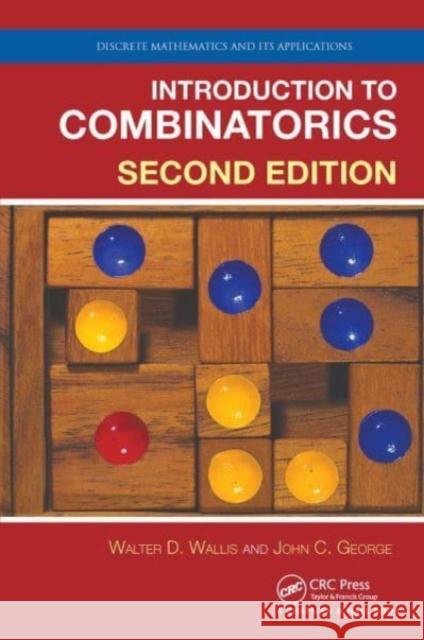
Walter D. Wallis; John C. George
Introduction to Combinatorics Walter D. Wallis John C. George 9781032476995 CRC Press - książkaWidoczna okładka, to zdjęcie poglądowe, a rzeczywista szata graficzna może różnić się od prezentowanej.

Introduction to Combinatorics

ISBN-13: 9781032476995 / Angielski / Miękka / 2023 / 444 str.

Walter D. Wallis; John C. George
cena 229,20 zł
(netto: 218,29 VAT:  5%)

Najniższa cena z 30 dni: 221,59 zł
Termin realizacji zamówienia:
ok. 22 dni roboczych
Bez gwarancji dostawy przed świętami

Darmowa dostawa!
inne wydania

The purpose of this undergraduate textbook is to offer all the material suitable for a beginning combinatorics course for students in STEM subjects particularly mathematics and computer science, although other subjects may benefit as well. This will be achieved through the use of plentiful (though brief) examples, and a variety of exercises and

What Is Combinatorics Anyway?


Broadly speaking, combinatorics is the branch of mathematics dealing


with different ways of selecting objects from a set or arranging objects. It


tries to answer two major kinds of questions, namely, counting questions: how many ways can a selection or arrangement be chosen with a particular set of properties; and structural


questions: does there exist a selection or arrangement of objects with a


particular set of properties?


The authors have presented a text for students at all levels of preparation.


For some, this will be the first course where the students see several real proofs.


Others will have a good background in linear algebra, will have completed the calculus


stream, and will have started abstract algebra.


The text starts by briefly discussing several examples of typical combinatorial problems


to give the reader a better idea of what the subject covers. The next


chapters explore enumerative ideas and also probability. It then moves on to


enumerative functions and the relations between them, and generating functions and recurrences.,


Important families of functions, or numbers and then theorems are presented.


Brief introductions to computer algebra and group theory come next. Structures of particular


interest in combinatorics: posets, graphs, codes, Latin squares, and experimental designs follow. The


authors conclude with further discussion of the interaction between linear algebra


and combinatorics.


Features


  • Two new chapters on probability and posets.


  • Numerous new illustrations, exercises, and problems.


  • More examples on current technology use


  • A thorough focus on accuracy


  • Three appendices: sets, induction and proof techniques, vectors and matrices, and biographies with historical notes,


  • Flexible use of MapleTM and MathematicaTM


Kategorie:
Nauka, Matematyka
Kategorie BISAC:
Mathematics > Kombinatoryka i teorii grafów
Wydawca:
CRC Press
Seria wydawnicza:
Discrete Mathematics and Its Applications
Język:
Angielski
ISBN-13:
9781032476995
Rok wydania:
2023
Dostępne języki:
Ilość stron:
444
Waga:
0.82 kg
Wymiary:
22.9 x 15.2
Oprawa:
Miękka

In Introduction to Combinatorics, Wallis (emer., Southern Illinois Univ.) and George (Gordon State College) present a well-thought-out compilation of topics covering elementary combinatorics. At the beginning, the authors present a thorough background on the fundamentals of combinatorics with topics such as permutations and combinations, the pigeonhole principle, and the principle of inclusion and exclusion. Later chapters are independent of one another and can be selected based on student and instructor interests. These topics include graph theory, coding theory, and balanced incomplete block designs. At the end of each chapter, there are exercises and problems. These vary in difficulty from straightforward practice to more involved proof problems. Solutions and/or hints are provided in the back of the book. In addition, three appendixes discuss proof techniques, matrices and vectors, and historical figures; these allow flexibility in covering the material in various ways that can be based on students’ backgrounds. Overall, this textbook is a highly readable work that will benefit and enlighten all those interested in learning about combinatorics. It will work in a traditional classroom setting and for independent study. Given the level of material, it is geared toward junior or senior level undergraduate students.
--S. L. Sullivan, Catawba College

Introduction


Some Combinatorial Examples


Sets, Relations and Proof Techniques


Two Principles of Enumeration


Graphs


Systems of Distinct Representatives


Fundamentals of Enumeration


Permutations and Combinations


Applications of P(n, k) and (n k)


Permutations and Combinations of Multisets


Applications and Subtle Errors


Algorithms


Probability


Introduction


Some Definitions and Easy Examples


Events and Probabilities


Three Interesting Examples


Probability Models


Bernoulli Trials


The Probabilities in Poker


The Wild Card Poker Paradox


The Pigeonhole Principle and Ramsey’s Theorem


The Pigeonhole Principle


Applications of the Pigeonhole Principle


Ramsey’s Theorem — the Graphical Case


Ramsey Multiplicity


Sum-Free Sets


Bounds on Ramsey Numbers


The General Form of Ramsey’s Theorem


The Principle of Inclusion and Exclusion


Unions of Events


The Principle


Combinations with Limited Repetitions


Derangements


Generating Functions and Recurrence Relations


Generating Functions


Recurrence Relations


From Generating Function to Recurrence


Exponential Generating Functions


Catalan, Bell and Stirling Numbers


Introduction


Catalan Numbers


Stirling Numbers of the Second Kind


Bell Numbers


Stirling Numbers of the First Kind


Computer Algebra and Other Electronic Systems


Symmetries and the P´olya-Redfield Method


Introduction


Basics of Groups


Permutations and Colorings


An Important Counting Theorem


P´olya and Redfield’s Theorem


Partially-Ordered Sets


Introduction


Examples and Definitions


Bounds and lattices


Isomorphism and Cartesian products


Extremal set theory: Sperner’s and Dilworth’s theorems


Introduction to Graph Theory


Degrees


Paths and Cycles in Graphs


Maps and Graph Coloring


Further Graph Theory


Euler Walks and Circuits


Application of Euler Circuits to Mazes


Hamilton Cycles


Trees


Spanning Trees


Coding Theory


Errors; Noise


The Venn Diagram Code


Binary Codes; Weight; Distance


Linear Codes


Hamming Codes


Codes and the Hat Problem


Variable-Length Codes and Data Compression


Latin Squares


Introduction


Orthogonality


Idempotent Latin Squares


Partial Latin Squares and Subsquares


Applications


Balanced Incomplete Block Designs


Design Parameters 


Fisher’s Inequality


Symmetric Balanced Incomplete Block Designs


New Designs from Old 


Difference Methods


Linear Alge

W.D. Wallis is Professor Emeritus of Southern Illiniois University. John C George is Asscoiate Professor at Gordon State College.


Udostępnij

Facebook - konto krainaksiazek.pl


Opinie o Krainaksiazek.pl na Opineo.pl

Partner Mybenefit

Krainaksiazek.pl w programie rzetelna firma Krainaksiaze.pl - płatności przez paypal

Czytaj nas na:

Facebook - krainaksiazek.pl
  • książki na zamówienie
  • granty
  • książka na prezent
  • kontakt
  • pomoc
  • opinie
  • regulamin
  • polityka prywatności

Zobacz:

  • Księgarnia czeska

  • Wydawnictwo Książkowe Klimaty

1997-2025 DolnySlask.com Agencja Internetowa

© 1997-2022 krainaksiazek.pl
     
KONTAKT | REGULAMIN | POLITYKA PRYWATNOŚCI | USTAWIENIA PRYWATNOŚCI
Zobacz: Księgarnia Czeska | Wydawnictwo Książkowe Klimaty | Mapa strony | Lista autorów
KrainaKsiazek.PL - Księgarnia Internetowa

Polityka prywatnosci - link
Krainaksiazek.pl - płatnośc Przelewy24
Przechowalnia Przechowalnia







