Introduction to Circuit Analysis and Design » książka





Introduction to Circuit Analysis and Design
ISBN-13: 9789048194421 / Angielski / Twarda / 2011 / 768 str.
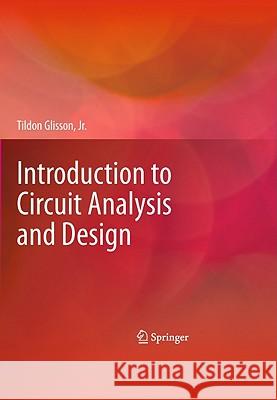
Introduction to Circuit Analysis and Design
ISBN-13: 9789048194421 / Angielski / Twarda / 2011 / 768 str.
(netto: 498,38 VAT: 5%)
Najniższa cena z 30 dni: 501,19
ok. 22 dni roboczych.
Darmowa dostawa!
Introduction to Circuit Analysis and Design takes the view that circuits have inputs and outputs, and that relations between inputs and outputs and the terminal characteristics of circuits at input and output ports are all-important in analysis and design. Two-port models, input resistance, output impedance, gain, loading effects, and frequency response are treated in more depth than is traditional. Due attention to these topics is essential preparation for design, provides useful preparation for subsequent coursed in electronic devices and circuits, and eases the transition from circuits to systems.
A strength of the book is its practical flavor. Without doubt, this will make it appealing to students.
Art Davis, Prof. Emeritus at San Jose State University in California
-----
This introductory circuits text presents a more complete coverage of operational amplifiers than other such texts, providing theoretical and practical information needed by today's electrical engineers.
John Hauser, Prof. at North Carolina State University
-----
Glisson's text does a great job of combining fundamental concepts, clear explanations and practical applications of the introductory circuits material.
John Trussell, Prof. at North Carolina State University
Preface.
1 Introduction. 1.1 Electric Circuits. 1.2 How to Study This Book. 1.3 Dimensions and Units. 1.4 Symbols and Notation. 1.5 Symbols Versus Numbers. 1.6 Presentation of Calculations. 1.7 Approximations. 1.8 Precision and Tolerance. 1.9 Engineering Notation. 1.10 Problems.
2 Current, Voltage, and Resistance. 2.1 Charge and Current. 2.2 Electric Field. 2.3 Electric Potential and Voltage. 2.4 Ohm’s Law and Resistance. 2.5 Resistivity. 2.6 Conductance and Conductivity. 2.7 Resistors. 2.8 E Series, Tolerance, and Standard Resistance Values. 2.9 Resistor Marking. 2.10 Variation of Resistivity and Resistance with Temperature. 2.11 American Wire Gauge (AWG) and Metric Wire Gauge (MWG). 2.12 DC and AC. 2.13 Skin Effect and Proximity Effect. 2.14 Concluding Remark. 2.15 Problems.
3 Circuit Elements, Circuit Diagrams, and Kirchhoff’s Laws. 3.1 Schematics and Circuit Diagrams. 3.2 Conductors and Connections. 3.3 Annotating Circuit Diagrams. 3.4 Series and Parallel Connections. 3.5 Open Circuits and Short Circuits. 3.6 Basic Circuit Elements: Resistors and Independent Sources. 3.7 Kirchhoff’s Current Law and Node Analysis. 3.8 Kirchhoff’s Voltage Law and Mesh Analysis. 3.9 Voltage and Current Dividers. 3.10 Superposition. 3.11 Problems.
4 Equivalent Circuits. 4.1 Terminal Characteristics. 4.2 Equivalent Circuits. 4.3 Source Transformations. 4.4 The´venin and Norton Equivalent Circuits. 4.5 Notation: Constant and Time-Varying Current and Voltage. 4.6 Significance of Terminal Characteristics and Equivalence. 4.7 Problems.
5 Work and Power. 5.1 Instantaneous Power and the Passive Sign Convention. 5.2 Instantaneous Power Dissipated by a Resistor: Joule’s Law. 5.3 Conservation of Power. 5.4 Peak Power. 5.5 Available Power. 5.6 Time Averages. 5.7 Average Power. 5.8 Root Mean Squared (RMS) Amplitude of a Current or Voltage. 5.9 Average Power Dissipated in a Resistive Load. 5.10 Summary: Power Relations. 5.11 Notation. 5.12 Measurement of RMS Amplitude. 5.13 Dissipation Derating. 5.14 Power Dissipation in Physical Components and Circuits. 5.15 Active and Passive Devices, Loads, and Circuits. 5.16 Power Transfer and Power Transfer Efficiency. 5.17 Superposition of Power. 5.18 Problems.6 Dependent Sources and Unilateral Two-Port Circuits. 6.1 Input Resistance and Output Resistance. 6.2 Dependent Sources. 6.3 Linear Two-Port Models. 6.4 Two-Ports in Cascade. 6.5 Voltage, Current, and Power Transfer. 6.6 Transfer Characteristics, Transfer Ratios, and Gain. 6.7 Power Gain. 6.8 Gains and Relative Values in Decibels (dB). 6.9 Design Considerations. 6.10 Problems.
7 Operational Amplifiers I. 7.1 Operational Amplifier Terminals and Voltage Reference. 7.2 DC Circuit Model for an Op Amp. 7.3 The Ideal Op Amp and Some Basic Op-Amp Circuits at DC. 7.4 Feedback and Stability of Op-Amp Circuits. 7.5 Input Resistance and Output Resistance of Op-Amp Circuits. 7.6 Properties of Common Op-Amp Circuits. 7.7 Op Amp Structure and Properties. 7.8 Output Current Limit. 7.9 Input Offset Voltage. 7.10 Input Bias Currents. 7.11 Power Dissipation in Op Amps and Op-Amp Circuits. 7.12 Design Considerations. 7.13 Problems.
8 Capacitance. 8.1 Capacitance. 8.2 Capacitors. 8.3 Terminal Characteristics of an Ideal Capacitor. 8.4 Charge-Discharge Time Constant. 8.5 Capacitors in Series and Parallel. 8.6 Leakage Resistance. 8.7 Stray and Parasitic Capacitance; Capacitive Coupling. 8.8 Variation of Capacitance with Temperature. 8.9 Energy Storage and Power Dissipation in a Capacitor. 8.10 Applications. 8.11 Problems.
9 Inductance. 9.1 Magnetic Field. 9.2 Self Inductance. 9.3 Inductance of Air-Core Coils. 9.4 Inductors. 9.5 Terminal Characteristic of an Inductor. 9.6 Time Constant. 9.7 Inductors in Series and Parallel. 9.8 Energy Storage and Power dissipation in an Inductor. 9.9 Parasitic Self-Inductance. 9.10 Reducing Ripple. 9.11 Inductive Kick. 9.12 Magnetically Coupled Coils and Mutual Inductance. 9.13 Parasitic Mutual Inductance. 9.14 Transformers. 9.15 Ideal Transformers. 9.16 Applications of Transformers. 9.17 Concluding Remarks. 9.18 Problems.
10 Complex Arithmetic and Algebra. 10.1 Complex Numbers. 10.2 Complex Arithmetic. 10.3 Conjugate of a Complex Number. 10.4 Magnitude of a Complex Number. 10.5 Arithmetic in a Complex Plane. 10.6 Polar Form of a Complex Number. 10.7 Eulers Identity and Polar Arithmetic. 10.8 The Symbols ∠ and ∡. 10.9 Problems.
11 Transient Analysis. 11.1 Unit Step Function. 11.2 Notation. 11.3 Initial Conditions. 11.4 First-Order Circuits. 11.5 Second-Order Circuits. 11.6 Time Invariance, Superposition, and Pulse Response. 11.7 Operator Notation. 11.8 Problems.
12 Sinusoids, Phasors, and Impedance. 12.1 Sinusoidal Voltages and Currents. 12.2 Time Origin, Phase Reference, and Initial Phase. 12.3 Phasors. 12.4 Phasor Diagrams. 12.5 Impedance and Generalized Ohm’s Law. 12.6 Admittance. 12.7 Impedance and Admittance Ratios in dB. 12.8 A Fundamental Relation. 12.9 Circuit Reduction: Elements in Series and Parallel. 12.10 Time Domain and Frequency Domain. 12.11 Sinusoidal and DC Steady State. 12.12 Frequency-Domain Circuit Analysis. 12.13 Reactance and Effective Resistance. 12.14 Susceptance and Effective Conductance. 12.15 Impedance and Admittance Triangles. 12.16 Linearity and Superposition. 12.17 The´venin and Norton Equivalent Circuits: Source Transformations. 12.18 Checking Your Work. 12.19 Resonance. 12.20 Quality Factors and Common Resonant Configurations. 12.21 Simulating Inductance Using Active RC Circuits. 12.22 Circuit Elements and Physical Circuit Components. 12.23 Problems.
13 Complex Power. 13.1 Definition of Complex Power. 13.2 Notation. 13.3 Power Calculations. 13.4 Reactive Power and Apparent Power. 13.5 Conservation of Complex Power. 13.6 Power Relations in Resonant Circuits. 13.7 Power Factor. 13.8 Power Triangle and Power-Factor Correction. 13.9 Superposition of Complex Power. 13.10 Power Transfer. 13.11 Impedance Matching. 13.12 Problems.
14 Three-Phase Circuits. 14.1 Three-Phase Sources. 14.2 Power Transmission and Distribution. 14.3 Residential Wiring. 14.4 Three-Phase Loads. 14.5 Balanced Y–Δ and Δ–Y Transformations. 14.6 Power Calculations for Balanced Three-Phase Loads. 14.7 Power-Factor Correction for Three-Phase Loads. 14.8 Instantaneous Power Delivered to a Balanced Load. 14.9 Problems.
15 Transfer Functions and Frequency-Domain Analysis. 15.1 Transfer Functions. 15.2 Dependence of a Transfer Function upon Source and Load. 15.3 Gain and Phase Shift. 15.4 Gain in Decibels (dB). 15.5 Standard Form of a Transfer Function. 15.6 Asymptotic Gain Plots: Linear Factors. 15.7 Asymptotic Gain Plots: Quadratic Factors. 15.8 Asymptotic Plots of Phase Shift Versus Frequency. 15.9 Filters and Bandwidth. 15.10 Frequency Response. 15.11 Problems.
16 Fourier Series. 16.1 Amplitude–Phase Series. 16.2 Exponential Series and Fourier Coefficients. 16.3 Quadrature Series. 16.4 Summary: Three Forms of Fourier Series. 16.5 Integral Formula for Fourier Coefficients. 16.6 A Table of Fourier Coefficients. 16.7 Modified Fourier Coefficients for Composite Waveforms. 16.8 Convergence of Fourier Series. 16.9 Gibbs’ Phenomenon. 16.10 Circuit Response to Periodic Excitation. 16.11 Spectra and Spectral Analysis. 16.12 Problems.
17 Operational Amplifiers II: AC Model and Applications. 17.1 AC Model for an Op Amp. 17.2 Linear Resistive-Feedback Amplifiers. 17.3 Linear Reactive-Feedback Circuits. 17.4 Output Swing. 17.5 Slew Rate. 17.6 Amplifiers in Cascade. 17.7 Capacitance Coupling. 17.8 Input Bias Current Compensation in Capacitance-Coupled Amplifiers. 17.9 Power Dissipation in Op Amps and Op-Amp Circuits. 17.10 Power-Conversion Efficiency. 17.11 Op-Amp Amplifier Circuit Design. 17.12 Problems.
18 Laplace Transformation and s-Domain Circuit Analysis. 18.1 Definition of the Laplace Transformation. 18.2 Convergence and Uniqueness. 18.3 One-Sided Laplace Transforms. 18.4 Shorthand Notation. 18.5 The Delta Function (Unit Impulse). 18.6 Tables of Operational Properties and Transform Pairs. 18.7 Inverse Transforms Using Partial-Fraction Expansions. 18.8 Terminal Characteristics and Equivalent Circuits. 18.9 Circuit Analysis in the s Domain. 18.10 Checking Your Work. 18.11 s-Domain Transfer Functions. 18.12 Forced Response and Unforced Response. 18.13 Impulse Response and Step Response. 18.14 Relation of s-Domain to Frequency-Domain Transfer Functions. 18.15 s-Domain Models for Op Amps and Basic Op-Amp Circuits. 18.16 Circuits in Cascade. 18.17 Poles, Zeros, and Pole-Zero Plots. 18.18 Stability. 18.19 Pole-Zero Cancellation. 18.20 Dominant Poles. 18.21 Pole-Zero Plots and Bode Plots. 18.22 Problems.
19 Active Filters. 19.1 Gain. 19.2 Group Delay. 19.3 A Simple Two-Pole Active Filter. 19.4 Sallen-Key (VCVS) Filters. 19.5 State-Variable Biquadratic Filter. 19.6 Modern Filter Design. 19.7 Problems.
Appendix: Answers to Exercises. Index.
Tildon H. Glisson is Professor Emeritus of Electrical Engineering at North Carolina State University, where he taught graduate and undergraduate courses in communication, control, signal processing, and (most recently) electric circuits. He served as Director of Graduate Programs for the Electrical and Computer Engineering Department and as Associate Dean and Interim Dean of the College of Engineering.
Introduction to Circuit Analysis and Design takes the view that circuits have inputs and outputs, and that relations between inputs and outputs and the terminal characteristics of circuits at input and output ports are all-important in analysis and design. Two-port models, input resistance, output impedance, gain, loading effects, and frequency response are treated in more depth than is traditional. Due attention to these topics is essential preparation for design, provides useful preparation for subsequent courses in electronic devices and circuits, and eases the transition from circuits to systems.The differences in depth of treatment arise from a focus on teaching analysis as preparation for design, where the devil is in the details. Introduction to Circuit Analysis and Design gives due attention to differences between physical circuits or devices and circuit or device models, including variation of resistance and capacitance with temperature, variation of resistance with frequency, parasitic and stray capacitance and inductance, residual effects such as leakage resistance of capacitors and winding resistance of inductors, and other such things either not covered or barely mentioned in other books. The treatment of operational amplifiers goes well beyond the ideal model, covering topics such as gain-bandwidth product, slew rate, bias-current compensation, output swing, and power dissipation, all of which must be considered in any realistic design. Where appropriate, chapters conclude with a section that discusses implications for and applications to design.




Czytaj nas na:
1997-2026 DolnySlask.com Agencja Internetowa
KrainaKsiazek.PL - Księgarnia Internetowa


