• Wyszukiwanie zaawansowane
  • Kategorie
  • Kategorie BISAC
  • Książki na zamówienie
  • Promocje
  • Granty
  • Książka na prezent
  • Opinie
  • Pomoc
  • Załóż konto
  • Zaloguj się

Introducing C++ for Scientists, Engineers and Mathematicians » książka


zaloguj się | załóż konto
Logo Krainaksiazek.pl

koszyk

konto

szukaj
topmenu
Księgarnia internetowa
Szukaj
Książki na zamówienie
Promocje
Granty
Książka na prezent
Moje konto
Pomoc
 
 
Wyszukiwanie zaawansowane
Pusty koszyk
Bezpłatna dostawa dla zamówień powyżej 20 złBezpłatna dostawa dla zamówień powyżej 20 zł

Kategorie główne

• Nauka
 [2946600]
• Literatura piękna
 [1856966]

  więcej...
• Turystyka
 [72221]
• Informatyka
 [151456]
• Komiksy
 [35826]
• Encyklopedie
 [23190]
• Dziecięca
 [619653]
• Hobby
 [140543]
• AudioBooki
 [1577]
• Literatura faktu
 [228355]
• Muzyka CD
 [410]
• Słowniki
 [2874]
• Inne
 [445822]
• Kalendarze
 [1744]
• Podręczniki
 [167141]
• Poradniki
 [482898]
• Religia
 [510455]
• Czasopisma
 [526]
• Sport
 [61590]
• Sztuka
 [243598]
• CD, DVD, Video
 [3423]
• Technologie
 [219201]
• Zdrowie
 [101638]
• Książkowe Klimaty
 [124]
• Zabawki
 [2473]
• Puzzle, gry
 [3898]
• Literatura w języku ukraińskim
 [254]
• Art. papiernicze i szkolne
 [8170]
Kategorie szczegółowe BISAC

Introducing C++ for Scientists, Engineers and Mathematicians

ISBN-13: 9781852334888 / Angielski / Miękka / 2001 / 544 str.
D. M. Capper; Derek Capper
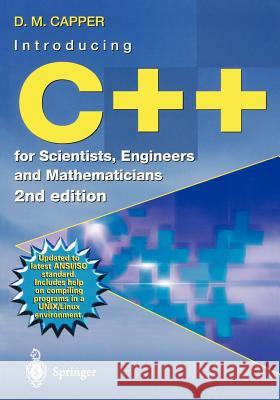
Introducing C++ for Scientists, Engineers and Mathematicians D. M. Capper Derek Capper 9781852334888 Springer - książkaWidoczna okładka, to zdjęcie poglądowe, a rzeczywista szata graficzna może różnić się od prezentowanej.

Introducing C++ for Scientists, Engineers and Mathematicians

ISBN-13: 9781852334888 / Angielski / Miękka / 2001 / 544 str.

D. M. Capper; Derek Capper
cena 282,42 zł
(netto: 268,97 VAT:  5%)

Najniższa cena z 30 dni: 269,85 zł
Termin realizacji zamówienia:
ok. 22 dni roboczych
Bez gwarancji dostawy przed świętami

Darmowa dostawa!

Since the first edition of C++ for Scientists, Engineers and Mathematicians, many things have changed. Perhaps the most important is that the ANSI C++ Standard was approved in 1998. The first edition of this book was incompatible with some parts of the Standard and every effort has been made to rectify this. The facilities offered by the C++ language have also grown enormously since the first edition. It is not just the language itself that has grown, but the ANSI Standard also defines an extensive range of library facilities. I have also made two changes in emphasis since the first edition. Firstly, since there is so much important material to cover, some less important features of the language have been removed. The second change is to try to illustrate the language by means of complete programs, rather than code fragments. Hopefully, this will give you more confidence in applying new techniques. Finally, although C++ is a bigger language than it was, it is even more fun to use.


Kategorie:
Informatyka, Programowanie
Kategorie BISAC:
Computers > Languages - C++
Computers > Programming - Compilers
Wydawca:
Springer
Język:
Angielski
ISBN-13:
9781852334888
Rok wydania:
2001
Wydanie:
2001
Ilość stron:
544
Waga:
0.92 kg
Wymiary:
24.79 x 16.81 x 3.17
Oprawa:
Miękka
Wolumenów:
01
Dodatkowe informacje:
Bibliografia
Wydanie ilustrowane

From the reviews of the first edition: "The author of this book has done an outstanding job in introducing/explaining the aspects of C++...I highly recommend this book to students or professionals in engineering who are interested in migrating to C++ from Fortran." Reviewer: A reader from Madison Heights, MI United States "This is not only the best introductory C++ book for scientists and engineers, but it is one of the best C++ books in general that I have seen." Reviewer: James Bond from New Jersey, USA "I found this book to be an excellent introduction to C++ for use in scientific computing, and it remains the best Ie seen. With it I was able to use my existing programming experience in Fortran to write useful C++ very rapidly, although it should prove to be an excellent text for people with no pervious programming experience." Reviewer: Dave Strickland from Johns Hopkins University, Baltimore

1 Introduction.- 1.1 Getting Started.- 1.2 Solving a Quadratic Equation.- 1.3 An Object-oriented Example.- 1.4 Why Object-oriented?.- 1.5 Summary.- 1.6 Exercises.- 2 The Lexical Basis of C++.- 2.1 Characters and Tokens.- 2.2 Comments and White Space.- 2.3 Identifiers.- 2.4 Keywords.- 2.5 Constants.- 2.5.1 Integer Constants.- 2.5.2 Boolean Constants.- 2.5.3 Floating Point Constants.- 2.5.4 Character Constants.- 2.5.5 String Constants.- 2.6 Operators.- 2.7 Programming Style.- 2.8 Summary.- 2.9 Exercises.- 3 Fundamental Types and Basic Operators.- 3.1 Integral Data Types.- 3.1.1 Type int.- 3.1.2 Integer Multiplication.- 3.1.3 Integer Division.- 3.1.4 Integer Modulus or Remainder Operator.- 3.1.5 Increment and Decrement Operators.- 3.1.6 Associativity and Precedence of Integer Operators.- 3.1.7 Long Integers.- 3.1.8 Short Integers.- 3.1.9 Unsigned Integers.- 3.1.10 Booleans.- 3.1.11 Character Types.- 3.2 Floating Point Data Types.- 3.2.1 Type double.- 3.2.2 Type float.- 3.2.3 Type long double.- 3.3 Changing Types.- 3.3.1 Type Promotion and Conversion.- 3.3.2 Casts.- 3.4 Some Basic Operations.- 3.4.1 The sizeof Operator.- 3.4.2 Initialization.- 3.4.3 Assignment Operators.- 3.5 const.- 3.6 typedef.- 3.7 Summary.- 3.8 Exercises.- 4 Control Structure.- 4.1 Relational Operators.- 4.2 Logical Operators.- 4.3 Equal and Not Equal Operators.- 4.4 Blocks and Scope.- 4.5 Branch Statements.- 4.5.1 if Statement.- 4.5.2 if else Statement.- 4.5.3 switch Statement.- 4.6 Iteration Statements.- 4.6.1 while Statement.- 4.6.2 for Statement.- 4.6.3 do Statement.- 4.7 break and continue Statements.- 4.8 goto Statement.- 4.9 Comma Operator.- 4.10 Null Statement.- 4.11 Conditional Expression Operator.- 4.12 Order of Evaluation of Operands.- 4.13 The Preprocessor.- 4.13.1 include Directive.- 4.13.2 define Directive.- 4.13.3 Conditional Compilation.- 4.14 Enumerations.- 4.15 Summary.- 4.16 Exercises.- 5 Functions.- 5.1Introducing Functions.- 5.1.1 Defining and Calling Functions.- 5.1.2 Return Type.- 5.1.3 Function Declarations.- 5.1.4 Functions Cannot Declare Functions.- 5.1.5 Unused Arguments.- 5.1.6 Default Arguments.- 5.1.7 Ignoring the Return Value.- 5.2 Recursion.- 5.3 Inline Functions.- 5.4 More on Scope Rules.- 5.5 Storage Class static.- 5.6 Overloading Function Names.- 5.6.1 Ambiguity Resolution.- 5.7 Function main0.- 5.8 Standard Library.- 5.9 Using Functions.- 5.9.1 A Benchmark.- 5.9.2 Root Finding by Bisection.- 5.10 Summary.- 5.11 Exercises.- 6 Pointers and Arrays.- 6.1 Memory, Addressing and Pointers.- 6.1.1 Address-of Operator.- 6.1.2 Dereferencing or Indirection Operator.- 6.1.3 Pointers.- 6.1.4 Pointers Do Not Declare Memory.- 6.1.5 Null Pointer.- 6.2 One-dimensional Arrays.- 6.2.1 Pointers and One-dimensional Arrays.- 6.3 Type void.- 6.4 Pointer Conversions.- 6.5 Multi-dimensional Arrays.- 6.5.1 Pointers and Multi-dimensional Arrays.- 6.6 Initializing Arrays.- 6.7 Size of Arrays.- 6.8 Arrays of Pointers.- 6.9 Using Pointers and Arrays.- 6.9.1 Fitting Data to a Straight Line.- 6.9.2 Ragged Arrays.- 6.10 Summary.- 6.11 Exercises.- 7 Further Pointer Techniques.- 7.1 Strings.- 7.2 Pointers as Function Arguments.- 7.3 Passing Arrays as Function Arguments.- 7.3.1 One-dimensional Arrays.- 7.3.2 Multi-dimensional Arrays.- 7.4 Arguments to main().- 7.5 Pointers to Functions.- 7.6 Dynamic Memory Management.- 7.6.1 Allocating Memory.- 7.6.2 Deallocating Memory.- 7.7 Pass by Reference and Reference Variables.- 7.7.1 Reference Arguments.- 7.7.2 Reference Return Values.- 7.7.3 Reference Variables.- 7.8 Using Pointers, Arrays and Strings.- 7.8.1 Matrix Addition.- 7.8.2 An Alphabetic Sort.- 7.9 Summary.- 7.10 Exercises.- 8 Classes.- 8.1 Declaring Classes.- 8.2 Class Access Specifiers.- 8.3 Accessing Members.- 8.4 Assigning Objects.- 8.5 Functions and Classes.- 8.6 Data Hiding.- 8.7 Returning an Object.- 8.8 Reference Arguments.- 8.9 Pointers to Members.- 8.10 Pointer-to-Member Operators.- 8.11 Scope and Data Protection.- 8.12 Static Members.- 8.12.1 Static Data Members.- 8.12.2 Static Member Functions.- 8.13 Constructor Functions.- 8.14 Accessing const Class Objects.- 8.15 Friend Functions.- 8.16 Program Structure and Style.- 8.16.1 Separate Compilation.- 8.16.2 Header Files.- 8.17 Using Classes.- 8.18 Summary.- 8.19 Exercises.- 9 Operator Overloading.- 9.1 Introducing Overloaded Operators.- 9.1.1 Overloading the Assignment Operator.- 9.1.2 The this Pointer.- 9.1.3 Overloading the Addition Operator.- 9.1.4 Overloading the Unary Minus Operator.- 9.2 User-defined Conversions.- 9.2.1 Conversion by Constructors.- 9.2.2 Conversion Functions.- 9.2.3 Implicit Conversions.- 9.3 Operator Function Calls.- 9.3.1 Binary Operators.- 9.3.2 Prefix Unary Operators.- 9.3.3 Postfix Unary Operators.- 9.4 Some Special Binary Operators.- 9.4.1 Overloading the Subscripting Operator.- 9.4.2 Overloading the Function Call Operator.- 9.5 Defining Overloaded Operators.- 9.6 Using Overloaded Operators.- 9.6.1 Complex Arithmetic.- 9.6.2 Strings.- 9.7 Summary.- 9.8 Exercises.- 10 Constructors and Destructors.- 10.1 More on Constructor Functions.- 10.1.1 Dynamic Memory Management.- 10.1.2 Assignment and Initialization.- 10.1.3 Member Objects with Constructors.- 10.2 Destructor Functions.- 10.3 Using Constructors and Destructors.- 10.3.1 Singly Linked Lists.- 10.3.2 Doubly Linked Lists.- 10.4 Summary.- 10.5 Exercises.- 11 Bitwise Operations.- 11.1 Bitwise Operators.- 11.1.1 Bitwise Complement.- 11.1.2 Bitwise AND.- 11.1.3 Bitwise Exclusive OR.- 11.1.4 Bitwise Inclusive OR.- 11.1.5 Shift Operators.- 11.1.6 Bitwise Assignment Operators.- 11.2 Bit-fields.- 11.3 Unions.- 11.4 Using Bitwise Operators.- 11.4.1 A Bit Array Class.- 11.4.2 The Sieve of Eratosthenes.- 11.4.3 Bit Representation of Integral Types.- 11.4.4 Bit Representation of Floating Point Types.- 11.5 Summary.- 11.6 Exercises.- 12 Single Inheritance.- 12.1 Derived Classes.- 12.2 virtual Functions.- 12.3 Abstract Classes.- 12.4 Class Hierarchies.- 12.5 Constructors and Destructors.- 12.6 Member Access and Inheritance.- 12.6.1 Access Specifiers.- 12.6.2 Friendship and Derivation.- 12.7 Using Single Inheritance.- 12.7.1 A Bounds Checked Array Class.- 12.7.2 A Menu Class.- 12.8 Summary.- 12.9 Exercises.- 13 Multiple Inheritance.- 13.1 Derived Classes.- 13.2 Virtual Base Classes.- 13.3 Constructors and Destructors.- 13.4 Member Access Ambiguities.- 13.5 Using Multiple Inheritance.- 13.6 Summary.- 13.7 Exercises.- 14 Namespaces.- 14.1 Name Clashes.- 14.2 Creating a Namespace.- 14.3 Accessing Namespace Members.- 14.4 More on Creating Namespaces.- 14.5 Namespace Aliases.- 14.6 The using Directive.- 14.7 The using Declaration.- 14.8 The Standard Library.- 14.9 Unnamed Namespaces.- 14.10 Using Namespaces.- 14.11 Summary.- 14.12 Exercises.- 15 Exception Handling.- 15.1 Errors.- 15.2 Introducing throw, try and catch.- 15.3 Throwing a Fundamental Type.- 15.4 Extracting Information from a catch.- 15.5 Catching Everything.- 15.6 Derived Error Classes.- 15.7 Exception Specifications.- 15.8 Uncaught Exceptions.- 15.9 Dynamic Memory Allocation.- 15.10 Using Exception Handling.- 15.11 Summary.- 15.12 Exercises.- 16 Templates.- 16.1 Function Templates.- 16.2 Class Templates.- 16.3 Static Members.- 16.4 Class Templates and Functions.- 16.5 Function Template Arguments.- 16.6 Template Parameters.- 16.7 Templates and Friends.- 16.8 Specialized Templates.- 16.9 Member Function Specialization.- 16.10 Program Structure.- 16.11 Using Templates.- 16.12 Summary.- 16.13 Exercises.- 17 Standard Library.- 17.1 Introduction.- 17.2 Library Categories.- 17.2.1 Language Support.- 17.2.2 Diagnostics.- 17.2.3 General Utilities.- 17.2.4 Strings.- 17.2.5 Localization.- 17.2.6 Containers.- 17.2.7 Iterators.- 17.2.8 Algorithms.- 17.2.9 Numerics.- 17.3 Using the Standard Library.- 17.3.1 Complex Arithmetic.- 17.3.2 Boolean Arrays.- 17.4 Summary.- 17.5 Exercises.- 18 Input and Output.- 18.1 Introduction.- 18.2 Input and Output Classes.- 18.3 Output.- 18.3.1 Unformatted Output.- 18.4 Input.- 18.4.1 Unformatted Input.- 18.5 Flags, Manipulators and Formatting.- 18.6 File Input and Output.- 18.7 Assigning Streams.- 18.8 Stream Condition.- 18.9 User-defined Types.- 18.10 Using Input and Output.- 18.11 Summary.- 18.12 Exercises.- Appendix—A The ASCII Character Codes.- Appendix—B Operators.- Appendix—C Differences between C and C++.


Udostępnij

Facebook - konto krainaksiazek.pl


Opinie o Krainaksiazek.pl na Opineo.pl

Partner Mybenefit

Krainaksiazek.pl w programie rzetelna firma Krainaksiaze.pl - płatności przez paypal

Czytaj nas na:

Facebook - krainaksiazek.pl
  • książki na zamówienie
  • granty
  • książka na prezent
  • kontakt
  • pomoc
  • opinie
  • regulamin
  • polityka prywatności

Zobacz:

  • Księgarnia czeska

  • Wydawnictwo Książkowe Klimaty

1997-2025 DolnySlask.com Agencja Internetowa

© 1997-2022 krainaksiazek.pl
     
KONTAKT | REGULAMIN | POLITYKA PRYWATNOŚCI | USTAWIENIA PRYWATNOŚCI
Zobacz: Księgarnia Czeska | Wydawnictwo Książkowe Klimaty | Mapa strony | Lista autorów
KrainaKsiazek.PL - Księgarnia Internetowa

Polityka prywatnosci - link
Krainaksiazek.pl - płatnośc Przelewy24
Przechowalnia Przechowalnia





