International Handbook of Mathematical Learning Difficulties: From the Laboratory to the Classroom » książka





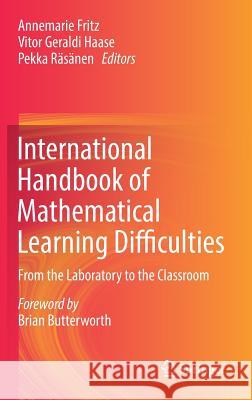
International Handbook of Mathematical Learning Difficulties: From the Laboratory to the Classroom
ISBN-13: 9783319971476 / Angielski / Twarda / 2019 / 843 str.
International Handbook of Mathematical Learning Difficulties: From the Laboratory to the Classroom
ISBN-13: 9783319971476 / Angielski / Twarda / 2019 / 843 str.
(netto: 1086,08 VAT: 5%)
Najniższa cena z 30 dni: 963,86
ok. 16-18 dni roboczych.
Darmowa dostawa!
This comprehensive volume provides teachers, researchers and education professionals with cutting edge knowledge developed in the last decades by the behavioral sciences, integrating cognitive, developmental and socioeconomic approaches to deal with the problems children face in learning mathematics.
Section 1: Development of number understanding: different theoretical perspectives
Chapter 1: Neurocognitive perspective on numerical development
Chapter 2: Everyday context and mathematics learning: on the role on spontaneous mathematical focusing tendencies in the development of numeracy
Chapter 3: Competence Models as a Basis for Defining, Understanding, and Diagnosing Students’ Mathematical Competences
Chapter 4: Mathematical performance amongst the poor: Comparative performance across developing countriesChapter 5: Didactics as source and remedy of mathematics learning difficulties
Chapter 6: Section 1 Discussion - Development of number understanding: different theoretical perspectives
Section 2: Mathematics learning and its difficulties around the world
Chapter 7: Special needs education in mathematics: The case of Nordic countries
Chapter 8: Math learning and its difficulties in the Middle European countries
Chapter 9: Mathematics learning and its difficulties in Eastern European countriesChapter 10: Maths Learning and its Difficulties in Southern European Countries
Chapter 11: Mathematics Learning Difficulties in the United States: Current Issues in Screening and Intervention
Chapter 12: Latin-American Countries
Chapter 13: Mathematics Learning and its difficulties: the cases of Chile and Uruguay
Chapter 14: Mathematical inclusion in Southern Africa
Chapter 15: Math Learning Difficulties in Australia
Chapter 16: Mathematical learning and the difficulties in Taiwan: insights from educational practice
Chapter 17: Maths Learning and its Difficulties in Israel
Chapter 18: Learning Difficulties and Disabilities in Mathematics: Indian ScenarioChapter 19: Discussion of Section 2: Math learning difficulties around the world
Section 3: Mathematical learning difficulties and its cognitive, motivational and emotional underpinnings
Chapter 20: Neurobiological origins of mathematical learning disabilities or dyscalculia: A review of brain imaging data
Chapter 21: Genetics of Dyscalculia 1: In search of genes
Chapter 22: Genetics of dyscalculia 2: In search of endophenotypes
Chapter 23: Comorbidity and differential diagnosis of dyscalculia and ADHD
Chapter 24: Working memory and mathematical learning
Chapter 25: The relation between spatial reasoning and mathematics achievement in children with mathematics learning difficulties
Chapter 26: The language dimension of mathematical difficulties
Chapter 27: Motivational and math anxiety perspective for mathematical learning and learning difficulties.
Chapter 28: MATH & EMOTIONS: THE CASE OF MATH ANXIETY
Chapter 29: Cognitive and Motivational Underpinnings of Mathematical Learning Difficulties: A DiscussionSection 4: Understanding the basics: building conceptual knowledge and characterizing obstacles to the development of arithmetic skills
Chapter 30: Counting and Basic Numerical Skills
Chapter 31: Multi-digit Addition, Subtraction, Multiplication, and Division Strategies
Chapter 32: Development of a sustainable place value understanding
Chapter 33: Using Schema-Based Instruction to Improve Students’ Mathematical Word Problem Solving PerformanceChapter 34: Geometry
Chapter 35: Understanding Rational Numbers – Obstacles for Learners With and Without Mathematical Learning Difficulties
Section 5: Mathematical learning difficulties: Approaches to recognition and intervention
Chapter 36: Assessing mathematical competence and performance: Quality characteristics, approaches, and research trends
Chapter 37: Diagnostics of dyscalculia
Chapter 38: Three Frameworks for Assessing Responsiveness to Instruction as a Means of Identifying Mathematical Learning DisabilitiesChapter 39: Technology-based diagnostic assessments for identifying early learning difficulties in mathematics
Chapter 40: Small group interventions for children aged 5-9 years old with learning difficulties in mathematics
Chapter 41: Perspectives to technology-enhanced-learning and teaching in mathematical learning difficulties
Chapter 42: Executive Function and Early Math Learning Difficulties
Chapter 43: Children’s mathematical difficulties: some contributory factors and interventions
Chapter 44: Beyond the "third method" for the assessment of developmental dyscalculia. Implications for research and practice.Chapter 45: Challenges and future perspectives
Annemarie Fritz-Stratmann is full professor of Psychology at the University of Duisburg-Essen, Germany, where she runs a research and counseling center for children with learning difficulties. She received a PhD in Psychology from the University of Cologne and has habilitation in psychology of special education and rehabilitation from the University of Dortmund. Since 2015 she is Distinguished Visiting professor at the University of Johannesburg. In the past 25 years her research turned to children with mathematical learning difficulties. Here, the focus of her scientific work was the empirical validation of a development model of key numerical concepts and arithmetic skills from age 4 to 8. Based on this model some diagnostic assessments (MARKO-Series) and training programs for pre-school and elementary school-children were developed. Recently her Dr. Fritz extended her interests to mathematical problems in secondary education and on math anxiety. She acts as a consultant to several scientific journals.
Vitor Geraldi Haase is full professor of Psychology at the Federal University of Minas Gerais (UFMG), Brazil. He graduated in medicine, did his medical residency in pediatric neurology, has an M.A. in applied linguistics and a Ph.D. in medical psychology (Ludwig-Maximilians-Universität zu München). Working at UFMG since 1995, he heads the Laboratory for Developmental Neuropsychology and Número, a clinic for math learning difficuties. He has been doing clinical work and research on numerical cognition applied to math learning difficulties for the last 10 years. The main focus of this research is the characterization of the molecular-genetic variability underlying the cognitive mechanisms associated with math learning difficulties and math anxiety. Dr. Haase is the author of more than 85 scientific articles and 42 book chapters; editor of three multi-authored books and consultant to several scientific journals. He has a research productivity grant from the Brazilian Council of Scientific and Technological Research (CNPq).
Pekka Räsänen is a clinical neuropsychologist and a principal investigator in Niilo Mäki Institute, Jyväskylä, Finland. After his graduation he has worked as a junior researcher in the Finnish Academy of Science, and as an interim associate professor of psychology in the University of Lapland. Since 1997 he has worked as a researcher and as an executive vice director in the Niilo Mäki Institute, which is the largest and most influential research unit on learning disabilities in Finland offering also clinical services, further education and a publication unit. The main focus of his research has been assessment and interventions of mathematical learning disabilities. He has written and co-authored over 50 academic publications and developed most of the standardised tests of mathematical disabilities used in Finland. He has also conducted studies on early grade mathematics learning in sub-Saharan Africa and Latin America. Together with his colleagues, he has developed intervention programs on language and mathematics for early education, as well as adaptive computer-assisted tests and rehabilitation programs for mathematical learning disabilities.
This comprehensive volume provides teachers, researchers and education professionals with cutting edge knowledge developed in the last decades by the educational, behavioural and neurosciences, integrating cognitive, developmental and socioeconomic approaches to deal with the problems children face in learning mathematics.
The neurocognitive mechanisms and the cognitive processes underlying acquisition of arithmetic abilities and their significance for education have been the subject of intense research in the last few decades, but the most part of this research has been conducted in non-applied settings and there’s still a deep discrepancy between the level of scientific knowledge and its implementation into actual educational settings. Now it’s time to bring the results from the laboratory to the classroom. Apart from bringing the theoretical discussions to educational settings, the volume presents a wide range of methods for early detection of children with risks in mathematics learning and strategies to develop effective interventions based on innovative cognitive test instruments. It also provides insights to translate research knowledge into public policies in order to address socioeconomic issues. And it does so from an international perspective, dedicating a whole section to the cultural diversity of mathematics learning difficulties in different parts of the world.All of this makes the International Handbook of Mathematical Learning Difficulties an essential tool for those involved in the daily struggle to prepare the future generations to succeed in the global knowledge society.




Czytaj nas na:
1997-2026 DolnySlask.com Agencja Internetowa
KrainaKsiazek.PL - Księgarnia Internetowa


