• Wyszukiwanie zaawansowane
  • Kategorie
  • Kategorie BISAC
  • Książki na zamówienie
  • Promocje
  • Granty
  • Książka na prezent
  • Opinie
  • Pomoc
  • Załóż konto
  • Zaloguj się

Interior Detailing: Concept to Construction » książka


zaloguj się | załóż konto
Logo Krainaksiazek.pl

koszyk

konto

szukaj
topmenu
Księgarnia internetowa
Szukaj
Książki na zamówienie
Promocje
Granty
Książka na prezent
Moje konto
Pomoc
 
 
Wyszukiwanie zaawansowane
Pusty koszyk
Bezpłatna dostawa dla zamówień powyżej 20 złBezpłatna dostawa dla zamówień powyżej 20 zł

Kategorie główne

• Nauka
 [2949965]
• Literatura piękna
 [1857847]

  więcej...
• Turystyka
 [70818]
• Informatyka
 [151303]
• Komiksy
 [35733]
• Encyklopedie
 [23180]
• Dziecięca
 [617748]
• Hobby
 [139972]
• AudioBooki
 [1650]
• Literatura faktu
 [228361]
• Muzyka CD
 [398]
• Słowniki
 [2862]
• Inne
 [444732]
• Kalendarze
 [1620]
• Podręczniki
 [167233]
• Poradniki
 [482388]
• Religia
 [509867]
• Czasopisma
 [533]
• Sport
 [61361]
• Sztuka
 [243125]
• CD, DVD, Video
 [3451]
• Technologie
 [219309]
• Zdrowie
 [101347]
• Książkowe Klimaty
 [123]
• Zabawki
 [2362]
• Puzzle, gry
 [3791]
• Literatura w języku ukraińskim
 [253]
• Art. papiernicze i szkolne
 [7933]
Kategorie szczegółowe BISAC

Interior Detailing: Concept to Construction

ISBN-13: 9780470504970 / Angielski / Twarda / 2010 / 304 str.
David Kent Ballast
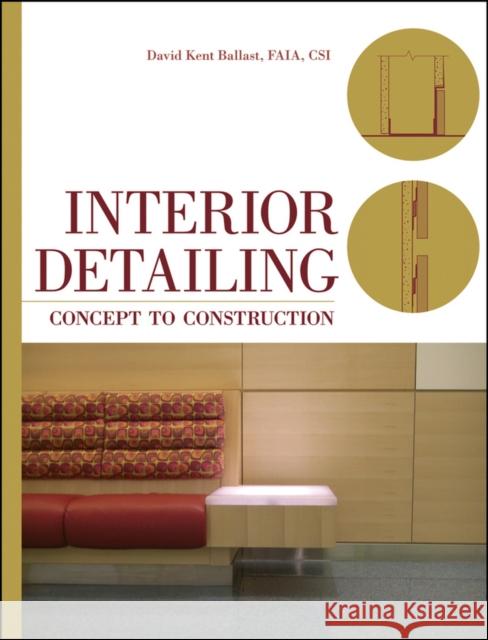
Interior Detailing: Concept to Construction Ballast, David Kent 9780470504970 John Wiley & Sons Inc - książkaWidoczna okładka, to zdjęcie poglądowe, a rzeczywista szata graficzna może różnić się od prezentowanej.

Interior Detailing: Concept to Construction

ISBN-13: 9780470504970 / Angielski / Twarda / 2010 / 304 str.

David Kent Ballast
cena 394,30
(netto: 375,52 VAT:  5%)

Najniższa cena z 30 dni: 391,06
Termin realizacji zamówienia:
ok. 30 dni roboczych
Bez gwarancji dostawy przed świętami

Darmowa dostawa!

The all-in-one interior detailing guide that unites creative and technical aspects A well-executed interior space requires the successful combination of the creative and the technical. Interior Detailing bridges the gap between design and construction, and shows how to develop and transform design concepts into details that meet the constraints, functional requirements, and constructability issues that are part of any interior design element. It offers guidance on how design professionals can combine imaginative thinking and the application of technical resources to create interiors that are aesthetically pleasing, functionally superior, and environmentally sound. Interior Detailing

  • Includes 150 easy-to-understand details showing how to logically think through the design and development of an assembly so that it conforms to the designer's intent and meets the practical requirements of good construction
  • Describes how to solve any detailing design problem in a rational way
  • Contains conceptual and practical approaches to designing and detailing construction components thatform interior spaces
  • Shows how a small number of principles can be used to solve nearly any detailing problem
This guide covers the subject of interior spaces comprehensively by balancing the contributions of physical beauty and structural integrity in one complete volume. By following the principles laid out in this book, interior designers and architects can plan for the construction of a unique interior environment more thoughtfully and with a clearer, better-defined purpose.

Kategorie:
Sztuka, Architektura
Kategorie BISAC:
Architecture > Interior Design - General
Architecture > Design, Drafting, Drawing & Presentation
Wydawca:
John Wiley & Sons Inc
Język:
Angielski
ISBN-13:
9780470504970
Rok wydania:
2010
Ilość stron:
304
Waga:
1.01 kg
Wymiary:
27.94 x 22.1 x 2.03
Oprawa:
Twarda
Wolumenów:
01
Dodatkowe informacje:
Bibliografia
Wydanie ilustrowane

List of Tables.

List of Illustrations.

Preface.

Acknowledgments.

Introduction.

How SI Units Are Used in This Book.

PART 1 ROADMAP TO SOLVING DETAILING PROBLEMS.

1 THE DESIGN/DETAILING PROCESS.

1–1 Introduction.

1–2 What Is Detailing?

Detailing as a Wicked Problem.

1–3 The Drawing–Thinking–Drawing Cycle.

1–4 Process Tools and Techniques.

Process Tools.

Practical Tips.

1–5 Detailing Components and Process.

The Four Aspects of Detailing.

The Detailing Process.

Example.

1–6 Three Purposes of a Detail.

Contributes to Design Concept.

Resolves Problems of Connection or Transition.

Coordinates with Adjacent Construction.

1–7 Programmatic Concepts versus Design Concepts.

2 CONSTRAINTS.

2–1 Introduction.

2–2 Substrates and Adjacent Construction.

Substrate Material.

Substrate Condition.

Substrate Size and Position.

Substrate Space.

2–3 Regulatory Requirements.

Fire Tests for Finish Materials.

Fire Tests for Construction Assemblies.

2–4 Budget.

2–5 Time.

2–6 Climate.

2–7 Local Labor Conditions and Trade Practices.

2–8 Industry Standards.

2–9 Materials.

Aesthetic Qualities.

Function.

Safety and Health.

Durability.

Maintainability.

Cost and Delivery Time.

Sustainability.

3 FUNCTION.

3–1 Introduction.

3–2 Concealment and Finish.

Covering Substrates.

Covering Joints and Connections.

Hiding Mechanical and Electrical Services.

3–3 Human Fit/Object Fit.

Base Dimensions on Human Size and Reach or Object Size.

Recognize Differences in Age, Height, Abilities.

Provide Adjustable Details.

Provide Alternate Fits.

3–4 Safety: Protection from Accidental Harm.

Use Nonslip Flooring.

Avoid Sharp Edges Close to Human Contact.

Provide Handrails and Guards When Necessary.

Design Stairs Correctly.

Mark Full–Height Glass.

Avoid Single Steps.

Avoid Slight Change of Level.

Use Nontoxic Materials.

3–5 Security: Protection from Intentional Harm.

Use Locks, Detection, and Intrusion Alarms as Appropriate.

Design Physical Barriers for the Level of Security Required.

Use Electronic Surveillance When Required.

Use Ballistic–Resistant Assemblies.

Devise Space Plan for Supervision.

3–6 Sustainability.

Detail with Materials That Incorporate as Little Embodied Energy as Possible.

Use Renewable Materials.

Use Materials with High Recycled Content.

When Possible, Use Products or Design Details That Can Reduce Energy Consumption.

Use Local Materials.

Use Materials with Low or No VOCs.

Use Materials with Low Toxicity.

Design Details and Select Materials to Minimize Moisture Problems.

Use Durable Materials and Details.

Design Details to Simplify Maintenance.

Specify Materials and Design Details to Maximize Recycling Potential.

Design Details for Reusability.

3–7 Change and Relocatability.

Design for Relocating the Detail with the Same User.

Detail for the Same Function but with a Change in Users.

Detail for a Change of Function of the Space with Different Users.

3–8 Fire Resistance.

Use Noncombustible Materials in Details.

Limit the Amount of Flammable Materials.

Use Applied Fire Retardants When Required.

Use Only Tested and Rated Assemblies and Materials.

Use Listed or Labeled Components.

3–9 Acoustical Control.

Noise Control and Reverberation.

Transmission Control.

Vibration and Impact Noise Control.

3–10 Moisture/Water Resistance.

Use Nonabsorbent Materials.

Use Nonferrous Metals.

Eliminate or Minimize Joints.

Employ Overlap.

Use Drips.

Use the Correct Sealant and Joint Design.

4 CONSTRUCTABILITY.

4–1 Introduction.

4–2 Structural Requirements.

Basic Concepts of Structure.

Use Simple Direct Bearing Connections Whenever Possible.

Incorporate Beam Action.

Use the Simplest Connections Possible.

Use Redundant Connections or Bearing When Required.

Use Structural Connections Approved by the Manufacturer.

Use Removable Connections for Reuse Potential.

4–3 Connections.

Use the Appropriate Method for Rigid Connections.

Determine Movable Connection Type Based on Use.

Minimize Number and Types of Connections.

Make Connections Accessible.

4–4 Movement.

Use Acclimated Materials.

Use Relieved Backs on Wood.

Use Control Joints.

Provide Expansion Joints.

Use Sliding/Overlapping Joints.

Use Slip Joints.

Use Building Expansion Joints.

Provide Clear Space.

4–5 Tolerances.

Provide Shim Space.

Provide Scribe.

Use Reveals.

Use Offsets.

Use Filler Strips.

Use Sliding or Overlapping Fit.

Use Adjustable Connections.

Give Adequate Clearance and Incorporate Intermediate Attachments.

4–6 Clearances.

Allow Space for Working and Assembly.

Provide Space for Installation of Pieces.

Allow for Tolerances.

4–7 Durability.

Self–Durable.

Applied Protection.

4–8 Maintainability.

Cleanability.

Adjustability.

Repair and Replacement.

4–9 Construction Process.

Number of Parts.

Sequence.

Trade Division of Labor.

Off–Shelf versus Custom Parts.

Shop versus Field Fabricated.

PART 2 ELEMENTS.

5 DIVIDING AND CREATING SPACE WITH PERMANENT BARRIERS.

5–1 Introduction.

5–2 Element Concepts.

5–3 Function.

5–4 Constraints.

5–5 Coordination.

Tolerance Coordination.

5–6 Methods.

Planar.

Panelized.

Barriers with Openings.

Translucent.

Partial Height.

Thick.

6 DIVIDING AND CREATING SPACE WITH TEMPORARY BARRIERS.

6–1 Introduction.

6–2 Element Concepts.

6–3 Function.

6–4 Constraints.

6–5 Coordination.

6–6 Methods.

Full Height.

Partial Height.

7 OVERHEAD LIMITS—CEILINGS.

7–1 Introduction.

7–2 Element Concepts.

7–3 Function.

7–4 Constraints.

7–5 Coordination.

Sprinkler Spacing.

HVAC Coordination.

Tolerance Coordination.

7–6 Methods.

Closed.

Open.

8 THE GROUND PLANE—FLOORS, STAIRS, AND RAMPS.

8–1 Introduction.

8–2 Element Concepts.

Flooring.

Stairs.

Ramps.

8–3 Function.

8–4 Constraints.

Fire Resistance of Floor Finishes.

Fire Resistance of Structural Flooring Components.

Slip Resistance and Tripping.

Accessibility.

Code Requirements.

8–5 Coordination.

Tolerance Coordination.

Light Reflectance and Acoustic Coordination.

8–6 Methods.

Flooring.

Handrails, Guards, and Stairways.

9 SPATIAL CONNECTION—OPENINGS, DOORS, AND GLAZING.

9–1 Introduction.

9–2 Element Concepts.

Openings.

Doors.

Glazing.

Window Covering.

9–3 Function.

9–4 Constraints.

9–5 Coordination.

9–6 Methods.

Doors.

Glazed Openings.

Window Coverings.

PART 3 TRANSITIONS.

10 WALL TRANSITIONS.

10–1 Introduction.

10–2 Connections of Major Elements.

10–3 Wall to Floor.

Standard Bases.

Featured Bases.

Component Bases.

10–4 Wall to Ceiling.

Standard Ceiling Transitions.

Structural Transitions.

Planar Transitions.

11 PLANAR TRANSITIONS.

11–1 Partition to Partition.

In–Plane Transitions.

Plain Offsets.

Interrupted Offsets.

11–2 Floor to Floor.

In–Plane Transitions.

Plain Offset Floors.

Interrupted Offset.

11–3 Ceiling to Ceiling.

In–Plane Transitions.

Offset Transitions.

12 STRUCTURAL TRANSITIONS.

12–1 Introduction.

12–2 Columns.

Column–to–Ceiling Transitions.

Column–to–Floor Transitions.

Column–to–Beam Transitions.

12–3 Beams.

Beam–to–Partition Transitions.

Beam–to–Ceiling Transitions.

Beam–to–Beam Transitions.

12–4 Suspended Objects.

Thin Supports.

Clamps.

Thick Supports.

Rigid Supports.

Appendix A: Resources.

Appendix B: Industry Standards for Interior Materials and Products.

Index.

DAVID KENT BALLAST, FAIA, CSI, a registered architect, has owned Architectural Research Consulting since 1981. The consulting firm provides applied research, technical advice, specifications, and information management services to architects, interior designers, and others in the construction industry. From 1987 to 2008, Ballast was an instructor in interior construction, CAD, and basic drafting at Arapahoe Community College. He is the author of a number of books on construction technology, including Handbook of Construction Tolerances, Second Edition, and Architect′s Handbook of Construction Detailing, Second Edition, both published by Wiley.

The all–in–one interior detailing guide that unites creative and technical aspects

A well–executed interior space requires the successful combination of the creative and the technical. Interior Detailing bridges the gap between design and construction, and shows how to develop and transform design concepts into details that meet the constraints, functional requirements, and constructability issues that are part of any interior design element. It offers guidance on how design professionals can combine imaginative thinking and the application of technical resources to create interiors that are aesthetically pleasing, functionally superior, and environmentally sound. Interior Detailing:

  • Includes 150 easy–to–understand details showing how to logically think through the design and development of an assembly so that it conforms to the designer′s intent and meets the practical requirements of good construction

  • Describes how to solve any detailing design problem in a rational way

  • Contains conceptual and practical approaches to designing and detailing construction components thatform interior spaces

  • Shows how a small number of principles can be used to solve nearly any detailing problem

This guide covers the subject of interior spaces comprehensively by balancing the contributions of physical beauty and structural integrity in one complete volume. By following the principles laid out in this book, interior designers and architects can plan for the construction of a unique interior environment more thoughtfully and with a clearer, better–defined purpose.


Udostępnij

Facebook - konto krainaksiazek.pl


Opinie o Krainaksiazek.pl na Opineo.pl

Partner Mybenefit

Krainaksiazek.pl w programie rzetelna firma Krainaksiaze.pl - płatności przez paypal

Czytaj nas na:

Facebook - krainaksiazek.pl
  • książki na zamówienie
  • granty
  • książka na prezent
  • kontakt
  • pomoc
  • opinie
  • regulamin
  • polityka prywatności

Zobacz:

  • Księgarnia czeska

  • Wydawnictwo Książkowe Klimaty

1997-2025 DolnySlask.com Agencja Internetowa

© 1997-2022 krainaksiazek.pl
     
KONTAKT | REGULAMIN | POLITYKA PRYWATNOŚCI | USTAWIENIA PRYWATNOŚCI
Zobacz: Księgarnia Czeska | Wydawnictwo Książkowe Klimaty | Mapa strony | Lista autorów
KrainaKsiazek.PL - Księgarnia Internetowa

Polityka prywatnosci - link
Krainaksiazek.pl - płatnośc Przelewy24
Przechowalnia Przechowalnia





