• Wyszukiwanie zaawansowane
  • Kategorie
  • Kategorie BISAC
  • Książki na zamówienie
  • Promocje
  • Granty
  • Książka na prezent
  • Opinie
  • Pomoc
  • Załóż konto
  • Zaloguj się

Interaction, Evolution and Chaos in Space » książka


zaloguj się | załóż konto
Logo Krainaksiazek.pl

koszyk

konto

szukaj
topmenu
Księgarnia internetowa
Szukaj
Książki na zamówienie
Promocje
Granty
Książka na prezent
Moje konto
Pomoc
 
 
Wyszukiwanie zaawansowane
Pusty koszyk
Bezpłatna dostawa dla zamówień powyżej 20 złBezpłatna dostawa dla zamówień powyżej 20 zł

Kategorie główne

• Nauka
 [2949965]
• Literatura piękna
 [1857847]

  więcej...
• Turystyka
 [70818]
• Informatyka
 [151303]
• Komiksy
 [35733]
• Encyklopedie
 [23180]
• Dziecięca
 [617748]
• Hobby
 [139972]
• AudioBooki
 [1650]
• Literatura faktu
 [228361]
• Muzyka CD
 [398]
• Słowniki
 [2862]
• Inne
 [444732]
• Kalendarze
 [1620]
• Podręczniki
 [167233]
• Poradniki
 [482388]
• Religia
 [509867]
• Czasopisma
 [533]
• Sport
 [61361]
• Sztuka
 [243125]
• CD, DVD, Video
 [3451]
• Technologie
 [219309]
• Zdrowie
 [101347]
• Książkowe Klimaty
 [123]
• Zabawki
 [2362]
• Puzzle, gry
 [3791]
• Literatura w języku ukraińskim
 [253]
• Art. papiernicze i szkolne
 [7933]
Kategorie szczegółowe BISAC

Interaction, Evolution and Chaos in Space

ISBN-13: 9783642775116 / Angielski / Miękka / 2012 / 278 str.
Peter Nijkamp; Aura Reggiani
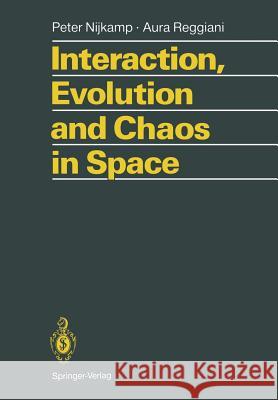
Interaction, Evolution and Chaos in Space Peter Nijkamp Aura Reggiani 9783642775116 Springer - książkaWidoczna okładka, to zdjęcie poglądowe, a rzeczywista szata graficzna może różnić się od prezentowanej.

Interaction, Evolution and Chaos in Space

ISBN-13: 9783642775116 / Angielski / Miękka / 2012 / 278 str.

Peter Nijkamp; Aura Reggiani
cena 403,47 zł
(netto: 384,26 VAT:  5%)

Najniższa cena z 30 dni: 385,52 zł
Termin realizacji zamówienia:
ok. 22 dni roboczych
Bez gwarancji dostawy przed świętami

Darmowa dostawa!

For many decades scholars from various disciplines have been intrigued by the question whether there are unifying principles or models that have a validity in different disciplines. The building of such analytical frameworks bridging the gaps between scientific traditions is a very ambitious task and has not been very successful up till now. In the past - in a static context - several such principles have been defined and advocated at the edge of the natural sciences on the one hand and social sciences (in particular, economics and geography) on the other hand, mainly based on the paradigm of 'social physics'. Some important contributions to the integration of the spatial systems sciences and physics can be found in gravity theory and entropy theory, which have formed the comer stones of interaction models in space. This book is about spatial interaction models. It describes the origin, the history and the correspondence of such models from a 'social physics' perspective. It is emphasized that such models need a clear behavioural underpinning as a sine qua non for a valid use in spatial systems analysis. This view also explains the use of micro-based disaggregate choice models as a tool for analyzing spatial systems. This is mainly analyzed in Part A of this book.


Kategorie:
Nauka, Ekonomia i biznes
Kategorie BISAC:
Business & Economics > Economics - General
Science > Earth Sciences - Geography
Business & Economics > Urban & Regional
Wydawca:
Springer
Język:
Angielski
ISBN-13:
9783642775116
Rok wydania:
2012
Wydanie:
Softcover Repri
Ilość stron:
278
Waga:
0.51 kg
Wymiary:
24.2 x 17.0
Oprawa:
Miękka
Wolumenów:
01

A Static Models of Spatial Interaction.- 1. Spatial Interaction Models and Gravity Theory a Concise Overview.- 1.1 Introduction.- 1.2 Gravity Analysis and Spatial Interaction Models.- 1.3 Gravity Theory and the Social Sciences.- 1.4 Alternative Utility Foundations and Specifications of Gravity Theory.- 1.4.1 Simple interaction theory.- 1.4.2 System-wide cost efficiency.- 1.4.3 Aggregate utility theory.- 1.5 The Scope of Gravity Models: Concluding Remarks.- 2. Entropy Theory and Spatial Interaction Analysis.- 2.1 Prologue.- 2.2 Entropy Theory and Spatial Interaction.- 2.3 Alternative Specifications of the Entropy Model.- 2.4 Alternative Theoretical Backgrounds of the Entropy Model.- 2.4.1 An economic utility approach.- 2.4.2 A probabilistic utility approach.- 2.4.3 Statistical information theory.- 2.4.4 Bayesian statistics.- 2.4.5 Maximum likelihood approach.- 2.5 Concluding Remarks.- 3. Entropy and Generalized Cost Minimization Models at the Macro Level.- 3.1 Prologue.- 3.2 Entropy and Linear Programming.- 3.3 Entropy and Geometric Programming.- 3.4 Spatial Patterns of Entropy and Linear Programming Models.- 3.5 Entropy Revisited.- 3.6 Concluding Remarks.- Annex 3A. Relationships Between Total Trip Costs and the Cost Friction Coefficient.- 4. Spatial interaction models and utility maximizing Behaviour at the micro level.- 4.1 Prologue.- 4.2 Spatial Interaction Behaviour and Individual Choice Behaviour: Theory.- 4.2.1 Introduction.- 4.2.2 Spatial interaction models and deterministic utility theory.- 4.2.3 Spatial interaction models and random utility theory.- 4.2.3.1 Basic concepts of random utility theory.- 4.2.3.2 Analogies between spatial interaction models and discrete choice models.- 4.2.4 Concluding remarks.- 4.3 Spatial Interaction Behaviour and Individual Choice Theory: An Application.- 4.3.1 Introduction.- 4.3.2 The model.- 4.3.3 The data.- 4.3.4 Results and concluding remarks.- 4.4 Conclusions.- Annex 4A. An Algorithm for Modal Split Choice with Congestion.- B Dynamic Models of Spatial Interaction.- 5. Dynamic and Stochastic Spatial Interaction Models.- 5.1 Prologue.- 5.2 Spatial Interaction Models Analyzed by Means of Optimal Control.- 5.2.1 Introduction.- 5.2.2 An optimal control approach.- 5.2.3 Concluding remarks.- 5.3 Spatial Interaction Models Analyzed by Means of Stochastic Optimal Control.- 5.3.1 Introduction.- 5.3.2 A stochastic optimal control approach.- 5.3.3 Concluding remarks.- 5.4 Spatial Interaction Models with Catastrophe Behaviour Analyzed in the Framework of Stochastic Optimal Control.- 5.4.1 The model.- 5.4.2 The stochastic optimal control version.- 5.5 Epilogue.- Annex 5A. The Generalized Spatial Interaction Model as a Solution to the Optimal Control Entropy Model.- Annex 5B. A (Generalized) Stochastic Spatial Interaction Model as a Solution to a Stochastic Optimal Control Problem.- Annex 5C. Stability and Bifurcations in a Phase Diagram Analysis for a Stochastic Optimal Control Problem.- 6 Spatial Modelling and Chaos Theory.- 6.1 Prologue.- 6.2 Chaos Theory: A Brief Review.- 6.2.1 A general introduction to non-linear modeling.- 6.2.2 Key issues in the theory of chaos.- 6.3 Spatial Applications of Chaos Theory: A Brief Survey.- 6.3.1 Introduction.- 6.3.2 Dendrinos.- 6.3.3 Dendrinos and Sonis.- 6.3.4 Mosekilde, Aracil and Allen.- 6.3.5 Nijkamp.- 6.3.6 Reiner, Munz, Haag and Weidlich.- 6.3.7 White.- 6.3.8 Zhang.- 6.3.9 Concluding remarks.- 6.4 A Model of Chaos for Spatial Interaction and Urban Dynamics.- 6.4.1 Introduction.- 6.4.2 Results of simulation experiments.- 6.4.2.1 The onset of chaotic motion.- 6.4.2.2 Chaotic urban evolution.- 6.4.3 Concluding remarks.- 6.5 Epilogue.- Annex 6A. Classification of Two-dimensional Critical Points.- Annex 6B. Strange Attractors: A Brief Overview.- Annex 6C. Steady State Solutions for a Generalized Lorenz System.- 7. Spatial Interaction Models and Chaos Theory.- 7.1 Prologue.- 7.2 Chaos in Spatial Interaction Models.- 7.2.1 Introduction.- 7.2.2 Chaotic elements in dynamic logit model: theory.- 7.2.3 Simulation experiments for a dynamic logit model.- 7.2.3.1 Dynamic processes in logit models.- 7.2.3.2 Dynamic processes in spatial interaction models.- 7.2.4 Concluding remarks.- 7.3 Delay Effects in Dynamic (Binary) Logit Models.- 7.3.1 Introduction.- 7.3.2 A logistic model with multiple delays.- 7.3.3 Concluding remarks.- 7.4 Conclusions.- Annex 7A. Stability Solutions for a Dynamic Logit Model.- Annex 7B. Stability Solutions for a Dynamic Spatial Interaction Model.- 8. Spatial Interaction Analysis and Ecologically-Based Models.- 8.1 Prologue.- 8.2 Prey-Predator Models: Introduction.- 8.3 Synergetic Models of Spatial Interaction.- 8.4 An Optimal Control Model for a Spatial Prey-Predator System.- 8.4.1 Introduction.- 8.4.2 Equilibrium analysis.- 8.4.3 Concluding remarks.- 8.5 Competition Models: Introduction.- 8.6 Impact of Chaotic Evolution in Spatial Competition.- 8.6.1 Introduction.- 8.6.2 The case of two competing regions.- 8.6.2.1 Equilibrium analysis.- 8.6.2.2 Simulation experiments.- 8.6.3 Concluding remarks.- 8.7 Epilogue.- Annex 8A. Stability Solutions for an Optimal Control Prey-Predator Problem.- Annex 8B. Transformation of a Continuous System into a Discrete System.- Annex 8C. Stability Analysis for a Particular Competing System.- 9. Retrospect and Prospect.- 9.1 Retrospect.- 9.2 Typology of Dynamic Spatial Interaction Models.- 9.2.1 Introduction.- 9.2.2 Macro-dynamic approaches.- 9.2.3 Micro-meso dynamic approaches.- 9.3 Evolution of Spatial Interaction Models.- 9.4 New Research Areas.- References.

Peter Nijkamp is Professor in Regional and Urban Economics and in Economic Geography at the VU University, Amsterdam. His main research interests cover quantitative plan evaluation, regional and urban modelling, multicriteria analysis, transport systems analysis, mathematical systems modelling, technological innovation, entrepreneurship, environmental and resource management, and sustainable development. In the past years he has focussed his research in particular on new quantitative methods for policy analysis, as well as on spatial-behavioural analysis of economic agents. He has a broad expertise in the area of public policy, services planning, infrastructure management and environmental protection. In all these fields he has published many books and numerous articles.
In 1996, he was awarded the most prestigious scientific prize in the Netherlands, the Spinoza award.

Nijkamp, Peter Professor Dr P. Nijkamp has received the 1996 Spin... więcej >


Udostępnij

Facebook - konto krainaksiazek.pl


Opinie o Krainaksiazek.pl na Opineo.pl

Partner Mybenefit

Krainaksiazek.pl w programie rzetelna firma Krainaksiaze.pl - płatności przez paypal

Czytaj nas na:

Facebook - krainaksiazek.pl
  • książki na zamówienie
  • granty
  • książka na prezent
  • kontakt
  • pomoc
  • opinie
  • regulamin
  • polityka prywatności

Zobacz:

  • Księgarnia czeska

  • Wydawnictwo Książkowe Klimaty

1997-2025 DolnySlask.com Agencja Internetowa

© 1997-2022 krainaksiazek.pl
     
KONTAKT | REGULAMIN | POLITYKA PRYWATNOŚCI | USTAWIENIA PRYWATNOŚCI
Zobacz: Księgarnia Czeska | Wydawnictwo Książkowe Klimaty | Mapa strony | Lista autorów
KrainaKsiazek.PL - Księgarnia Internetowa

Polityka prywatnosci - link
Krainaksiazek.pl - płatnośc Przelewy24
Przechowalnia Przechowalnia





