• Wyszukiwanie zaawansowane
  • Kategorie
  • Kategorie BISAC
  • Książki na zamówienie
  • Promocje
  • Granty
  • Książka na prezent
  • Opinie
  • Pomoc
  • Załóż konto
  • Zaloguj się

Interacting Complexities of Herds and Social Organizations: Agent Based Modeling » książka


zaloguj się | załóż konto
Logo Krainaksiazek.pl

koszyk

konto

szukaj
topmenu
Księgarnia internetowa
Szukaj
Książki na zamówienie
Promocje
Granty
Książka na prezent
Moje konto
Pomoc
 
 
Wyszukiwanie zaawansowane
Pusty koszyk
Bezpłatna dostawa dla zamówień powyżej 20 złBezpłatna dostawa dla zamówień powyżej 20 zł

Kategorie główne

• Nauka
 [2949965]
• Literatura piękna
 [1857847]

  więcej...
• Turystyka
 [70818]
• Informatyka
 [151303]
• Komiksy
 [35733]
• Encyklopedie
 [23180]
• Dziecięca
 [617748]
• Hobby
 [139972]
• AudioBooki
 [1650]
• Literatura faktu
 [228361]
• Muzyka CD
 [398]
• Słowniki
 [2862]
• Inne
 [444732]
• Kalendarze
 [1620]
• Podręczniki
 [167233]
• Poradniki
 [482388]
• Religia
 [509867]
• Czasopisma
 [533]
• Sport
 [61361]
• Sztuka
 [243125]
• CD, DVD, Video
 [3451]
• Technologie
 [219309]
• Zdrowie
 [101347]
• Książkowe Klimaty
 [123]
• Zabawki
 [2362]
• Puzzle, gry
 [3791]
• Literatura w języku ukraińskim
 [253]
• Art. papiernicze i szkolne
 [7933]
Kategorie szczegółowe BISAC

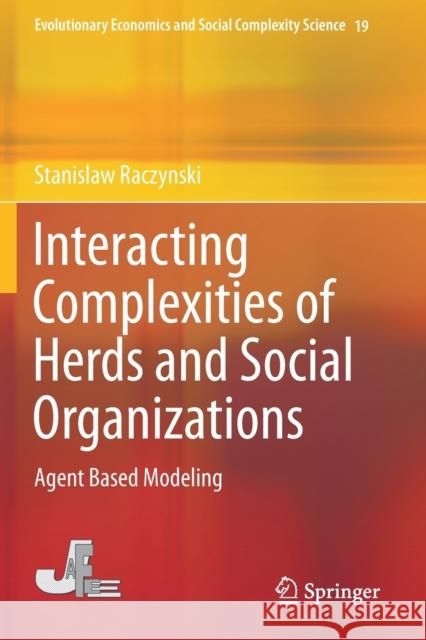
Interacting Complexities of Herds and Social Organizations: Agent Based Modeling

ISBN-13: 9789811393396 / Angielski / Miękka / 2020 / 150 str.
Stanislaw Raczynski
Interacting Complexities of Herds and Social Organizations: Agent Based Modeling Raczynski, Stanislaw 9789811393396 Springer Singapore - książkaWidoczna okładka, to zdjęcie poglądowe, a rzeczywista szata graficzna może różnić się od prezentowanej.

Interacting Complexities of Herds and Social Organizations: Agent Based Modeling

ISBN-13: 9789811393396 / Angielski / Miękka / 2020 / 150 str.

Stanislaw Raczynski
cena 229,96
(netto: 219,01 VAT:  5%)

Najniższa cena z 30 dni: 219,73
Termin realizacji zamówienia:
ok. 22 dni roboczych
Bez gwarancji dostawy przed świętami

Darmowa dostawa!
inne wydania

This book presents examples of and the latest simulation studies on artificial societies and populations, highlighting innovative implementations of various models of artificial societies and populations using a new, C++-related simulation tool. It demonstrates that the prey-predator models—including spatial distribution, moving patterns, limited renewable food, fear, gregarious (herd) instinct, clustering, epidemics, and competition—are more complex than other publications have suggested, and highlights the great discrepancy between agent-based and conventional continuous models. The book also discusses the modeling and simulation of self-organization and interactions between organizations, including terror organizations, offering fascinating insights into organizational dynamics.The book provides a broad range of examples and comparisons with the classical dynamics approach, showing readers how to construct models of complex systems. It starts with descriptions of the behavior of interacting individuals and also includes important information on the macro-behavior of the whole system.


Kategorie:
Nauka, Socjologia i społeczeństwo
Kategorie BISAC:
Social Science > Socjologia
Business & Economics > Strategia biznesowa
Business & Economics > Production & Operations Management
Wydawca:
Springer Singapore
Seria wydawnicza:
Evolutionary Economics and Social Complexity Science
Język:
Angielski
ISBN-13:
9789811393396
Rok wydania:
2020
Wydanie:
2020
Ilość stron:
150
Waga:
0.24 kg
Wymiary:
23.39 x 15.6 x 0.89
Oprawa:
Miękka
Wolumenów:
01
Dodatkowe informacje:
Wydanie ilustrowane

Chapter 1. Agent based models, tools.- Chapter 2. Simulating self-organization and interference between certain hierarchical structures.- Chapter 3. Interactions between terror and anti-terror organizations.- Chapter 4. Organization growth and decay: simulating interactions of hierarchical structures, corruption and gregarious effect.- Chapter 5. The spontaneous rise of the herd instinct: agent based simulation.- Chapter 6. Influence of the gregarious instinct and individuals’ behavior patterns on macro migrations: Simulation experiments.- Chapter 7. Simulating our self-destruction.- Chapter 8. Prey-predator models revisited: uncertainty, herd instinct, fear, limited food, epidemics, evolution and competition.- Chapter 9. Discret event simulation vs continuous system dynamics.

Stanislaw Raczynski received his master’s degree (1964) from the Electrical Engineering Department of the Academy of Mining and Metallurgy (AGH) in Krakow Poland, his Ph.D. (1969) and his “habilitation” degree (1977) in the field of control theory and optimization methods from the same academy. In 1964 Dr.Raczynski joined the AGH’s Institute for Automatics and Industrial Electronics, and from 1971 to 1972 he was head of the Computer Center at the AGH. Between 1973 and 1976 he worked as a researcher in the International Research Group in Moscow, USSR. In 1976 he became Head of the Systems Analysis Group at the AGH. From 1980 through 1983 he participated in the activities of the European Workshop on Industrial Computer Systems. Between 1983 and 1986 he was a Visiting Professor at the National University of Mexico, and in 1986 he joined the Panamericana University in Mexico City. From 1996 to 2000 and from 2002 to 2004 he was the International Director of The Society for Computer Simulation. He has written two books on computer simulation (Wiley, UK and LIMUSA, Mexico) and has published more than 80 articles and papers in professional journals and conference proceedings


This book presents examples of and the latest simulation studies on artificial societies and populations, highlighting innovative implementations of various models of artificial societies and populations using a new, C++-related simulation tool. It demonstrates that the prey-predator models—including spatial distribution, moving patterns, limited renewable food, fear, gregarious (herd) instinct, clustering, epidemics, and competition— are more complex than other publications have suggested, and highlights the great discrepancy between agent-based and conventional continuous models. The book also discusses the modeling and simulation of self-organization and interactions between organizations, including terror organizations, offering fascinating insights into organizational dynamics.

The book provides a broad range of examples and comparisons with the classical dynamics approach, showing readers how to construct models of complex systems. It starts with descriptions of the behavior of interacting individuals and also includes important information on the macro-behavior of the whole system.




Udostępnij

Facebook - konto krainaksiazek.pl


Opinie o Krainaksiazek.pl na Opineo.pl

Partner Mybenefit

Krainaksiazek.pl w programie rzetelna firma Krainaksiaze.pl - płatności przez paypal

Czytaj nas na:

Facebook - krainaksiazek.pl
  • książki na zamówienie
  • granty
  • książka na prezent
  • kontakt
  • pomoc
  • opinie
  • regulamin
  • polityka prywatności

Zobacz:

  • Księgarnia czeska

  • Wydawnictwo Książkowe Klimaty

1997-2025 DolnySlask.com Agencja Internetowa

© 1997-2022 krainaksiazek.pl
     
KONTAKT | REGULAMIN | POLITYKA PRYWATNOŚCI | USTAWIENIA PRYWATNOŚCI
Zobacz: Księgarnia Czeska | Wydawnictwo Książkowe Klimaty | Mapa strony | Lista autorów
KrainaKsiazek.PL - Księgarnia Internetowa

Polityka prywatnosci - link
Krainaksiazek.pl - płatnośc Przelewy24
Przechowalnia Przechowalnia



