• Wyszukiwanie zaawansowane
  • Kategorie
  • Kategorie BISAC
  • Książki na zamówienie
  • Promocje
  • Granty
  • Książka na prezent
  • Opinie
  • Pomoc
  • Załóż konto
  • Zaloguj się

Integrating Ecology and Poverty Reduction: Ecological Dimensions » książka


zaloguj się | załóż konto
Logo Krainaksiazek.pl

koszyk

konto

szukaj
topmenu
Księgarnia internetowa
Szukaj
Książki na zamówienie
Promocje
Granty
Książka na prezent
Moje konto
Pomoc
 
 
Wyszukiwanie zaawansowane
Pusty koszyk
Bezpłatna dostawa dla zamówień powyżej 20 złBezpłatna dostawa dla zamówień powyżej 20 zł

Kategorie główne

• Nauka
 [2946600]
• Literatura piękna
 [1856966]

  więcej...
• Turystyka
 [72221]
• Informatyka
 [151456]
• Komiksy
 [35826]
• Encyklopedie
 [23190]
• Dziecięca
 [619653]
• Hobby
 [140543]
• AudioBooki
 [1577]
• Literatura faktu
 [228355]
• Muzyka CD
 [410]
• Słowniki
 [2874]
• Inne
 [445822]
• Kalendarze
 [1744]
• Podręczniki
 [167141]
• Poradniki
 [482898]
• Religia
 [510455]
• Czasopisma
 [526]
• Sport
 [61590]
• Sztuka
 [243598]
• CD, DVD, Video
 [3423]
• Technologie
 [219201]
• Zdrowie
 [101638]
• Książkowe Klimaty
 [124]
• Zabawki
 [2473]
• Puzzle, gry
 [3898]
• Literatura w języku ukraińskim
 [254]
• Art. papiernicze i szkolne
 [8170]
Kategorie szczegółowe BISAC

Integrating Ecology and Poverty Reduction: Ecological Dimensions

ISBN-13: 9781489994288 / Angielski / Miękka / 2014 / 428 str.
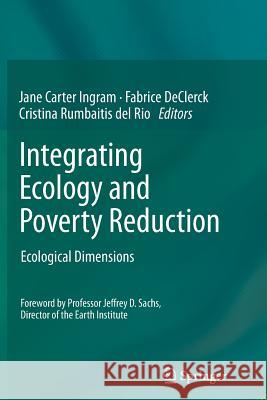
Jane Carter Ingram; Fabrice DeClerck; Cristina Rumbaitis Del Rio
Integrating Ecology and Poverty Reduction: Ecological Dimensions Ingram, Jane Carter 9781489994288 Springer - książkaWidoczna okładka, to zdjęcie poglądowe, a rzeczywista szata graficzna może różnić się od prezentowanej.

Integrating Ecology and Poverty Reduction: Ecological Dimensions

ISBN-13: 9781489994288 / Angielski / Miękka / 2014 / 428 str.

Jane Carter Ingram; Fabrice DeClerck; Cristina Rumbaitis Del Rio
cena 605,23 zł
(netto: 576,41 VAT:  5%)

Najniższa cena z 30 dni: 578,30 zł
Termin realizacji zamówienia:
ok. 22 dni roboczych
Bez gwarancji dostawy przed świętami

Darmowa dostawa!
inne wydania

In the past, the science of ecology has frequently been excluded from the development agenda for various reasons. Increasingly however there has been a renewed interest in finding more ecologically sustainable means of development that have required a strong foundation in ecological knowledge (for example EcoAgriculture Partnerships, EcoHealth presented at ESA, and EcoNutrition proposed by Deckelbaum et al). Each of these examples has already taken the critical first step at integrating ecological knowledge with agriculture, health and nutrition, respectively. However, this is only the first step; more attention needs to be placed not only on the role that two fields can play towards poverty alleviation, but on the role of a truly integrated, interdisciplinary approach towards development goals that is firmly grounded in ecological understanding. We feel that a critical look at what ecology can and cannot provide to the development agenda, in light of the Millennium Development goals, is timely and crucial. The introduction and the final section of the book will then integrate the lessons and principles outlined in each of the chapters. All chapter authors will be heavily encouraged to focus on how their sub-discipline in ecology impacts overall human well-being and environmental sustainability.


Kategorie:
Nauka, Biologia i przyroda
Kategorie BISAC:
Technology & Engineering > Environmental - General
Science > Environmental Science (see also Chemistry - Environmental)
Science > Life Sciences - Ecology
Wydawca:
Springer
Język:
Angielski
ISBN-13:
9781489994288
Rok wydania:
2014
Wydanie:
2012
Ilość stron:
428
Waga:
0.68 kg
Wymiary:
23.5 x 15.5
Oprawa:
Miękka
Wolumenów:
01
Dodatkowe informacje:
Wydanie ilustrowane

Table of Contents (Primary authors and Section Leaders in Bold Italics)

Forward- Importance of ecology to poverty reduction (Jeffrey Sachs)

Part 1: Introduction (Collective Editors)

Ch 1.1. Purpose

Ch 1.2. Conceptual Framework

Ch 1.3. Organization of Book

Part 2: The Ecological Dimensions and Solutions to Global Development Challenges

Section 2.1. Hunger (Section Leader: Fabrice DeClerck, CATIE and Pedro Sanchez, Columbia University Earth Institute)

Ch. 2.1.1. Ecological Services in Agricultural Landscapes

Ch. 2.1.2. Human Nutrition as an ecological service

Ch. 2.1.3. Achieving Conservation and Food Production in Agricultural Landscapes

Ch. 2.2.4. Ecological Principles for Sustainable Fisheries

Section 2.2. Water Resources (Section Leader: Roberto Lenton and Casey Brown, Int’l Res. Inst. for Climate and Society)

Ch. 2.2.1. Ecological Challenges and Solutions for Insuring Sustainable Supplies of Water for Irrigation

Ch. 2.2.2. Ecological Dimensions of Securing Safe and Abundant Drinking Water

Ch. 2.2.3. Ecology of Watershed Management

Section 2.3. Human Health (Section Leader: Matt Bonds, Earth Institute at Columbia University)

Ch. 2.3.1. Ecology of Infectious Diseases

Ch. 2.3.2. Landscape Ecology: the connections between Land-use Practices and Human Health

Ch. 2.3.3. Ecological Dimensions of HIV/AIDS

Section 2.4. Energy (Dan Kammen at the University of California at Berkeley (proposed) and Nina Sengupta, Auroville)

Ch. 2.4.1. Ecological Considerations of Developing Sustainable Energy Sources

Ch. 2.4.2. Ecological Challenges and Benefits of Using Biofuels as Alternative Fuels

Ch.2.4.3. Ecological Sustainability of Fuelwood as a Dominant Energy Source in Rural Communities

Section 2.5. Disasters (Section Leader: J. Carter Ingram, Wildlife Conservation Society)

Ch. 2.5.1. Ecological Resilience as a guiding principle for sustainable resource management

Ch. 2.5.2. Ecology of Drought

Ch. 2.5.3. Ecological Dimensions of Disaster Prevention

Section 2.6 Climate Change (Section Leader: Cristina Rumbaitis del Rio, Rockefeller Foundation)

Ch. 2.6.1. Ecological Impacts of Climate Change

Ch. 2.6.2. The Role of Ecology in Mitigating the Societal Impacts of Climate Change

Ch. 2.6.3. The Role of Ecology in Adaptation to Climate Change

*Section 2.7. Education (Section Leader:Robin Sears, School for Field Studies))

*Section 2.8. Gender equality (Section Leader: Isabelle Guttierez, CATIE)

Section 2.9. Synthesis of Direct Application of Ecological Theory (Collective Editors)

*Currently, these are set to be one chapter, but depending on our work with the section leaders may be broken down into different chapters.

Part 3: Mediating Forces for Leveraging Ecology towards Poverty Reduction in a Globalized World (Collective Editors)

Section 3.1. Population (Section Leader: TBD, proposed Joel Cohen)

Ch. 3.1.1. Population Growth

Ch. 3.1.2. Migration

Ch. 3.1.3. Urbanization

Section 3.2. Ecological Restoration (Section leader: TBD, proposed David Lamb)

Ch. 3.2.1. Ecological restoration of degraded environments as a way of improving livelihoods and decreasing vulnerability

Ch. 3.2.2. Ecological restoration of coastal vegetation after disasters

Ch. 3.2.3. Ecological approaches towards environmental remediation

Ch. 3.2.4. Ecological engineering for wetland restoration

Section 3.3. Financing (Section Leader: Guido Schmidt Traub, Team Leader, Millennium Development Goals (MDG) Support Team, New York, United Nations Development Program)

Ch. 3.3.1. Ecological Impacts, Challenges and Opportunities Associated with Trade

Ch. 3.3.2. The Role of Foreign Aid for Supporting Ecological Applications Towards Development Challenges

Ch. 3.3.3. Natural Resource Markets and Enterprises

Section 3.4. Economics: Payments for Ecosystem Services (Section Leader: Jose Gobbi, CATIE)

Ch. 3.4.1. Payments for Carbon

Ch. 3.4.2. Payments for Water

Ch. 3.4.3. Payments for Biodiversity Conservation

Section 3.5. Governance & Social Movements (Section Leader: Marc Levy, Center for International Earth Science Information Network)

Ch. 3.5.1. Land Tenure

Ch. 3.5.2. Conflict

Ch. 3.5.3. Post-Conflict Situations

Section 3.6. International Policy Mechanisms (Section Leader: Genevieve Patenaude, University of Edinburgh)

Ch. 3.6.1. Kyoto Protocol, Clean Development Mechanism and the IPCC

Ch. 3.6.2. Convention on Biological Diversity

Ch. 3.6.3. Millennium Development Goals

Ch. 3.6.4. Protected Areas

Ch. 3.6.5. Developing Environmental Policy: Addressing Uncertainty and Significance in Ecological Research

Section 3.7. Synthesis of Mediating Forces (Collective Authors)

Part 4. Conclusions (Collective Authors):

4.1. Doing Interdisciplinary Science: Methods, Challenges and Benefits

4.2. The Future and Evolving Role of Ecology in Society

The three editors of this volume, Jane Carter Ingram, Fabrice DeClerck, and Cristina Rumbatis del Rio, have collaborated on multiple projects addressing the role of ecology in poverty reduction and began working together at the Earth Institute of Columbia University. Their educational and professional backgrounds in ecology, geography, and sustainable development have served as the inspiration for this book and their professional pursuits. The editors hope that the issues presented and explored in this volume will serve to encourage ecological scientists and practitioners in international development fields to collaborate together to identify creative, sustainable and viable solutions to challenges preventing poverty alleviation around the world. J. Carter Ingram is the lead of the Ecosystem Services and Payments for Ecosystem Services group at the Wildlife Conservation Society in New York, NY.  Cristina Rumbaitis del Rio is an Associate Director at the Rockefeller Foundation in New York, NY (USA). Fabrice DeClerck is a professor of community and landscape ecology at CATIE in Costa Rica.

Integrating Ecology and Poverty Reduction offers a timely assessment of the current and potential role of ecological science and tools for contributing to poverty reduction.  The chapters in the first volume, Ecological Dimensions, address the ecological apsects of major development challenges and the contributions of ecological science to solving these problems. In the second volume, Application of Ecology in Development Solutions, authors address the roles and limitations of ecological science in creating longterm sustainable solutions to some of those problems and the social, economic and governance factors that mediate the implementation of these solutions.

Integrating Ecology and Poverty Reduction is designed to illustrate the opportunities for ecological science to contribute to international development challenges and solutions; to foster new ways of thinking about the relationships between humans and the ecosystems in which they live; and to explore the tradeoffs and advantages in using an ecological approach to addressing poverty in a world of increasing population, high rates of poverty and continued ecological degradation.  The issues addressed and explored by experts in ecology and international development fields will be especially relevant for students and professionals interested in the intersection of poverty reduction and environmental sustainability. 

About the Editors

J. Carter Ingram is the lead of the Ecosystem Services and Payments for Ecosystem Services group at the Wildlife Conservation Society in New York, NY. Fabrice DeClerck is a professor of community and landscape ecology at CATIE in Costa Rica. Cristina Rumbaitis del Rio is an Associate Director at the Rockefeller Foundation in New York, NY.


Udostępnij

Facebook - konto krainaksiazek.pl


Opinie o Krainaksiazek.pl na Opineo.pl

Partner Mybenefit

Krainaksiazek.pl w programie rzetelna firma Krainaksiaze.pl - płatności przez paypal

Czytaj nas na:

Facebook - krainaksiazek.pl
  • książki na zamówienie
  • granty
  • książka na prezent
  • kontakt
  • pomoc
  • opinie
  • regulamin
  • polityka prywatności

Zobacz:

  • Księgarnia czeska

  • Wydawnictwo Książkowe Klimaty

1997-2025 DolnySlask.com Agencja Internetowa

© 1997-2022 krainaksiazek.pl
     
KONTAKT | REGULAMIN | POLITYKA PRYWATNOŚCI | USTAWIENIA PRYWATNOŚCI
Zobacz: Księgarnia Czeska | Wydawnictwo Książkowe Klimaty | Mapa strony | Lista autorów
KrainaKsiazek.PL - Księgarnia Internetowa

Polityka prywatnosci - link
Krainaksiazek.pl - płatnośc Przelewy24
Przechowalnia Przechowalnia





