• Wyszukiwanie zaawansowane
  • Kategorie
  • Kategorie BISAC
  • Książki na zamówienie
  • Promocje
  • Granty
  • Książka na prezent
  • Opinie
  • Pomoc
  • Załóż konto
  • Zaloguj się

Integral Knowledge Creation and Innovation: Empowering Knowledge Communities » książka


zaloguj się | załóż konto
Logo Krainaksiazek.pl

koszyk

konto

szukaj
topmenu
Księgarnia internetowa
Szukaj
Książki na zamówienie
Promocje
Granty
Książka na prezent
Moje konto
Pomoc
 
 
Wyszukiwanie zaawansowane
Pusty koszyk
Bezpłatna dostawa dla zamówień powyżej 20 złBezpłatna dostawa dla zamówień powyżej 20 zł

Kategorie główne

• Nauka
 [2946912]
• Literatura piękna
 [1852311]

  więcej...
• Turystyka
 [71421]
• Informatyka
 [150889]
• Komiksy
 [35717]
• Encyklopedie
 [23177]
• Dziecięca
 [617324]
• Hobby
 [138808]
• AudioBooki
 [1671]
• Literatura faktu
 [228371]
• Muzyka CD
 [400]
• Słowniki
 [2841]
• Inne
 [445428]
• Kalendarze
 [1545]
• Podręczniki
 [166819]
• Poradniki
 [480180]
• Religia
 [510412]
• Czasopisma
 [525]
• Sport
 [61271]
• Sztuka
 [242929]
• CD, DVD, Video
 [3371]
• Technologie
 [219258]
• Zdrowie
 [100961]
• Książkowe Klimaty
 [124]
• Zabawki
 [2341]
• Puzzle, gry
 [3766]
• Literatura w języku ukraińskim
 [255]
• Art. papiernicze i szkolne
 [7810]
Kategorie szczegółowe BISAC

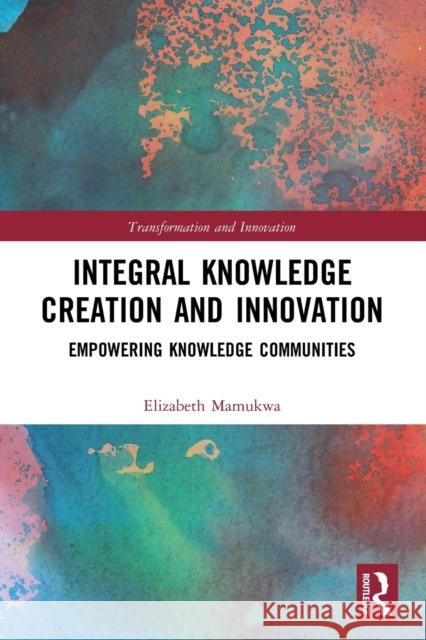
Integral Knowledge Creation and Innovation: Empowering Knowledge Communities

ISBN-13: 9780367532956 / Angielski
Elizabeth Mamukwa
Integral Knowledge Creation and Innovation: Empowering Knowledge Communities Elizabeth Mamukwa 9780367532956 Routledge - książkaWidoczna okładka, to zdjęcie poglądowe, a rzeczywista szata graficzna może różnić się od prezentowanej.

Integral Knowledge Creation and Innovation: Empowering Knowledge Communities

ISBN-13: 9780367532956 / Angielski

Elizabeth Mamukwa
cena 204,40
(netto: 194,67 VAT:  5%)

Najniższa cena z 30 dni: 201,44
Termin realizacji zamówienia:
ok. 22 dni roboczych
Bez gwarancji dostawy przed świętami

Darmowa dostawa!
inne wydania

The focus of this book is placed on creating and developing knowledge in the world of work. It is premised on the fact that knowledge is not static, but forever evolving and by the realisation that the best way to improve knowledge is to do so as a community, and not individually.

This work focuses on the creation of new knowledge, and how this has happened throughout all ages, as far back as the time of ancient philosophy to today. A product of integral research, it covers the process of creating new knowledge, leveraging existing knowledge, sometimes resulting in cutthroat innovations. It also includes knowledge systems such as conventional university systems to Mode 2 university concepts, culminating on integral research to innovation.

This book will help the reader to realise that the subject of knowledge creation is no longer business as usual. Many innovations have been created for human benefit in general, but such innovations may have benefited only parts of society. The challenge in the world is that, while new innovations may be brilliant, there are sections of society who continue to slip into poverty. Modern innovators must also consider such communities and come up with appropriate interventions. This book will open the eyes of innovators to new possibilities. In addition, the subject of knowledge should not be an elitist affair. One may stand to gain a lot by seeing the knowledge in other people, whatever their station in life. This realisation can enable serious innovators to widen their scope in terms of the sources of existing knowledge which can be improved and reassessed as new knowledge. Such existing knowledge can be identified by engaging the very communities that may be affected by a problem or challenge. Such communities will have had time to interrogate their situations and think of possible solutions to such, though they might not have the economic capacity to implement such solutions. This is always a useful starting point if one is seeking a solution to a community problem.

This book will be useful to students interested in the subject of knowledge and innovation, from under-graduate to PhD level. It will also benefit captains of industry, executives and managers who are interested in improving their knowledge improvement cycles in their companies.


Kategorie:
Nauka, Ekonomia i biznes
Kategorie BISAC:
Business & Economics > Industries - General
Business & Economics > Zarządzanie wiedzą
Business & Economics > Development - Economic Development
Wydawca:
Routledge
Seria wydawnicza:
Transformation and Innovation
Język:
Angielski
ISBN-13:
9780367532956

"Elizabeth Mamukwa’s book is a multi-layered revelation: it practically demonstrates how to build and empower local knowledge communities; it is a solid pointer towards the much needed evolution of universities to become innovation platforms and catalysts for the production of relevant knowledge in the public and communal space; it is also an inspiring key to the renewal of societies, in particular of their capacity to innovate; and, finally, it has the power to enable a veritable renaissance of authentic knowledge creation in Zimbabwe, if not for Africa as a whole. For anyone working in the field of social innovation and societal renewal, I strongly recommend reading this important book." — Professor Alexander Schieffer, Co-Founder, Trans4m Center for Integral Development, Switzerland; Co-Founder, Home for Humanity, France; Co-Series Editor of the Routledge Transformation and Innovation Series

"This book could not have been published at a better time for Africa, and Zimbabwe in particular. The whole education systems is being reengineered to focus more on innovation and industrialisation, having realised that education that was being generated was not creating the knowledge that was necessary for innovation and transformation of our societies. In Integral Knowledge Creation and Innovation, Dr Mamukwa gives an exposé of this seemingly complex concept yet something that was lost from our indigenous knowledge systems embedded in the Ubuntu philosophy. The emphasis on knowledge creation not for its sake but for innovation is quite apt to prepare the African reader for the pending fourth industrial revolution. The book emphasises the need for collaboration in this knowledge creation. Collaboration is now the way to go regardless of the sector or industry one is in, and the concept of multi-disciplinary approaches to problem-solving promoted here is the way to go in this era. I like the concept of Communiversity introduced in this book that places knowledge creation and innovation in the right context of communities to ensure relevance, ownership and sustainability of research outputs. This concept, if supported, could prove complementary if not more effective than the innovation hubs being established at most conventional universities." — Moses Chundu, Lecturer, Economics Department, University of Zimbabwe and Executive Director, Africa Leadership & Management Academy

"A timely and exceedingly valuable publication intended for scholars and social scientists engaged in research, innovation and knowledge creation. The book comprehensively captures the narratives on knowledge creation through the Mode 1 and Mode 2 university. The mode 1 being the more traditional format of university education while the Mode 2 is relatively contemporary, putting emphasis on transdisciplinary approaches that transcends local and national boundaries. This resource draws exciting contrasts in Knowledge Creation from all corners of the globe. This text is indeed a must-read for you as it extends the frontiers of knowledge in research and innovation." — Professor David D. Chakuchichi, Dean of Student Affairs, Zimbabwe Open University

"Dr Elizabeth Mamukwa in this book shares readily knowledge she acquired through her doctoral and post-doctoral research journeys. The former culminated in her Calabash of Knowledge Creation/Denhere re Ruzivo innovation and the latter being a revelation of concepts such as technopreneurship at the Harare Institute of Technology and numerous work based innovations from the mode 2 Da Vinci Institute of Technology. The book which is structured along the 4 Cs concept, the acronym for Call, Context, Co-Creation and Contribution, raises consciousness and know-how on the subject of Knowledge Creation and Development in order to empower individuals, communities and many organizations. Dr Mamukwa skilfully weaves knowledge with philosophy and religion and challenges individuals and organisations to collaborate, albeit from different perspectives, in taking knowledge creation and the encouragement and promotion of innovation to a higher level of impacting communities.

In the process she consolidates indigenous and exogenous knowledge rhythms taking into consideration learnings from the four corners of the earth, North, South, East and West, with a view to coming up with better knowledge systems. The book will thus be very relevant to the entire business community, the knowledge industry and to academia." — Passmore Matupire (PhD)

1. Introducing Knowledge Creation PART I: THE CALL: WHY KNOWLEDGE CREATION 2. Why Knowledge Creation and Innovation PART II: THE CONTEXT: A BACKGROUND TO KNOWLEDGE CREATION 3. The Philosophy of Knowledge Creation PART III: CONTEXT: KNOWLEDGE CONCIOUSNESS IN DIFFERENT SOCIETIES AND COMMUNITIES 4. Religion and the Subject of Knowledge 5. Knowledge Creation and Societal Learning in the East: The SECI Model 6. Knowledge Creation and Societal Learning in the North and West PART IV: CO-CREATION: THE MODE 2 UNIVERSITY AND KNOWLEDGE CREATION THROUGH INNOVATION 7. Knowledge Creation and Innovation at a Zimbabwean University: The Harare Institute of Technology Case Story 8. The Mode 2 University: The Da Vinci Institute Case Story PART V: CO-CREATION: RESEARCH METHODOLOGY 9. My Research to Innovation Journey: Research Methodology 10. Cooperative Inquiry: Towards New Forms of Knowledge Creation PART VI: CONTRIBUTION: OVERVIEW AND OUTCOMES OF THE RESEARCH 11. The Calabash of Knowledge Creation (Denhe re Ruzivo) 12. The Second Calabash: Pundutso Centre for Integral Development 13. Conclusion to Knowledge Creation and Innovation

Elizabeth Mamukwa is Research Director at the Pundutso Research Institute. She was the chief editor for Integral Green Zimbabwe (2014). She began her career as a schoolteacher and then moved to Industry and Commerce in the Human Resources discipline. She has worked in five corporates in the Agriculture, Engineering, Manufacturing and Telecommunications sectors, rising to the position of Human Resources Director. She also carries out some consulting work.


Udostępnij

Facebook - konto krainaksiazek.pl


Opinie o Krainaksiazek.pl na Opineo.pl

Partner Mybenefit

Krainaksiazek.pl w programie rzetelna firma Krainaksiaze.pl - płatności przez paypal

Czytaj nas na:

Facebook - krainaksiazek.pl
  • książki na zamówienie
  • granty
  • książka na prezent
  • kontakt
  • pomoc
  • opinie
  • regulamin
  • polityka prywatności

Zobacz:

  • Księgarnia czeska

  • Wydawnictwo Książkowe Klimaty

1997-2025 DolnySlask.com Agencja Internetowa

© 1997-2022 krainaksiazek.pl
     
KONTAKT | REGULAMIN | POLITYKA PRYWATNOŚCI | USTAWIENIA PRYWATNOŚCI
Zobacz: Księgarnia Czeska | Wydawnictwo Książkowe Klimaty | Mapa strony | Lista autorów
KrainaKsiazek.PL - Księgarnia Internetowa

Polityka prywatnosci - link
Krainaksiazek.pl - płatnośc Przelewy24
Przechowalnia Przechowalnia






