• Wyszukiwanie zaawansowane
  • Kategorie
  • Kategorie BISAC
  • Książki na zamówienie
  • Promocje
  • Granty
  • Książka na prezent
  • Opinie
  • Pomoc
  • Załóż konto
  • Zaloguj się

Information Extraction: Algorithms and Prospects in a Retrieval Context » książka

zaloguj się | załóż konto
Logo Krainaksiazek.pl

koszyk

konto

szukaj
topmenu
Księgarnia internetowa
Szukaj
Książki na zamówienie
Promocje
Granty
Książka na prezent
Moje konto
Pomoc
 
 
Wyszukiwanie zaawansowane
Pusty koszyk
Bezpłatna dostawa dla zamówień powyżej 20 złBezpłatna dostawa dla zamówień powyżej 20 zł

Kategorie główne

• Nauka
 [2946600]
• Literatura piękna
 [1856966]

  więcej...
• Turystyka
 [72221]
• Informatyka
 [151456]
• Komiksy
 [35826]
• Encyklopedie
 [23190]
• Dziecięca
 [619653]
• Hobby
 [140543]
• AudioBooki
 [1577]
• Literatura faktu
 [228355]
• Muzyka CD
 [410]
• Słowniki
 [2874]
• Inne
 [445822]
• Kalendarze
 [1744]
• Podręczniki
 [167141]
• Poradniki
 [482898]
• Religia
 [510455]
• Czasopisma
 [526]
• Sport
 [61590]
• Sztuka
 [243598]
• CD, DVD, Video
 [3423]
• Technologie
 [219201]
• Zdrowie
 [101638]
• Książkowe Klimaty
 [124]
• Zabawki
 [2473]
• Puzzle, gry
 [3898]
• Literatura w języku ukraińskim
 [254]
• Art. papiernicze i szkolne
 [8170]
Kategorie szczegółowe BISAC

Information Extraction: Algorithms and Prospects in a Retrieval Context

ISBN-13: 9781402049873 / Angielski / Twarda / 2006 / 246 str.
Marie-Francine Moens
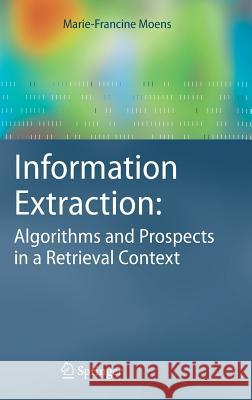
Information Extraction: Algorithms and Prospects in a Retrieval Context Marie-Francine Moens 9781402049873 Springer - książkaWidoczna okładka, to zdjęcie poglądowe, a rzeczywista szata graficzna może różnić się od prezentowanej.

Information Extraction: Algorithms and Prospects in a Retrieval Context

ISBN-13: 9781402049873 / Angielski / Twarda / 2006 / 246 str.

Marie-Francine Moens
cena 403,47 zł
(netto: 384,26 VAT:  5%)

Najniższa cena z 30 dni: 385,52 zł
Termin realizacji zamówienia:
ok. 22 dni roboczych
Bez gwarancji dostawy przed świętami

Darmowa dostawa!

This book covers content recognition in text, elaborating on past and current most successful algorithms and their application in a variety of settings: news filtering, mining of biomedical text, intelligence gathering, competitive intelligence, legal information searching, and processing of informal text. Today, there is considerable interest in integrating the results of information extraction in retrieval systems, because of the demand for search engines that return precise answers to flexible information queries.


Kategorie:
Nauka
Kategorie BISAC:
Computers > System Administration - Storage & Retrieval
Computers > Artificial Intelligence - Natural Language Processing
Computers > Artificial Intelligence - Computer Vision & Pattern Recognition
Wydawca:
Springer
Seria wydawnicza:
Information Retrieval
Język:
Angielski
ISBN-13:
9781402049873
Rok wydania:
2006
Wydanie:
2006
Numer serii:
000318554
Ilość stron:
246
Waga:
0.54 kg
Wymiary:
24.18 x 16.41 x 1.85
Oprawa:
Twarda
Wolumenów:
01
Dodatkowe informacje:
Bibliografia
Wydanie ilustrowane

From the reviews:

"Information Extraction (IE) and Information Retrieval (IR) are core enabling technologies ... . In this text, Moens brings these two techniques together to illustrate how information derived using IE could be highly beneficial in IR systems. ... the text is highly readable and aimed at both practitioners and researchers ... . One trait that I offer particular praise to the author for is the pragmatic presentation of ideas. ... the text should be beneficial both to seasoned professionals in this area and relative newcomers." (Tom Betts, Informer, Winter 2006/2007)

"After definition and explanation of the basic concepts and description of the historical development of the area, the past and current most successful algorithms and their application in a variety of domains are discussed. Especially important is the explanation of statistical and machine learning algorithms for information detection and classification and integration of their results in probabilistic retrieval models. ... Because its broad coverage and clear and sound explanation it is suitable and valuable both for researchers and for students." (Antonín Ríha, Zentralblatt MATH, Vol. 1108 (10), 2007)

"This book ... provide a comprehensive overview of text-extraction algorithms. It does well in ... explaining the intricacies of the basic approaches and concepts used. ... for advanced undergraduate students, graduate students, researchers, and people working in the field, the book is a good starting point for learning the basics. ... I would recommend the book for those who need to get into ... the field. ... the book is one that should be on your must-read list if you are involved in this field." (Karthik Gajjala, ACM Computing Reviews, Vol. 49 (2), February, 2008)

1 Information Extraction and Information Technology.- 1.1 Defining Information Extraction.-1.2 Explaining Information Extraction.- 1.3 Information Extraction and Information Retrieval.- 1.4 Information Extraction and Other Information Processing Tasks.- 1.5 The Aims of the Book.- 1.6 Conclusions. -1.7 Bibliography.- 2 Information Extraction from an Historical Perspective.- 2.1 Introduction.- 2.2 A Historical Overview.- 2.3 The Common Extraction Process.- 2.4 A Cascade of Tasks.- 2.5 Conclusions.- 2.6 Bibliography.- 3 The Symbolic Techniques.- 3.1 Introduction.- 3.2 Conceptual Dependency Theory and Scripts.-3.3 Frame Theory.-3.4 Actual Implementations of Symbolic Techniques.- 3.5 Conclusions.- 3.6 Bibliography.- 4 Pattern Recognition.- 4.1 Introduction.- 4.2 What is Pattern Recognition?.- 4.3 The Classification Scheme.- 4.4 The Information Units to Extract.- 4.5 The Features.- 4.6 Conclusions.- 4.7 Bibliography.- 5 Supervised Classification.- 5.1 Introduction.- 5.2 Support Vector Machines.- 5.3 Maximum Entropy Models.- 5.4 Hidden Markov Models.- 5.5 Conditional Random Fields.- 5.6 Decision Rules and Trees.- 5.7 Relational Learning.- 5.8 Conclusions.- 5.9 Bibliography.- 6 Unsupervised Classification Aids.- 6.1 Introduction.- 6.2 Clustering.- 6.3 Expansion.- 6.4 Self-training.- 6.5 Co-training.- 6.6 Active Learning.- 6.7 Conclusions.-6.8 Bibliography.- 7 Integration of Information Extraction in Retrieval Models.- 7.1 Introduction.- 7.2 State of the Art of Information Retrieval.- 7.3 Requirements of Retrieval Systems.- 7.4 Motivation of Incorporating Information Extraction.- 7.5 Retrieval Models.- 7.6 Data Structures.- 7.7 Conclusions.- 7.8 Bibliography.- 8 Evaluation of Information Extraction Technologies.- 8.1 Introduction.- 8.2 Intrinsic Evaluation ofInformation Extraction.- 8.3 Extrinsic Evaluation of Information Extraction in Retrieval.- 8.4 Other Evaluation Criteria.- 8.5 Conclusions.- 8.6 Bibliography.- 9 Case Studies.- 9.1 Introduction.- 9.2 Generic versus Domain Specific Character.- 9.3 Information Extraction from News Texts.- 9.4 Information Extraction from Biomedical Texts.- 9.5 Intelligence Gathering.- 9.6 Information Extraction from Business Texts.- 9.7 Information Extraction from Legal Texts.- 9.8 Information Extraction from Informal Texts.- 9.9 Conclusions.- 9.10 Bibliography.- 10 The Future of Information Extraction in a Retrieval Context.- 10.1 Introduction.- 10.2 The Human Needs and the Machine Performances.- 10.3 Most Important Findings.- 10.4 Algorithmic Challenges.- 10.5 The Future of IE in a Retrieval Context.- 10.6 Bibliography.-

Information extraction regards the processes of structuring and combining content that is explicitly stated or implied in one or multiple unstructured information sources. It involves a semantic classification and linking of certain pieces of information and is considered as a light form of content understanding by the machine. Currently, there is a considerable interest in integrating the results of information extraction in retrieval systems, because of the growing demand for search engines that return precise answers to flexible information queries. Advanced retrieval models satisfy that need and they rely on tools that automatically build a probabilistic model of the content of a (multi-media) document.

The book focuses on content recognition in text. It elaborates on the past and current most successful algorithms and their application in a variety of domains (e.g., news filtering, mining of biomedical text, intelligence gathering, competitive intelligence, legal information searching, and processing of informal text). An important part discusses current statistical and machine learning algorithms for information detection and classification and integrates their results in probabilistic retrieval models. The book also reveals a number of ideas towards an advanced understanding and synthesis of textual content.

The book is aimed at researchers and software developers interested in information extraction and retrieval, but the many illustrations and real world examples make it also suitable as a handbook for students.


Udostępnij

Facebook - konto krainaksiazek.pl


Opinie o Krainaksiazek.pl na Opineo.pl

Partner Mybenefit

Krainaksiazek.pl w programie rzetelna firma Krainaksiaze.pl - płatności przez paypal

Czytaj nas na:

Facebook - krainaksiazek.pl
  • książki na zamówienie
  • granty
  • książka na prezent
  • kontakt
  • pomoc
  • opinie
  • regulamin
  • polityka prywatności

Zobacz:

  • Księgarnia czeska

  • Wydawnictwo Książkowe Klimaty

1997-2025 DolnySlask.com Agencja Internetowa

© 1997-2022 krainaksiazek.pl
     
KONTAKT | REGULAMIN | POLITYKA PRYWATNOŚCI | USTAWIENIA PRYWATNOŚCI
Zobacz: Księgarnia Czeska | Wydawnictwo Książkowe Klimaty | Mapa strony | Lista autorów
KrainaKsiazek.PL - Księgarnia Internetowa

Polityka prywatnosci - link
Krainaksiazek.pl - płatnośc Przelewy24
Przechowalnia Przechowalnia





