Indigenization Discourse in Social Work » książka





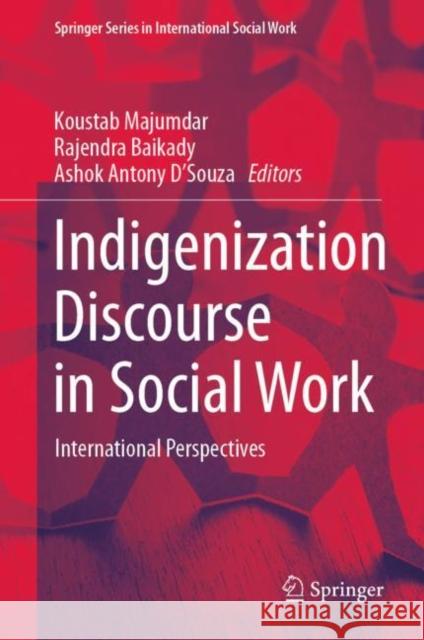
Indigenization Discourse in Social Work
ISBN-13: 9783031377112 / Twarda / 2023 / 433 str.
1. Understanding Indigenous Social Work Education and Practice: Local and Global Debates
Koustab Majumdar, Rajendra Baikady and Ashok Antony D'Souza
Part I: Indigenous Social Work: Multidimensional Perspectives
2. Decolonial Social Work from an Indigenous Perspective
Autumn Asher BlackDeer
3. Acting With Intentional Dissent as Minorities: Opportunities and Challenges in the Higher Education
Bindi Bennett, Donna Baines, Trevor G. Gates, Debora Ortega, Jioji Ravulo, Dyann Ross, Su Zhaohui and Krystal Evans
4. Linking the Global Indigenous Landscape: A Social Work Sustainability Perspective with Co-Production of Knowledge
Jean E. Balestrery
5. Georgian Social Work Development: From Micro to Macro Social Work Roles
Shorena Sadzaglishvili and Ketevan Gigineishvili
Part II- Indigenous Social Work: Curriculum and Pedagogy
6. Indigenizing the Social Work Curriculum: Why It Matters and How to Start?
Donalee Unal
7. Comparative Conceptions of Social Work: Context, Sources of Knowledge and the Professional Role in Scotland and Nigeria
Richard Ingram, Susan Levy and Uzoma Okoye
8. Teaching Indigenous Social Work in Mainstream Social Work Education in Taiwan
Wan-Jung (Wendy) Hsieh, Wan-Yi Lin and Ciwang Teyra
9. Integrating Indigenous Perspectives into International Social Work Education: A Case Study in Japan
Masateru Higashida, Kana Matsuo and Josef Gohori
10. Innovations in Social Work in Aotearoa New Zealand: Embedding Indigenous Wisdom Within Social Work Education and Practice
Ksenija Napan and Helene Connor
11. Indigenous Social Work Education for the Global South
Koustab Majumdar, Rajendra Baikady and Ashok Antony D'Souza
12. Colonization, Racism, and Positionality in Social Work Education in Chile: Contemporary and Multilocal Perspectives
Gabriela Rubilar Donoso, Alicia Rain and Catherine A. LaBrenz
13. Exploring a Decoloniality Perspective of Social Work Education in Malawi
Felix Kakowa and Daniel Kabunduli Nkhata
Part III Indigenous Social Work: Poiesis and Praxis
14. Indigenous Knowledge as a Resource in Social Work Practice: The Case of Bedouin Society
Nuzha Allassad Alhuzail
15. Indigenous Practice of Social Work in North East India: Issues and Challenges
Deepshikha Carpenter
16. The Role of Malawi’s Indigenous Knowledge and Practices in Social Work Practice
Daniel Kabunduli Nkhata and Felix Kakowa
17. Resources for a Practice of Anti-Discriminatory and Indigenous Social Work in the South of Spain from a Biographical Experience
Roser Manzanera-Ruiz, Maria del Valle Medina-Rodriguez and Gemma María González-García
18. Indigenizing Social Work with Older People in Africa: Issues, Trends, and Implications for Practice
Charles Kiiza Wamara and Janestic Twikirize
19. Social Work with Remote Indigenous Community in Indonesia: Policy, Service, and Practice
Adi Fahrudin, Suradi, Atik Rahmawati and Husmiati Yusuf
20. Intercultural Health in Chilean Indigenous and Afrodescendant Older People: Challenges for Culturally Relevant Social Work
Lorena P. Gallardo-Peralta, Esteban Sánchez-Moreno and Julio Tereucán Angulo
Part IV Indigenous Social Work: Insights from Diverse Cultural Contexts
21. Embracing Cultural and Indigenous Approaches to Child Discipline: A Response to Corporal Punishment Outlawing in Zimbabwe
Mulwayini Mundau and Tanatswa Silvanus Chineka
22. Alternative Childcare Arrangement in Indigenous Communities: Apprenticeship System and Informal Child Fostering in South East Nigeria
Chinwe U. Nnama-Okechukwu, Ngozi E. Chukwu and Uzoma O. Okoye
23. Indigenous Social Work Practice: The Influence of Yoruba Concepts on Effective Intervention in Social Work Settings
Makinde Christiana Omone Bose, Arogundade Toluwanimi Oreoluwa, Ilesanmi Itunu, Adeoye Ayodele and Azorondu Abigail
24. Inculcating Spirituality in Social Work Practice with Indigenous People in Zimbabwe
Dickson Machimbidza and Vincent Mabvurira
25. Interconnectedness and Co-creating Indigenous Social Work: Collaborative Approach and Future Directions for Sustainable Development
Koustab Majumdar, Rajendra Baikady and Ashok Antony D'Souza
Koustab Majumdar, MPhil, PhD, is associated with Ramakrishna Mission Vivekananda Educational and Research Institute (Deemed to be University, Ranchi campus, India). He is also a Visiting Scholar at International Center for Cultural Studies (ICSS), National Yang Ming Chiao Tung University (NYCU), Taiwan. Dr. Majumdar was awarded with Taiwan Fellowship (2023) by Ministry of Foreign Affairs (MOFA), China (Taiwan) to conduct his post-doctoral research on Comparative Indigenous Social Welfare Policy at ICSS_NYCU. He worked as a research associate at the Tata Institute of Social Sciences and RKMVERI. Dr. Majumdar became the recipient of tuition fee scholarship (2019) to attend Chula Right Livelihood Summer School (Chulalongkorn University), Bangkok, Thailand. He has been associated with many international journals as a reviewer. Majumdar’s research interests include agrarian change, environmental education, social work education, international social work, social welfare policies, rural and tribal livelihood and participatory re-search. He is also a member of a number of international bodies such as - Development Studies Association, UK, Canada, India Research Centre for Learning and Engagement (CIRCLE), University of Guelph, Canada, International Consortium for Social Development (ICSD), UNESCO Inclusive Policy Lab.
Rajendra Baikady, PhD, FRSA is Assistant Professor in the Department of Social Work, at the Central University of Kerala, India. He was a Special Post-Doctoral Fellow and Assistant Lecturer at the Department of the Social Work University of Johannesburg, South Africa during the aca-demic year 2020-2022. In addition to this, Baikady is Principal Investigator (Summer Research Fellowship) at International Socioeconomic Laboratory, Harvard University, United States, and a Research Associate at the Water Policy Center in India. He completed his first Post-Doctoral Fellowship at the He-brew University of Jerusalem, Israel (2019-2020), and was awarded Golda Meir Fellowship by Lady Davis Trust at the Hebrew University of Jerusalem. He was also a recipient of the Taiwan Government’s Short Term Research Award (2018) for academic research at National Chengchi University, Taiwan, and the Confucius Institute Understanding China Fellowship by the Government of China (2018-2019) for academic research at Shandong University, China. He has wide research experience in evaluating best practices of social work education and practice in both local and global contexts. Dr. Baikady is also affiliated with the Department of Social Work and Community Development, University of Johannesburg, South Africa as Senior Research Associate and The Harriet Tubman Institute, York University, Canada as Faculty Fellow. Dr. Baikady is the Founding Editor-in-Chief of the journal Discover Global Society published by Springer, London.
Ashok Antony D’Souza, PhD is Professor and Chairperson at the Department of Studies and Research in Social Work, Rani Channamma University, Belagavi, Karnataka, India. He is a person with a deep passion for teaching and research. His multidisciplinary outlook – obtained primarily from his post-graduate degrees in Philosophy, Social Work, Commerce and Management – has enabled him to strive for meaningful integration of methodologies and knowledge streams in social work education, research and extension initiatives. He has completed five research projects, authored four books, edited five books and has published over forty research papers in national and inter-national journals. Dr. D’Souza works closely with students, especially in finding more meaningful ways of engaging with vulnerable communities such as Indigenous people and other population groups facing difficult circumstances. He is also a member of the Editorial Board of two journals and has been serving as the chairperson on various academic bodies.
This contributed volume provides an in-depth understanding of contemporary debates, discussions and insights on Indigenous social work theory, education and practice across the globe. Based on theoretical and empirical perspectives, authors collectively contribute to a comprehensive, critical and up-to-date discussion about Indigenous social work theories, decolonization of social work education, Indigenous social work curriculum, Indigenous social work practice, and cultural perspectives towards enhancing Indigenous social work education and practice.
The key features of this book are:
- Critical insights into the historical evolution of Indigenous social work;
- Global debates on the westernization and indigenization of social work education;
- An overview of Indigenous social work and its practice in diverse cultural contexts;
- Critical perspective of Indigenous social work education; and
- Coverage of a diverse range of geographical areas.
Indigenization Discourse in Social Work: International Perspectives is an indispensable resource for students, scholars, independent researchers, academicians, policymakers and practitioners who are working in the field of social work, especially those who are interested in Indigenous social work issues. Moreover, it is an invaluable text for students, scholars and academicians who are interested in international social work with a special focus on Indigenous social work. In addition, students and scholars in sociology, development studies, public policy and economics working with Indigenous people and who are interested in Indigenous studies will find this book useful as an interdisciplinary reference.




Czytaj nas na:
1997-2026 DolnySlask.com Agencja Internetowa
KrainaKsiazek.PL - Księgarnia Internetowa


