• Wyszukiwanie zaawansowane
  • Kategorie
  • Kategorie BISAC
  • Książki na zamówienie
  • Promocje
  • Granty
  • Książka na prezent
  • Opinie
  • Pomoc
  • Załóż konto
  • Zaloguj się

Indian Stock Market: An Empirical Analysis of Informational Efficiency » książka


zaloguj się | załóż konto
Logo Krainaksiazek.pl

koszyk

konto

szukaj
topmenu
Księgarnia internetowa
Szukaj
Książki na zamówienie
Promocje
Granty
Książka na prezent
Moje konto
Pomoc
 
 
Wyszukiwanie zaawansowane
Pusty koszyk
Bezpłatna dostawa dla zamówień powyżej 20 złBezpłatna dostawa dla zamówień powyżej 20 zł

Kategorie główne

• Nauka
 [2946350]
• Literatura piękna
 [1816154]

  więcej...
• Turystyka
 [70666]
• Informatyka
 [151172]
• Komiksy
 [35576]
• Encyklopedie
 [23172]
• Dziecięca
 [611458]
• Hobby
 [135995]
• AudioBooki
 [1726]
• Literatura faktu
 [225763]
• Muzyka CD
 [378]
• Słowniki
 [2917]
• Inne
 [444280]
• Kalendarze
 [1179]
• Podręczniki
 [166508]
• Poradniki
 [469467]
• Religia
 [507199]
• Czasopisma
 [496]
• Sport
 [61352]
• Sztuka
 [242330]
• CD, DVD, Video
 [3348]
• Technologie
 [219391]
• Zdrowie
 [98638]
• Książkowe Klimaty
 [124]
• Zabawki
 [2382]
• Puzzle, gry
 [3525]
• Literatura w języku ukraińskim
 [259]
• Art. papiernicze i szkolne
 [7107]
Kategorie szczegółowe BISAC

Indian Stock Market: An Empirical Analysis of Informational Efficiency

ISBN-13: 9788132215899 / Angielski / Miękka / 2013 / 124 str.
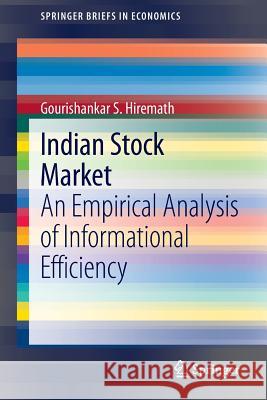
Gourishankar S. Hiremath
Indian Stock Market: An Empirical Analysis of Informational Efficiency Hiremath, Gourishankar S. 9788132215899 Springer - książkaWidoczna okładka, to zdjęcie poglądowe, a rzeczywista szata graficzna może różnić się od prezentowanej.

Indian Stock Market: An Empirical Analysis of Informational Efficiency

ISBN-13: 9788132215899 / Angielski / Miękka / 2013 / 124 str.

Gourishankar S. Hiremath
cena 201,24
(netto: 191,66 VAT:  5%)

Najniższa cena z 30 dni: 192,74
Termin realizacji zamówienia:
ok. 22 dni roboczych.

Darmowa dostawa!

India is one of the major emerging economies of the world and has witnessed tremendous economic growth over the last decades. The reforms in the financial sector were introduced to infuse energy and vibrancy into the process of economic growth. The Indian stock market now has the largest number of listed companies in the world. The phenomenal growth of the Indian equity market and its growing importance in the economy is indicated by the extent of market capitalization and the increasing integration of the Indian economy with the global economy. Various schools of thought explain the behaviour of stock returns. The Efficient Market Theory is the most important theory of the School of Neoclassical Finance based on rational expectation and no-trade argument. The book investigates the growth and efficiency of the Indian stock market in the theoretical framework of the Efficiency Market Hypothesis (EMH). The main objective of the present study is to examine the returns behaviour in the Indian equity market in the changed market environment. A detailed and rigorous analysis, made with the help of the sophisticated time series econometric models, is one of the key elements of this volume. The analysis empirically tests the random walk hypothesis and focuses on issues like nonlinear dynamics, structural breaks and long memory. It uses new and disaggregated data on recent reforms and changes in the market microstructure. The data on various indices including sectoral indices help in measuring the relative efficiency of the market and understanding how liquidity and market capitalization affect the efficiency of the market.


Kategorie:
Nauka, Ekonomia i biznes
Kategorie BISAC:
Business & Economics > Ekonometria
Business & Economics > Finance - General
Business & Economics > Makroekonomia
Wydawca:
Springer
Seria wydawnicza:
Springerbriefs in Economics
Język:
Angielski
ISBN-13:
9788132215899
Rok wydania:
2013
Wydanie:
2014
Numer serii:
000433834
Ilość stron:
124
Waga:
0.21 kg
Wymiary:
23.39 x 15.6 x 0.79
Oprawa:
Miękka
Wolumenów:
01
Dodatkowe informacje:
Wydanie ilustrowane

Chapter 1. Introduction

1.1Background                                                                                                              

1.2       Theoretical Foundations                                                                              

            1.2.1  Forms of efficiency                                                                             

1.3         Random Walk Model                                                                                  

1.4         Policy Reforms, Growth and Emergence of Stock Market in India           

 1.5         Issues and scope of the study                                                                     

 1.6         Nature and Sources of Data       

2 Random Walk Characteristics of Stock Returns

 2.1 Introduction

 2.2 Review of Previous Work   

 2.3 Weak Form Efficiency: Empirical Tests

  2.3.1 Parametric Tests

  2.3.2  Nonparametric Tests

 2.4 Discussion on Empirical Results

 2.5 Concluding Remarks

 References

3 Nonlinear Dependence in Stock Returns

 3.1 Introduction

 3.2 Methodology

 3.3 Empirical Results

 3.4 Concluding Remarks

 References

4 Mean-reverting Tendency in Stock Returns

 4.1 Introduction          

 4.2 Review of Previous Works

 4.3 Data and Methodology

  4.3.1 Zivot and Andrews (1992) Sequential Break Test

  4.3.2  Lee-Strazicich (2003) LM Unit Root Multiple breaks Test

 4.4 Empirical Findings

 4.5 Conclusion

 References

5 Long Memory in Stock Returns: Theory and Evidence

 5.1 Introduction

 5.2 Theory of Long Memory

  5.2.1 Meaning and Definitions

  5.2.2  ARFIMA Model

 5.3 Review of Previous Work

 5.4 Testing Methods

  5.4.1 Geweke and Porter-Hudak Semi parametric (GPH) Test

  5.4.2 Robinson’s Gaussian Semi parametric (RGSE) Test

  5.4.3 Andrews and Guggenberger Bias Reduced (AGBR) Test

 5.5 Empirical Evidence

 5.5 Concluding Remarks

6 Long Memory in Stock Market Volatility

 6.1 Introduction

 6.2 Review of Previous Work

 6.3 Data and Methodology

 6.4 Empirical Results

 6.5 Concluding Observations

 References

Summary and Conclusion

Appendix


            References

Gourishankar S Hiremath is Assistant Professor of Economics & Finance at Indian Institute of Technology Kharagpur (India). He previously worked at Indian Institute of Technology Jodhpur, Gokhale Institute of Politics and Economics, Pune, and ICFAI Business School (IBS)-Hyderabad. He holds a PhD in Financial Economics from University of Hyderabad, India and his areas of specialisation include Financial Markets – Indian Capital Market, International Finance, Financial and Commodity Derivatives and Applied Time Series Econometrics.  Dr. Hiremath has published several research papers in leading journals and in National and International conference proceedings. He has done research for National Bank for Agriculture and Rural Development (NABARD) and Climate Works Foundation, New Delhi. He is a member of Panel of Experts, Young Entrepreneurs Incentive Scheme of Rajasthan Financial Corporation sponsored by Council of State Industrial Development and Investment Corporations of India.

India is one of the major emerging economies of the world and has witnessed tremendous economic growth over the last decades. The reforms in the financial sector were introduced to infuse energy and vibrancy into the process of economic growth. The Indian stock market now has the largest number of listed companies in the world. The phenomenal growth of the Indian equity market and its growing importance in the economy is indicated by the extent of market capitalization and the increasing integration of the Indian economy with the global economy. Various schools of thought explain the behaviour of stock returns. The Efficient Market Theory is the most important theory of the School of Neoclassical Finance based on rational expectation and no-trade argument. The book investigates the growth and efficiency of the Indian stock market in the theoretical framework of the Efficiency Market Hypothesis (EMH). The main objective of the present study is to examine the returns behaviour in the Indian equity market in the changed market environment. A detailed and rigorous analysis, made with the help of the sophisticated time series econometric models, is one of the key elements of this volume. The analysis empirically tests the random walk hypothesis and focuses on issues like nonlinear dynamics, structural breaks and long memory. It uses new and disaggregated data on recent reforms and changes in the market microstructure. The data on various indices including sectoral indices help in measuring the relative efficiency of the market and understanding how liquidity and market capitalization affect the efficiency of the market.




Udostępnij

Facebook - konto krainaksiazek.pl


Opinie o Krainaksiazek.pl na Opineo.pl

Partner Mybenefit

Krainaksiazek.pl w programie rzetelna firma Krainaksiaze.pl - płatności przez paypal

Czytaj nas na:

Facebook - krainaksiazek.pl
  • książki na zamówienie
  • granty
  • książka na prezent
  • kontakt
  • pomoc
  • opinie
  • regulamin
  • polityka prywatności

Zobacz:

  • Księgarnia czeska

  • Wydawnictwo Książkowe Klimaty

1997-2026 DolnySlask.com Agencja Internetowa

© 1997-2022 krainaksiazek.pl
     
KONTAKT | REGULAMIN | POLITYKA PRYWATNOŚCI | USTAWIENIA PRYWATNOŚCI
Zobacz: Księgarnia Czeska | Wydawnictwo Książkowe Klimaty | Mapa strony | Lista autorów
KrainaKsiazek.PL - Księgarnia Internetowa

Polityka prywatnosci - link
Krainaksiazek.pl - płatnośc Przelewy24
Przechowalnia Przechowalnia




