Including the Excluded in South Asia: Power, Politics and Policy Perspectives from the Region » książka

topmenu




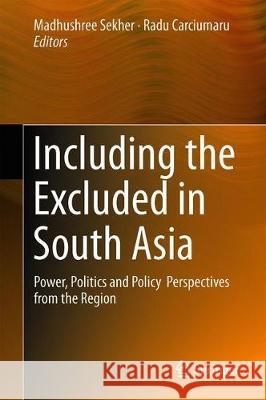
Including the Excluded in South Asia: Power, Politics and Policy Perspectives from the Region
ISBN-13: 9789813297586 / Angielski / Twarda / 2019 / 254 str.
Including the Excluded in South Asia: Power, Politics and Policy Perspectives from the Region
ISBN-13: 9789813297586 / Angielski / Twarda / 2019 / 254 str.
cena 402,53
(netto: 383,36 VAT: 5%)
Najniższa cena z 30 dni: 385,52
(netto: 383,36 VAT: 5%)
Najniższa cena z 30 dni: 385,52
Termin realizacji zamówienia:
ok. 22 dni roboczych.
ok. 22 dni roboczych.
Darmowa dostawa!
Kategorie:
Kategorie BISAC:
Wydawca:
Springer
Język:
Angielski
ISBN-13:
9789813297586
Rok wydania:
2019
Dostępne języki:
Ilość stron:
254
Oprawa:
Twarda
Introduction
Chapter 1. Why is Social Exclusion? A Cross-Country Perspective (approx. 6500 words)
Professor Madhushree Sekher & Radu Carciumaru
Part 1. Contextualizing Social Exclusion/Inclusion
Over the years, the understanding of social exclusion has gone far beyond per capita income to address various kinds of distributional concerns. Disaggregating the social exclusion concept, an expansive approach includes a broad range of social, economic and political conditions that affect human wellbeing.
Chapter 2. – (earlier numbered Chapter 3) Inclusion and Marginalization: Concepts and Measures (appox.5000 words)
Professor M.H Suryanarayana, IGIDR Mumbai
Chapter 3. - Persisting Ethnic Tensions in Sri Lanka: Towards a Structural Analysis (approx. 5000 words)
Professor Siripala Tellambura Hettige, University of Colombo, Sri Lanka
Chapter 4. Social Inclusion/ Exclusion Policy Discourse in Nepal (approx. 7,000 words)
Professor Om Gurung, Tribhuvan University, Nepal
Part 2 Inequality and Politics of Inclusion
Social exclusion lies at the heart of the processes that generate inequality among social categories. Exist from the effects of social exclusion, and therefore, inclusion, depends on the programs and policy initiatives that create opportunities to bypass exclusionary conditions and processes.
Dr. Anwar Alam, Senior Fellow, Policy Perspectives Foundation, New Delhi
Chapter 6. Constitutional Reforms in Sri Lanka: From Majoritarian Control System to Integration and
Accommodation? (approx. 6500 words)
Radu Carciumaru, South Asia Institute, Heidelberg University
Chapter 7 (earlier numbered chapter 14). Politics of Public Policy in India: Institutional Internalization of
Inequality and Exclusion in Policy Legislation (approx. 6500 words)
Professor Madhushree Sekher, Tata Institute of Social Sciences, Mumbai and Suchandrima Chakraborty, International Institute for Population Policies, Mumbai
Part 3. State, Institutions and Representation
Social exclusion is reflected in and perpetuated by the dominant social structure and the consequent opportunity structures that the excluded face. This draws focus on the role of various agency and processes in causing exclusion.
Chapter 8. Democratic Participation in Bangladesh: Does it Vary Across Ethnicity, Religion and Gender (7,000
words)
Professor Sk. Tawfique M. Haque and Md. Akram Hossain, North-South University, Bangladesh
Chapter 9. Democratic institutions in Sri Lanka’s local level politics: Challenges to Social Inclusion (approx.
5000 words)
Shashik Dhanushka Silva, Social Scientists’ Association, Sri Lanka; Applied Research Unit of UNOPS
Chapter 10. earlier Chapter 9 Intricacies of Nation-States and Incidences of Exclusion (approx. 7000 words)
Allen Thomas, Research Scholar, CSSEIP, TISS Mumbai
Part 4. Governance Systems and Opportunities for Inclusion
Tackling social exclusion requires concerted and long-term effort, not only through government initiatives that
address issues of legal rights and access to resources, but also aim at changing attitudes and perceptions
Chapter 11. Right to Information: A Viable Institution? Emerging Politics of Accountability (approx. 7000
words)
Dr. Himanshu Jha, Research Fellow, University of Heidelberg, Germany
Chapter 12. Land Alienation and Threats to Livelihoods of Indigenous Populations (approx. 7,000 words)
Dr. Seema Mallik, Utkal University, Odisha
Chapter 13. Manual Scavengers: A Blind Spot in Urban Development Discourse (approx.5000 words)
Dr. Shaileshkumar Darokar, Associate Professor, Tata Institute of Social Sciences, Mumbai
Chapter 14. Diversity in Higher Education in India (approx. 7,000 words)
Dr. Geetha Rani, Associate Professor, Central University of Tamil Nadu, Thiruvarur
Chapter 15. Institutional Responses to Exclusion and Poverty in Highlands (approx. 6000 words)
Dr. Mansi Awasthi, Post-Doc research fellow, Tata Institute of Social Sciences, Mumbai
Madhushree Sekher is Professor at Tata Institute of Social Sciences, Mumbai. Institutions, political economy of representation, governance, inclusive development and policy implementation are her core research interests. Her current research is on institutions for food security, inequalities and social welfare systems, and democratic representation in India. She has been a recipient of the Australian Research Council (Discovery) Grant, and grants from International Food Policy Research Institute (IFPRI), Indian Council for Social Science Research and Sir Ratan Tata Trust. She is currently associated with an international research consortium to study ethnic power relations funded by Swiss Development Council and Swiss National Science Foundation. She was a Visiting Faculty at IFPRI-¬‐Washington, and Universities of Hohenheim, Sydney and Alberta, and at Cornell University. Author of many research articles and books, including ‘Feeding India: Livelihoods, Entitlements and Capabilities’ (Earthscan, 2013 and ‘Governance and Governed: Multi-¬‐Country Perspectives on State, Society and Development (Springer, 2017), she has a PhD in Political Science from the Institute for Social and Economic Change, Bangalore, and was recipient of World Bank Robert S. McNamara Fellowship for post-doctoral research.
Radu Carciumaru is Head of CrossCulture Programme at ifa (Institute for Foreign Policy, Germany) and associated researcher at the South Asia Institute, Heidelberg University. Prior to joining ifa, Radu Carciumaru acted as Resident Representative/Head of Heidelberg University’s New Delhi Branch Office and governing board member of the German Centre for Research and Innovation New Delhi, for over four years. Radu Carciumaru holds a PhD in Political Science from Heidelberg University and has several publications on institutional design in plural societies, conflict negotiation, prevention and management.
He is board member of the Research Committee Politics and Ethnicity (RC14) of the International Political Science Association (RC 14), co-founder of APSA foundation and Sri Lanka Working Group, fellow of South Asia Democratic Forum (SADF, Brussels), research fellow of the Centre for the Study of Law and Governance, member of the editorial board of Politex (St Petersburg State University, Russia), former managing editor of the Heidelberg Papers in South Asian and Comparative Politics (2010-2016), as well as former research fellow at the School of International Studies, Jawaharlal Nehru University and Assistant Professor of Political Science at Ashoka University. His areas of expertise include institutional design in plural societies, power sharing and negotiation theories, ethnic conflict regulation, international and regional cooperation, comparative politics and political economy.
This book analyses and discusses the multiple dimensions of social exclusion/inclusion seen in South Asia. It not only captures how ‘social exclusion’ is intrinsic to deprivation or deprivation in itself, but also the processes of political engagement and social interactions that the socially excluded develop as strategies and networks for their advancement. Consequently, the book goes beyond structures or agency, and examines the question of a more dynamic approach to provide spaces for the ‘socially excluded’ to self-manage exclusion, thereby raising discussions around the contested positions that underlie development discourse on social inequality.
While social exclusion linked to identities is studied, the book argues that hierarchies and inequalities based on social identities cut across and affect various groups of excluded. Consequently, these phenomena create or lead to various processes of exclusion. The book illustrates that social exclusion should not be limited to privileging the differences that characterize the exclusionary processes, but should also comprise underpinning strategies of ‘inclusion’, emphasizing the need to focus on imperatives ‘to include’. As a result, the book acknowledges that social exclusion is not limited to analyzing the different identities that face exclusion, but also understanding the systems and processes that create social exclusion, or create opportunities for inclusion of the excluded.
The book addresses readership across academic disciplines (including in the growing field of state capacity and governance), and practitioners (administrators and policy-making communities). Conclusively, the book, provides a platform to intensively exchange the multifaceted and critical issue of social exclusion/inclusion, and thus contributes to inclusive sustainable development discourse.




Czytaj nas na:
1997-2026 DolnySlask.com Agencja Internetowa
Zobacz: Księgarnia Czeska | Wydawnictwo Książkowe Klimaty | Mapa strony | Lista autorów
KrainaKsiazek.PL - Księgarnia Internetowa

KrainaKsiazek.PL - Księgarnia Internetowa

