• Wyszukiwanie zaawansowane
  • Kategorie
  • Kategorie BISAC
  • Książki na zamówienie
  • Promocje
  • Granty
  • Książka na prezent
  • Opinie
  • Pomoc
  • Załóż konto
  • Zaloguj się

In Situ Detection of DNA Damage: Methods and Protocols » książka


zaloguj się | załóż konto
Logo Krainaksiazek.pl

koszyk

konto

szukaj
topmenu
Księgarnia internetowa
Szukaj
Książki na zamówienie
Promocje
Granty
Książka na prezent
Moje konto
Pomoc
 
 
Wyszukiwanie zaawansowane
Pusty koszyk
Bezpłatna dostawa dla zamówień powyżej 20 złBezpłatna dostawa dla zamówień powyżej 20 zł

Kategorie główne

• Nauka
 [2946912]
• Literatura piękna
 [1852311]

  więcej...
• Turystyka
 [71421]
• Informatyka
 [150889]
• Komiksy
 [35717]
• Encyklopedie
 [23177]
• Dziecięca
 [617324]
• Hobby
 [138808]
• AudioBooki
 [1671]
• Literatura faktu
 [228371]
• Muzyka CD
 [400]
• Słowniki
 [2841]
• Inne
 [445428]
• Kalendarze
 [1545]
• Podręczniki
 [166819]
• Poradniki
 [480180]
• Religia
 [510412]
• Czasopisma
 [525]
• Sport
 [61271]
• Sztuka
 [242929]
• CD, DVD, Video
 [3371]
• Technologie
 [219258]
• Zdrowie
 [100961]
• Książkowe Klimaty
 [124]
• Zabawki
 [2341]
• Puzzle, gry
 [3766]
• Literatura w języku ukraińskim
 [255]
• Art. papiernicze i szkolne
 [7810]
Kategorie szczegółowe BISAC

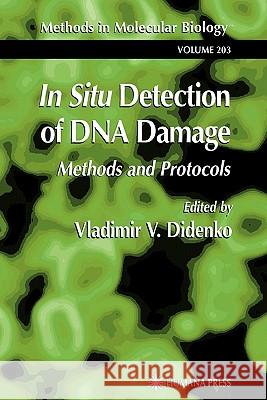
In Situ Detection of DNA Damage: Methods and Protocols

ISBN-13: 9781617372728 / Angielski / Miękka / 2010 / 313 str.
Vladimir V. Didenko
In Situ Detection of DNA Damage: Methods and Protocols Didenko, Vladimir V. 9781617372728 Springer - książkaWidoczna okładka, to zdjęcie poglądowe, a rzeczywista szata graficzna może różnić się od prezentowanej.

In Situ Detection of DNA Damage: Methods and Protocols

ISBN-13: 9781617372728 / Angielski / Miękka / 2010 / 313 str.

Vladimir V. Didenko
cena 401,58
(netto: 382,46 VAT:  5%)

Najniższa cena z 30 dni: 385,52
Termin realizacji zamówienia:
ok. 22 dni roboczych
Bez gwarancji dostawy przed świętami

Darmowa dostawa!

Detection and analysis of DNA damage is of critical importance in a variety of biological disciplines studying apoptosis, cell cycle and cell di- sion, carcinogenesis, tumor growth, embryogenesis and aging, neu- degenerative and heart diseases, anticancer drug development, environmental and radiobiological research, and others. Individual cells within the same tissue or in cell culture may vary in the extent of their DNA damage and, consequently, can display different re- tions to it. These differences between individual cells in the same cell popu- tion are detected using in situ approaches. In situ is a Latin term meaning on site or in place. It is used to denote the processes occurring or detected in their place of origin. In mole- lar and cell biology this usually refers to undisrupted mounted cells or tissue sections. In that meaning in situ is used as part of the terms in situ PCR, in situ transcription, in situ hybridization, in situ end labeling, and in situ ligation. Sometimes the in situ term is applied at the subcellular level to cells disrupted in the process of analysis, for example, in the detection of specific sequences in chromosomes using fluorescent in situ hybridization (FISH). Historically, the term was used primarily in methods dealing with nucleic acids."


Kategorie:
Nauka, Biologia i przyroda
Kategorie BISAC:
Science > Life Sciences - Genetics & Genomics
Science > Biologia molekularna
Science > Research & Methodology
Wydawca:
Springer
Seria wydawnicza:
Methods in Molecular Biology (Paperback)
Język:
Angielski
ISBN-13:
9781617372728
Rok wydania:
2010
Numer serii:
000203440
Ilość stron:
313
Waga:
0.45 kg
Wymiary:
22.86 x 15.24 x 1.78
Oprawa:
Miękka
Wolumenów:
01

"Investigators working in the general area of DNA damage, including apoptosis, will find this book of use. The protocols are sufficiently detailed so as to allow experienced laboratory workers access to the described methods. . .the broad spectrum of methods described allows for individual investigators to exercise options."-Doody's Health Sciences Book Review Journal

"Here, a panel of experts describe all the major in situ techniques for studying DNA damage and apoptosis, and how approaches originally designed to label apoptotic cells can be used for DNA damage analysis (and vice versa)." - European Journal of Histochemistry

Part I. Labeling DNA Breaks Using Terminal Transferase (TUNEL Assay) Labeling DNA Damage with Terminal Transferase: Applicability, Specificity, and Limitations P. Roy Walker, Christine Carson, Julie Leblanc, and Marianna Sikorska TUNEL Assay: An Overview of Techniques Deryk T. Loo Electron Microscopic Detection of DNA Damage Labeled by TUNEL Antonio Migheli Quantitative Differentiation of Both Free 3' OH and 5' OH DNA Ends Using Terminal Transferase-Based Labeling Combined with Transmission Electron Microscopy Yoshinori Otsuki and Yuko Ito Determination of Three-Dimensional Distribution of Apoptotic DNA Damage by Combination of TUNEL and Quick-Freezing and Deep-Etching Techniques Shinichi Ohno, Takeshi Baba, Nobuo Terada, and Yasuhisa Fujii In Situ Detection of DNA Strand Breaks in Analysis of Apoptosis by Flow- and Laser-Scanning Cytometry Zbigniew Darzynkiewicz, Elzbieta Bedner, and Piotr Smolewski Part II. Labeling DNA Breaks Using DNA Polymerase I or its Klenow Fragment DNA Damage Detection Using DNA Polymerase I or its Klenow Fragment: Applicability, Specificity, Limitations Jan Hein van Dierendonck Labeling DNA Breaks In Situ by Klenow Enzyme Katherine A. Wood In Situ Nick Translation at the Electron Microscopic Level Marc Thiry Part III. Labeling DNA Breaks Using Ligase In Situ DNA Ligation as a Method for Labeling Apoptotic Cells in Tissue Sections: An Overview Peter J. Hornsby and Vladimir V. Didenko Detection of Specific Double-Strand DNA Breaks and Apoptosis In Situ Using T4 DNA Ligase Vladimir V. Didenko In Situ Detection of Double-Strand DNA Breaks with Terminal 5'OH Groups Vladimir V. Didenko, Hop Ngo, and David S. Baskin Part IV. Detection of DNA Breaks in Agarose Trapped Cells: Comet Assay and Related Techniques The Comet Assay: Principles, Applications, and Limitations Andrew R. Collins The Comet Assay: An Overview of Techniques Peggy L. Olive Ultrasensitive Detection of DNA Damage by the Combination of the Comet and TUNEL Assays Andrei L. Kindzelskii and Howard R. Petty Application of FISH to Detect DNA Damage: DNA Breakage Detection-FISH (DBD-FISH) José Luis Fernández and Jaime Gosálvez Part V. Detection of Modified Bases and AP Sites in DNA Simultaneous In Situ Detection of DNA Fragmentation and RNA/DNA Oxidative Damage Using TUNEL Assay and Immunohistochemical Labeling for 8-Hydroxy-2'-Deoxyguanosine (8-OHdG) Alexander E. Kalyuzhny The In Situ Detection of Apurinic/Apyrimidinic Sites and DNA Breaks Bearing Extension Blocking Termini Philip K. Liu, Jiankun Cui, Niki Moore, and Dongya Huang Part VI. Indirect and General Markers of DNA Damage Markers of Poly (ADP-Ribose) Polymerase Activity as Correlates of DNA Damage Yinong Zhou, Shi Liang, and Lawrence R. Williams Ultrasound Imaging of Apoptosis: DNA-Damage Effects Visualized Gregory J. Czarnota, Michael C. Kolios, John W. Hunt, and Michael D. Sherar p53 Induction as an Indicator of DNA Damage Galina Selivanova Detection of Caspases Activation In Situ by Fluorochrome-Labeled Inhibitors of Caspases (FLICA) Zbigniew Darzynkiewicz, Elzbieta Bedner, Piotr Smolewski, Brian W. Lee, and Gary L. Johnson Index

Detection and analysis of DNA damage is critically important in the study of the widest variety of biological phenomena, ranging from apoptosis and aging to heart diseases and anticancer drug development. In In Situ Detection of DNA Damage: Methods and Protocols, Vladimir Didenko and a panel of experts describe all the major in situ techniques for studying DNA damage and apoptosis, and show how approaches originally designed to label apoptotic cells can be used for DNA damage analysis (and vice versa). The readily reproducible techniques presented here include all those designed to detect specific single- and double-stranded DNA breaks in tissue sections while using polymerases, ligases, nucleases, and kinases. In-depth protocols for single-cell electrophoresis (comet assay) are presented, as well as those for the detection of indirect markers of DNA damage and modified bases. Technical reviews discuss specificity, sensitivity, advantages, and limitations of the techniques described, and compare them with alternative approaches.
State-of-the-art and highly practical, In Situ Detection of DNA Damage: Methods and Protocols presents for the first time a complete set of enzymatic methods for determining DNA breaks, and will greatly facilitate the work of all those studying not only the in situ detection of DNA damage but also the labeling of apoptotic cells.


Udostępnij

Facebook - konto krainaksiazek.pl


Opinie o Krainaksiazek.pl na Opineo.pl

Partner Mybenefit

Krainaksiazek.pl w programie rzetelna firma Krainaksiaze.pl - płatności przez paypal

Czytaj nas na:

Facebook - krainaksiazek.pl
  • książki na zamówienie
  • granty
  • książka na prezent
  • kontakt
  • pomoc
  • opinie
  • regulamin
  • polityka prywatności

Zobacz:

  • Księgarnia czeska

  • Wydawnictwo Książkowe Klimaty

1997-2025 DolnySlask.com Agencja Internetowa

© 1997-2022 krainaksiazek.pl
     
KONTAKT | REGULAMIN | POLITYKA PRYWATNOŚCI | USTAWIENIA PRYWATNOŚCI
Zobacz: Księgarnia Czeska | Wydawnictwo Książkowe Klimaty | Mapa strony | Lista autorów
KrainaKsiazek.PL - Księgarnia Internetowa

Polityka prywatnosci - link
Krainaksiazek.pl - płatnośc Przelewy24
Przechowalnia Przechowalnia






