• Wyszukiwanie zaawansowane
  • Kategorie
  • Kategorie BISAC
  • Książki na zamówienie
  • Promocje
  • Granty
  • Książka na prezent
  • Opinie
  • Pomoc
  • Załóż konto
  • Zaloguj się

Improving Classifier Generalization » książka


zaloguj się | załóż konto
Logo Krainaksiazek.pl

koszyk

konto

szukaj
topmenu
Księgarnia internetowa
Szukaj
Książki na zamówienie
Promocje
Granty
Książka na prezent
Moje konto
Pomoc
 
 
Wyszukiwanie zaawansowane
Pusty koszyk
Bezpłatna dostawa dla zamówień powyżej 20 złBezpłatna dostawa dla zamówień powyżej 20 zł

Kategorie główne

• Nauka
 [2946600]
• Literatura piękna
 [1856966]

  więcej...
• Turystyka
 [72221]
• Informatyka
 [151456]
• Komiksy
 [35826]
• Encyklopedie
 [23190]
• Dziecięca
 [619653]
• Hobby
 [140543]
• AudioBooki
 [1577]
• Literatura faktu
 [228355]
• Muzyka CD
 [410]
• Słowniki
 [2874]
• Inne
 [445822]
• Kalendarze
 [1744]
• Podręczniki
 [167141]
• Poradniki
 [482898]
• Religia
 [510455]
• Czasopisma
 [526]
• Sport
 [61590]
• Sztuka
 [243598]
• CD, DVD, Video
 [3423]
• Technologie
 [219201]
• Zdrowie
 [101638]
• Książkowe Klimaty
 [124]
• Zabawki
 [2473]
• Puzzle, gry
 [3898]
• Literatura w języku ukraińskim
 [254]
• Art. papiernicze i szkolne
 [8170]
Kategorie szczegółowe BISAC

Improving Classifier Generalization

ISBN-13: 9789811950759 / Angielski / Miękka / 2023
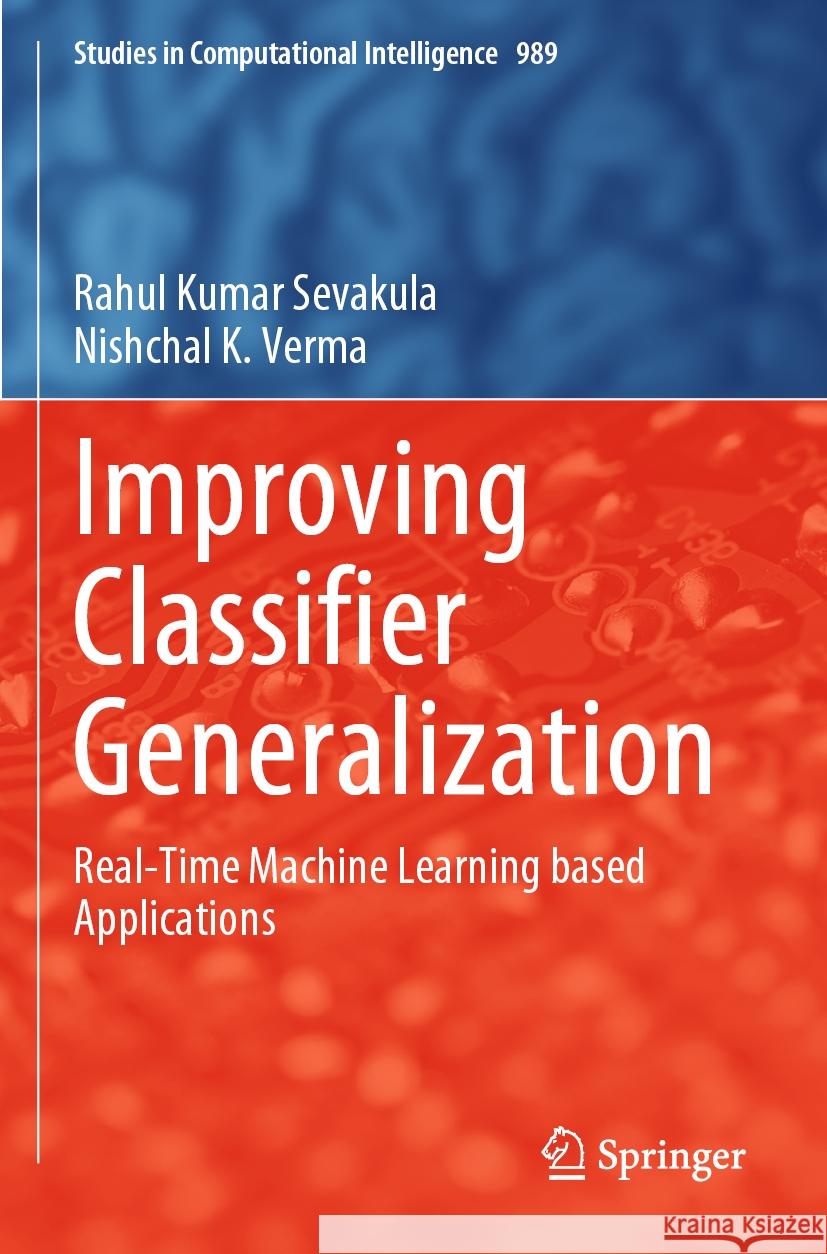
Rahul Kumar Sevakula; Nishchal K. Verma
Improving Classifier Generalization Rahul Kumar Sevakula, Verma, Nishchal K. 9789811950759 Springer Nature Singapore - książkaWidoczna okładka, to zdjęcie poglądowe, a rzeczywista szata graficzna może różnić się od prezentowanej.

Improving Classifier Generalization

ISBN-13: 9789811950759 / Angielski / Miękka / 2023

Rahul Kumar Sevakula; Nishchal K. Verma
cena 605,23 zł
(netto: 576,41 VAT:  5%)

Najniższa cena z 30 dni: 578,30 zł
Termin realizacji zamówienia:
ok. 22 dni roboczych
Bez gwarancji dostawy przed świętami

Darmowa dostawa!
inne wydania

This book elaborately discusses techniques commonly used to improve generalization performance in classification approaches. The contents highlight methods to improve classification performance in numerous case studies: ranging from datasets of UCI repository to predictive maintenance problems and cancer classification problems. The book specifically provides a detailed tutorial on how to approach time-series classification problems and discusses two real time case studies on condition monitoring. In addition to describing the various aspects a data scientist must consider before finalizing their approach to a classification problem and reviewing the state of the art for improving classification generalization performance, it also discusses in detail the authors own contributions to the field, including MVPC - a classifier with very low VC dimension, a graphical indices based framework for reliable predictive maintenance and a novel general-purpose membership functions for Fuzzy Support Vector Machine which provides state of the art performance with noisy datasets, and a novel scheme to introduce deep learning in Fuzzy Rule based classifiers (FRCs). This volume will serve as a useful reference for researchers and students working on machine learning, health monitoring, predictive maintenance, time-series analysis, gene-expression data classification. 

Kategorie:
Informatyka, Programowanie
Kategorie BISAC:
Technology & Engineering > Engineering (General)
Mathematics > Prawdopodobieństwo i statystyka
Wydawca:
Springer Nature Singapore
Seria wydawnicza:
Studies in Computational Intelligence
Język:
Angielski
ISBN-13:
9789811950759
Rok wydania:
2023
Waga:
0.34 kg
Wymiary:
23.5 x 15.5
Oprawa:
Miękka

Chapter 1. Introduction to classification algorithms

a. Basics
b. Bias-variance tradeoff
c. Generalization and sampling error
References

Chapter 2. Methods to improve generalization performance
a. Statistical Learning Theory
i. Vapnik-Chervonenkis Dimension
ii. Growth function
b. Maximum margin classifiers
c. Having fewer parameters - Occam's razor
d. Regularization
e. Boosting
i. Gradient Boosting
f. Transfer learning
g. Unsupervised greedy layerwise learning of deep networks
h. Dropout
i. Conclusions
References

Chapter 3. MVPC – a classifier with very low VC dimension
a. Majority Vote Point classifier
b. Implementation of MVPC
c. Evaluating and comparing VC dimension
i. Upper bound on VC dimension
ii. Empirical estimation of VC dimension with search space reduction
iii. Comparing with linear classifiers
d. Case study on Time-series classification
e. Case study on Gene-expression data classification
f. Conclusions
References

Chapter 4. Framework for reliable fault detection with sensor data
a. Data acquisition framework to simulate real time environment
b. Data Pre-processing
i. Normalization robust to outliers
c. Feature Extraction
d. Feature Selection algorithm using Graphical Indices
i. Feature Ranking and Graphical Indices
ii. Dataset Rejection
iii. Dataset Retrieval
iv. Feature Selection Architecture
e. Classification
f. Sensitive Position Analysis (SPA)
i. Parameter range identification (PRI)
g. Case Study on Air Compressor Fault Detection
i. Leakage Inlet Valve (LIV) fault detection
ii. Leakage Outlet Valve (LOV) fault detection
iii. Online Testing
iv. Real time testing
h. Tutorial for time-series classification
i. Conclusions
References

Chapter 5. Membership functions for Fuzzy Support Vector Machine in noisy environment
a. Fuzzy Support Vector Machine (FSVM)
i. Available Membership Functions for FSVM
ii. Limitations of earlier Membership Functions
iii. Convex Hulls analysis on FSVM
b. Set Measures - Distance Measure between Points and Non-Empty Sets
i. Distance between a Point and a Non Empty Set
ii. Hausdorf Distance (HD)
c. Proposed General Purpose Membership Functions
i. GPMFs with density based clustering
ii. Proposed GPMFs with Fuzzy C-Means clustering
d. Case Study on datasets from UCI repository
i. Class Imbalance Learning in FSVM
ii. Performance Evaluation
iii. Experimentation
e. Results and Analysis
i. Statistical Analysis
f. Conclusions
References

Chapter 6. Stacked Denoising Sparse Autoencoder based Fuzzy rule classifiers
a. Stacked Autoencoder (SAE) based FRC
i. Autoencoders and denoising autoencoders
ii. Weight initialization with unsupervised greedy layerwise learning
iii. Naive stacked autoencoder based FRC
b. Data pre-processing Strategies for SDSAE based FRC
i. Pre-processing Strategy I (PP-I)
ii. Gaussian Mixture Model (GMM) for Pre-Processing
iii. Pre-processing Strategy II
iv. Pre-processing Strategy III (PP-III)
v. Preprocessing of Nominal Features
c. Fine Tuning of weights for FRC Modeling
i. Process Definitions
ii. Fine Tuning Strategy I (FT-I)
iii. Fine Tuning Strategy II (FT-II)
iv. Fine Tuning Strategy III (FT-III)
d. Integration with Expert Knowledge
e. Case study on datasets from UCI repository
i. Dataset wise Observations
f. Conclusions
References

Chapter 7. Epilogue
a. Transfer learning for Molecular Cancer Classification
b. Transfer learning for time-series classification
c. Directions for future work
d. Conclusions
References

Dr Sevakula Rahul Kumar has over 10 years of research experience in machine learning (ML) and deep learning (DL). He received his Bachelor’s degree from the National Institute of Technology (NIT) Warangal, India in 2009 and later his Ph.D. degree from the Indian Institute of Technology (IIT) Kanpur, India in 2017. He is currently a Sr. Research Scientist at Whoop, and his research interests lie at the intersection of ML, physiological signals, cardiovascular health monitoring (medicine) and wearables. Prior to joining Whoop, he was an Instructor (junior research faculty) at Harvard Medical School and Massachusetts General Hospital, USA, and a Data Scientist at IBM India. He has filed multiple patent disclosures and has published over 45 research papers in international peer-reviewed journals and conferences. He is also a reviewer for several journals of national and international repute.

Dr. Nishchal K. Verma is a Professor in the Department of Electrical Engineering at Indian Institute of Technology (IIT) Kanpur, India.  Dr. Verma's research interest falls in Artificial Intelligence (AI) related theories and its practical applications to inter-disciplinary domains like machine learning, deep learning, computer vision, prognosis and health management, bioinformatics, cyber-physical systems, complex and highly non-linear systems modeling, clustering, and classifications, etc. He has published more than 250 research papers in peer-reviewed reputed conferences and journals along with 4 books (edited/ co-authored) in the field of AI. He has 20+ years of experience in the field of AI. He is currently serving as Associate Editor/ Editorial Board Member of various reputed journals and conferences. He has also developed several AI-related key technologies for The BOEING Company, USA.


This book elaborately discusses techniques commonly used to improve generalization performance in classification approaches. The contents highlight methods to improve classification performance in numerous case studies: ranging from datasets of UCI repository to predictive maintenance problems and cancer classification problems. The book specifically provides a detailed tutorial on how to approach time-series classification problems and discusses two real time case studies on condition monitoring. In addition to describing the various aspects a data scientist must consider before finalizing their approach to a classification problem and reviewing the state of the art for improving classification generalization performance, it also discusses in detail the authors own contributions to the field, including MVPC - a classifier with very low VC dimension, a graphical indices based framework for reliable predictive maintenance and a novel general-purpose membership functions for Fuzzy Support Vector Machine which provides state of the art performance with noisy datasets, and a novel scheme to introduce deep learning in Fuzzy Rule based classifiers (FRCs). This volume will serve as a useful reference for researchers and students working on machine learning, health monitoring, predictive maintenance, time-series analysis, gene-expression data classification. 



Udostępnij

Facebook - konto krainaksiazek.pl


Opinie o Krainaksiazek.pl na Opineo.pl

Partner Mybenefit

Krainaksiazek.pl w programie rzetelna firma Krainaksiaze.pl - płatności przez paypal

Czytaj nas na:

Facebook - krainaksiazek.pl
  • książki na zamówienie
  • granty
  • książka na prezent
  • kontakt
  • pomoc
  • opinie
  • regulamin
  • polityka prywatności

Zobacz:

  • Księgarnia czeska

  • Wydawnictwo Książkowe Klimaty

1997-2025 DolnySlask.com Agencja Internetowa

© 1997-2022 krainaksiazek.pl
     
KONTAKT | REGULAMIN | POLITYKA PRYWATNOŚCI | USTAWIENIA PRYWATNOŚCI
Zobacz: Księgarnia Czeska | Wydawnictwo Książkowe Klimaty | Mapa strony | Lista autorów
KrainaKsiazek.PL - Księgarnia Internetowa

Polityka prywatnosci - link
Krainaksiazek.pl - płatnośc Przelewy24
Przechowalnia Przechowalnia





