• Wyszukiwanie zaawansowane
  • Kategorie
  • Kategorie BISAC
  • Książki na zamówienie
  • Promocje
  • Granty
  • Książka na prezent
  • Opinie
  • Pomoc
  • Załóż konto
  • Zaloguj się

Imbalanced Learning » książka


zaloguj się | załóż konto
Logo Krainaksiazek.pl

koszyk

konto

szukaj
topmenu
Księgarnia internetowa
Szukaj
Książki na zamówienie
Promocje
Granty
Książka na prezent
Moje konto
Pomoc
 
 
Wyszukiwanie zaawansowane
Pusty koszyk
Bezpłatna dostawa dla zamówień powyżej 20 złBezpłatna dostawa dla zamówień powyżej 20 zł

Kategorie główne

• Nauka
 [2950560]
• Literatura piękna
 [1849509]

  więcej...
• Turystyka
 [71097]
• Informatyka
 [151150]
• Komiksy
 [35848]
• Encyklopedie
 [23178]
• Dziecięca
 [617388]
• Hobby
 [139064]
• AudioBooki
 [1657]
• Literatura faktu
 [228597]
• Muzyka CD
 [383]
• Słowniki
 [2855]
• Inne
 [445295]
• Kalendarze
 [1464]
• Podręczniki
 [167547]
• Poradniki
 [480102]
• Religia
 [510749]
• Czasopisma
 [516]
• Sport
 [61293]
• Sztuka
 [243352]
• CD, DVD, Video
 [3414]
• Technologie
 [219456]
• Zdrowie
 [101002]
• Książkowe Klimaty
 [124]
• Zabawki
 [2311]
• Puzzle, gry
 [3459]
• Literatura w języku ukraińskim
 [254]
• Art. papiernicze i szkolne
 [8079]
Kategorie szczegółowe BISAC

Imbalanced Learning

ISBN-13: 9781118074626 / Angielski / Twarda / 2013 / 216 str.
Haibo He; Yunqian Ma
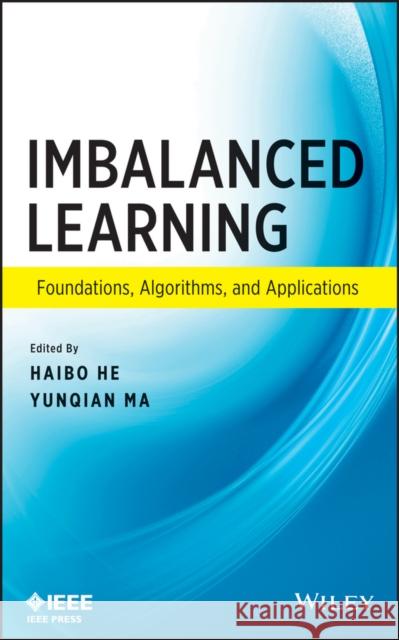
Imbalanced Learning Ma, Yunqian 9781118074626 IEEE Computer Society Press - książkaWidoczna okładka, to zdjęcie poglądowe, a rzeczywista szata graficzna może różnić się od prezentowanej.

Imbalanced Learning

ISBN-13: 9781118074626 / Angielski / Twarda / 2013 / 216 str.

Haibo He; Yunqian Ma
cena 552,01
(netto: 525,72 VAT:  5%)

Najniższa cena z 30 dni: 548,60
Termin realizacji zamówienia:
ok. 30 dni roboczych
Dostawa w 2026 r.

Darmowa dostawa!

The first book of its kind to review the current status and future direction of the exciting new branch of machine learning/data mining called imbalanced learning Imbalanced learning focuses on how an intelligent system can learn when it is provided with imbalanced data. Solving imbalanced learning problems is critical in numerous data-intensive networked systems, including surveillance, security, Internet, finance, biomedical, defense, and more. Due to the inherent complex characteristics of imbalanced data sets, learning from such data requires new understandings, principles, algorithms, and tools to transform vast amounts of raw data efficiently into information and knowledge representation. The first comprehensive look at this new branch of machine learning, this book offers a critical review of the problem of imbalanced learning, covering the state of the art in techniques, principles, and real-world applications. Featuring contributions from experts in both academia and industry, Imbalanced Learning: Foundations, Algorithms, and Applications provides chapter coverage on:

  • Foundations of Imbalanced Learning
  • Imbalanced Datasets: From Sampling to Classifiers
  • Ensemble Methods for Class Imbalance Learning
  • Class Imbalance Learning Methods for Support Vector Machines
  • Class Imbalance and Active Learning
  • Nonstationary Stream Data Learning with Imbalanced Class Distribution
  • Assessment Metrics for Imbalanced Learning
Imbalanced Learning: Foundations, Algorithms, and Applications will help scientists and engineers learn how to tackle the problem of learning from imbalanced datasets, and gain insight into current developments in the field as well as future research directions.

Kategorie:
Technologie
Kategorie BISAC:
Technology & Engineering > Electronics - General
Wydawca:
IEEE Computer Society Press
Język:
Angielski
ISBN-13:
9781118074626
Rok wydania:
2013
Ilość stron:
216
Waga:
0.50 kg
Wymiary:
24.13 x 15.75 x 1.78
Oprawa:
Twarda
Wolumenów:
01
Dodatkowe informacje:
Bibliografia

“This book certainly qualifies as a reference for graduate studies in machine learning. Research students are sure to find it highly valuable and a prized possession, especially taking into account the wealth of supporting literature that the authors have brought to the fore.”  (Computing Reviews, 27 March 2014)


Preface ix

Contributors xi

1 Introduction 1
Haibo He

1.1 Problem Formulation, 1

1.2 State–of–the–Art Research, 3

1.3 Looking Ahead: Challenges and Opportunities, 6

1.4 Acknowledgments, 7

References, 8

2 Foundations of Imbalanced Learning 13
Gary M. Weiss

2.1 Introduction, 14

2.2 Background, 14

2.3 Foundational Issues, 19

2.4 Methods for Addressing Imbalanced Data, 26

2.5 Mapping Foundational Issues to Solutions, 35

2.6 Misconceptions About Sampling Methods, 36

2.7 Recommendations and Guidelines, 38

References, 38

3 Imbalanced Datasets: From Sampling to Classifiers 43
T. Ryan Hoens and Nitesh V. Chawla

3.1 Introduction, 43

3.2 Sampling Methods, 44

3.3 Skew–Insensitive Classifiers for Class Imbalance, 49

3.4 Evaluation Metrics, 52

3.5 Discussion, 56

References, 57

4 Ensemble Methods for Class Imbalance Learning 61
Xu–Ying Liu and Zhi–Hua Zhou

4.1 Introduction, 61

4.2 Ensemble Methods, 62

4.3 Ensemble Methods for Class Imbalance Learning, 66

4.4 Empirical Study, 73

4.5 Concluding Remarks, 79

References, 80

5 Class Imbalance Learning Methods for Support Vector Machines 83
Rukshan Batuwita and Vasile Palade

5.1 Introduction, 83

5.2 Introduction to Support Vector Machines, 84

5.3 SVMs and Class Imbalance, 86

5.4 External Imbalance Learning Methods for SVMs: Data Preprocessing Methods, 87

5.5 Internal Imbalance Learning Methods for SVMs: Algorithmic Methods, 88

5.6 Summary, 96

References, 96

6 Class Imbalance and Active Learning 101
Josh Attenberg and S¸eyda Ertekin

6.1 Introduction, 102

6.2 Active Learning for Imbalanced Problems, 103

6.3 Active Learning for Imbalanced Data Classification, 110

6.4 Adaptive Resampling with Active Learning, 122

6.5 Difficulties with Extreme Class Imbalance, 129

6.6 Dealing with Disjunctive Classes, 130

6.7 Starting Cold, 132

6.8 Alternatives to Active Learning for Imbalanced Problems, 133

6.9 Conclusion, 144

References, 145

7 Nonstationary Stream Data Learning with Imbalanced Class Distribution 151
Sheng Chen and Haibo He

7.1 Introduction, 152

7.2 Preliminaries, 154

7.3 Algorithms, 157

7.4 Simulation, 167

7.5 Conclusion, 182

7.6 Acknowledgments, 183

References, 184

8 Assessment Metrics for Imbalanced Learning 187

Nathalie Japkowicz

8.1 Introduction, 187

8.2 A Review of Evaluation Metric Families and their Applicability

to the Class Imbalance Problem, 189

8.3 Threshold Metrics: Multiple– Versus Single–Class Focus, 190

8.4 Ranking Methods and Metrics: Taking Uncertainty into Consideration, 196

8.5 Conclusion, 204

8.6 Acknowledgments, 205

References, 205

Index 207

HAIBO HE, PhD, is an Associate Professor in the Department of Electrical, Computer, and Biomedical Engineering at the University of Rhode Island. He received the National Science Foundation (NSF) CAREER Award and Providence Business News (PBN) Rising Star Innovator Award.

YUNQIAN MA PhD, is a senior principal research scientist of Honeywell Labs at Honeywell Inter–national, Inc. He received the International Neural Network Society (INNS) Young Investigator Award.

The first book of its kind to review the current status and future direction of the exciting new branch of machine learning/data mining called imbalanced learning

Imbalanced learning focuses on how an intelligent system can learn when it is provided with imbalanced data. Solving imbalanced learning problems is critical in numerous data–intensive networked systems, including surveillance, security, Internet, finance, biomedical, defense, and more. Due to the inherent complex characteristics of imbalanced data sets, learning from such data requires new understandings, principles, algorithms, and tools to transform vast amounts of raw data efficiently into information and knowledge representation.

The first comprehensive look at this new branch of machine learning, this book offers a critical review of the problem of imbalanced learning, covering the state of the art in techniques, principles, and real–world applications. Featuring contributions from experts in both academia and industry, Imbalanced Learning: Foundations, Algorithms, and Applications provides chapter coverage on:

  • Foundations of Imbalanced Learning
  • Imbalanced Datasets: From Sampling to Classifiers
  • Ensemble Methods for Class Imbalance Learning
  • Class Imbalance Learning Methods for Support Vector Machines
  • Class Imbalance and Active Learning
  • Nonstationary Stream Data Learning with Imbalanced Class Distribution
  • Assessment Metrics for Imbalanced Learning

Imbalanced Learning: Foundations, Algorithms, and Applications will help scientists and engineers learn how to tackle the problem of learning from imbalanced datasets, and gain insight into current developments in the field as well as future research directions.


Udostępnij

Facebook - konto krainaksiazek.pl


Opinie o Krainaksiazek.pl na Opineo.pl

Partner Mybenefit

Krainaksiazek.pl w programie rzetelna firma Krainaksiaze.pl - płatności przez paypal

Czytaj nas na:

Facebook - krainaksiazek.pl
  • książki na zamówienie
  • granty
  • książka na prezent
  • kontakt
  • pomoc
  • opinie
  • regulamin
  • polityka prywatności

Zobacz:

  • Księgarnia czeska

  • Wydawnictwo Książkowe Klimaty

1997-2025 DolnySlask.com Agencja Internetowa

© 1997-2022 krainaksiazek.pl
     
KONTAKT | REGULAMIN | POLITYKA PRYWATNOŚCI | USTAWIENIA PRYWATNOŚCI
Zobacz: Księgarnia Czeska | Wydawnictwo Książkowe Klimaty | Mapa strony | Lista autorów
KrainaKsiazek.PL - Księgarnia Internetowa

Polityka prywatnosci - link
Krainaksiazek.pl - płatnośc Przelewy24
Przechowalnia Przechowalnia




